What research says about these races, and how little there is
Baghurst and colleagues opened their 2019 case study by noting how little is known about the physical demands of obstacle course racing compared with road races. They describe obstacles that include jumping, climbing and crawling over rough terrain such as hills, water and mud. Their single participant raced an extreme event lasting a full day and night, and his effort rose and fell with the obstacles rather than holding steady as in a road race. His coach had prepared him with a running plan plus push-ups, pull-ups, kettlebell work and grip exercises.
A 2023 study by Żuchowski and colleagues compared 23 elite Polish obstacle course racers with 17 special forces soldiers on a 3,000 metre run, sit-ups and straight pull-ups. The racers had a lower body mass index, ran slightly faster and did more pull-ups, about 19 against 15 on average.
One case study and one small comparison of elite athletes are not a training manual. Read them as a sketch of the demands: running, interrupted by obstacles that ask a lot of pulling and gripping.
Six qualities, and where each one is trained
Most of these are trained on the turf lane, kettlebells and battle ropes of RPM's functional area, plus the pulling stations on the training floor.
| Quality | On the course | In the gym |
|---|---|---|
| Running on uneven ground | The distance between obstacles | Treadmill runs with incline changes, outdoor runs on grass or sand in the cooler months |
| Grip | Hanging, carrying and rope obstacles | Farmer and suitcase carries, holds at the end of sets, battle ropes |
| Pulling strength | Walls and climbing obstacles | Pulldowns, rows and a pull-up progression |
| Carrying | Awkward loads over rough ground | Kettlebell and dumbbell carries, sled drags |
| Crawling and getting up | Going under and over obstacles | Bear crawls on the turf, burpees, getting up off the floor |
| Jumping and landing | Dropping off walls and crossing gaps | Stepping down from a box, small jumps with soft landings |
Learn to land before you jump higher. Plyometric training gives the landing checks and a progression.
Grip and pulling: what runners tend to skip
Many runners arrive with good legs and lungs and weak hands. Grip and pulling strength take weeks to build, so start them early and train them twice a week at the end of a strength session.
- Farmer carries: a heavy kettlebell or dumbbell in each hand, walking tall for a set distance or time.
- Suitcase carries: one weight on one side, which adds a trunk challenge as you resist leaning.
- Holds: at the end of a set of rows or deadlifts, keep holding the weight for a few extra seconds.
- Battle ropes: short bursts of waves for forearm and shoulder endurance.
- Pulling: pulldowns and rows for strength, then slow lowering on a bar if one is available. Training for your first pull-up sets out the steps.
For strength sessions, ACSM's position stand starts novices on two or three days a week at loads they can lift 8 to 12 times, adding load in small steps once they can manage one or two reps more than planned. Kettlebell carries and swings are covered in kettlebell training.
Running that survives the obstacles
A race asks you to run after your arms and grip are already tired. Train that directly with circuits that alternate running and stations, and keep at least one plain run a week to build the base.
| Circuit | Run | Station | Rounds |
|---|---|---|---|
| Carry and run | Three to four minutes at a steady effort | A farmer carry, then a suitcase carry on each side | Four to six |
| Crawl and run | Two to three minutes, a little faster | Bear crawls on the turf, then ten burpees | Four to five |
| Pull and run | Three minutes steady | A set of rows or pulldowns, then a hold | Four |
Rest only as long as it takes to walk between the treadmill and the station. Start at the low end of the rounds.
From May to September most of this running moves onto treadmills. Heat and humidity raise the strain of exercise outdoors, so follow official heat guidance. Moving a running habit indoors for the hot months is covered in summer running indoors.
A sample week
| Day | Session |
|---|---|
| Saturday | Long easy run, outdoors on mixed ground once it is cool enough |
| Sunday | Strength: squats, rows, pulldowns, then grip work |
| Monday | Easy run or rest |
| Tuesday | Obstacle circuits: carry and run, crawl and run |
| Wednesday | Rest |
| Thursday | Strength: hinges, step-ups, presses, then pulling and holds |
| Friday | Short easy run or rest |
Hands and forearms can stay tired for a while after heavy grip work. If grip work leaves you unable to hold a bar the next day, cut the volume.
Check the event as well as your fitness
Races differ widely in distance, terrain and obstacles, and this guide makes no claim about any event. Before you build a plan, get these from the organiser:
- The distance and the list of obstacles, so you know how much running and how much pulling to expect.
- What happens if you cannot clear an obstacle, since some races set penalties.
- Required kit, and whether there is water or mud on the course.
- Age rules and any health declaration. If you have a medical condition or an injury, see a doctor or physiotherapist before hard training.
Obstacle race training at RPM
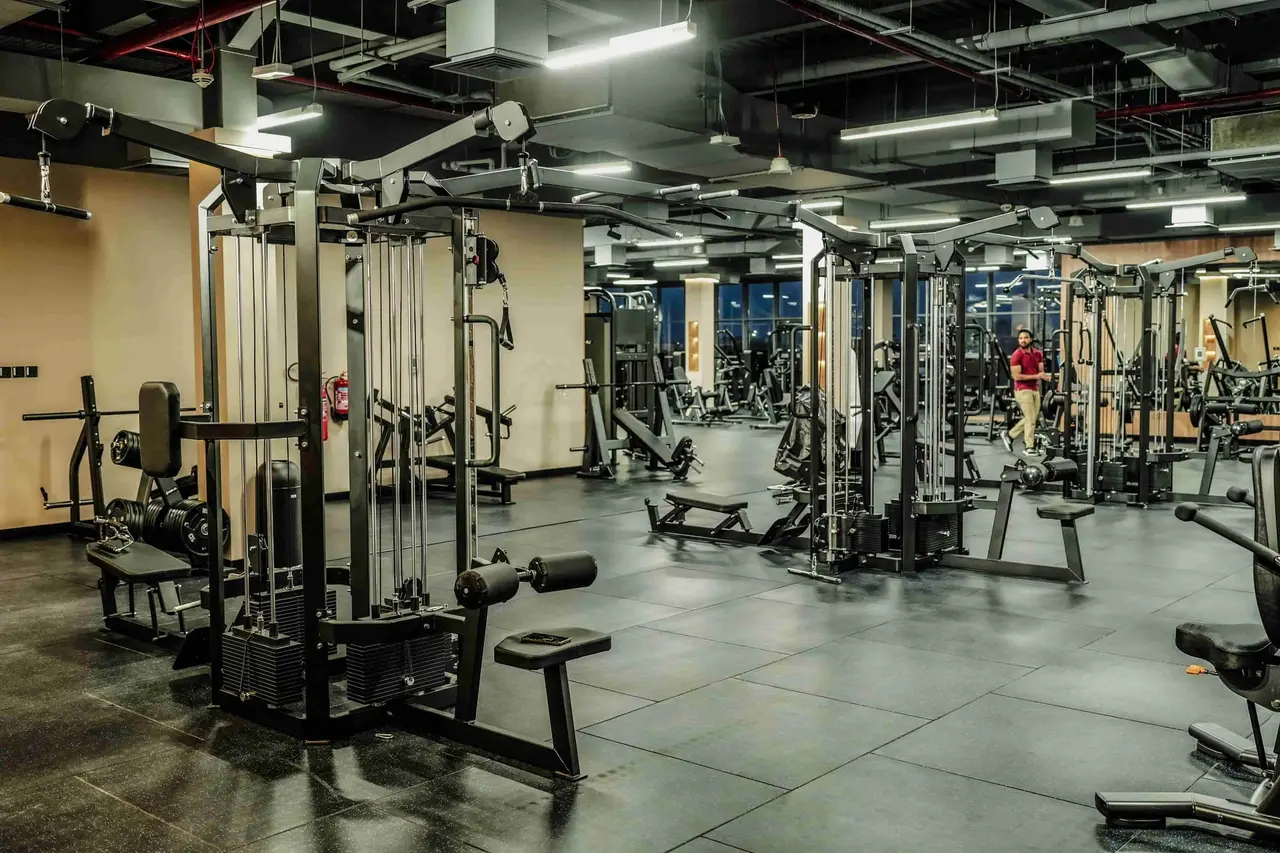
RPM is a single, independent club on Level 4 of AD HUB Sports Complex in Al Manhal, with no link to any race. Its functional area has a turf lane with a sled, battle ropes, kettlebells and dumbbells, plus step boxes and medicine and slam balls. The training floor adds treadmills, a plate-loaded pulldown and multi-station cable towers.
- A pull-up bar and climbing equipment are not confirmed, so ask before you plan your bar practice around them.
- The Ladies section is reserved for women and carries its own strength and cardio equipment.
- Engine and Atelier are the tiers with coaching: the first adds coached programming, the second is built around one-to-one sessions. Ask what each includes.
- On the free guided tour, ask when the turf lane is quiet enough for crawls and carries.
Sources
- Baghurst T, Prewitt SL, Tapps T. Physiological demands of extreme obstacle course racing: a case study. International Journal of Environmental Research and Public Health, 2019
- Żuchowski P, et al. Comparison of physical fitness, self-assessed resilience, and self-assessed character traits between elite Polish obstacle course racers and Polish special operations force personnel. Military Medicine, 2023
- American College of Sports Medicine position stand. Progression models in resistance training for healthy adults. Medicine and Science in Sports and Exercise, 2009
Questions, answered.
Do I need to be able to do a pull-up?
It depends on the race and its obstacles, so check the obstacle list and the penalty rules with the organiser. Pulling strength helps on many obstacles, and a pull-up progression is a sensible part of the plan either way.
Can I prepare for mud and water in a gym?
Not really. The gym builds the strength and fitness. Practise on rough ground outdoors where it is allowed, and expect race conditions to feel different.
Should I train in my race shoes?
Use them for some runs and circuits before race day, so nothing about their fit or grip surprises you.
Is an obstacle race a reasonable first event for a beginner?
A shorter format is a gentler start if the race offers one. Build a regular running habit and two strength sessions a week first, and ask the organiser which format suits a newcomer.