Why the pulldown alone is not the whole answer
A pull-up asks you to lift your whole body from a hang until your chin clears the bar. The pulldown trains the same direction of pull while you stay seated and choose the load, which makes it the obvious starting point. Two studies from 2009 suggest it is a starting point rather than a substitute.
- Johnson and colleagues tested 35 college men and 23 college women. Both groups handled more weight relative to body mass on a maximal pull-up, with weight added or counterbalanced, than on a maximal pulldown. Maximal pulldown strength tracked maximal pull-up strength closely in the men, but only loosely, and not significantly, in the women.
- Halet and colleagues tested 28 women swimmers. Their number of free-hanging pull-ups was only moderately related to their heaviest pulldown and unrelated to their pulldown reps, and the authors concluded the two exercises should not be substituted for one another in training.
- The limits: both were small studies of college students and athletes, and both measured relationships at one point in time rather than following a training plan. They do not tell you how long a first rep takes.
Read together, the studies argue for training both: the pulldown and rows to build strength, and regular time on a bar to learn the movement. Strength training at RPM shows the floor where that work would happen.
Exercises that build towards it
| Exercise | What it builds | Kit to look for |
|---|---|---|
| Pulldown | The vertical pull, with a load you can set in small steps | A plate-loaded pulldown or a cable station |
| Seated cable row and one-arm dumbbell row | The upper back and the arms, which finish every rep on the bar | Cable towers, dumbbells and a bench |
| Inverted row | Pulling part of your body weight, with your feet on the floor | A bar set low in a rack, if the team allows it |
| Dead hang | Grip, and comfort hanging from straight arms | A bar you can hang from |
| Top hold and slow lowering | Control of the hardest part of the movement | A bar, with a box to step up to the top position |
| Assisted reps | The full movement with part of your weight taken off | An assisted machine or a band, if the club has one |
Higher pulldown sets, rows and inverted rows build the strength. Hangs, holds and lowering teach the movement on the bar. A plan needs both kinds.
Hanging, holding and lowering
Strength comes from more than lifting. The American College of Sports Medicine's 2009 position stand recommends concentric (lifting), eccentric (lowering) and isometric (holding still) muscle actions in strength programmes. On a bar, the hang and the top hold are the static work and the slow descent is the lowering, so you can start all of it before you can pull yourself up once.
- Dead hang: arms straight, shoulders drawn slightly down and away from your ears. Work up to about half a minute in one go.
- Top hold: step up from a box so your chin is over the bar, then hold that position with your elbows bent. A few seconds is a good start.
- Slow lowering: from the top hold, take three to five seconds to lower yourself to straight arms. Step back up and repeat rather than jumping.
- Stop each set while you still control the lowering. A drop at the end teaches the opposite of what you want.
Overhand, underhand or neutral grip
| Grip | Usual name | What people tend to notice |
|---|---|---|
| Palms facing away | Pull-up | The classic version, and often the hardest one at first |
| Palms facing you | Chin-up | Many people find the arms help more here |
| Palms facing each other | Neutral grip | Often the most comfortable on the shoulders, if the bar has parallel handles |
These are common observations, not findings from the studies above. Pick the grip you can control and keep it the same for a few weeks so your numbers compare.
Grip width on the pulldown matters less than many people believe. How to train your back at the gym covers the research on that, along with how many weekly pulling sets to aim for.
A two-day practice week
For people new to resistance training, ACSM's position stand points to two or three training days a week and to loads that allow roughly 8 to 12 reps. Hanging work tires your hands and forearms long before your back, so most beginners do better with two focused bar days and a rest day in between.
Put this at the start of an upper-body or full-body session, while you are fresh.
| Day | Strength work | Bar work |
|---|---|---|
| A | Pulldown: three sets, 8 to 12 reps | Slow lowering, 3 efforts, then 2 dead hangs |
| B | One-arm dumbbell row, then seated cable row: three sets of each, 8 to 12 reps | Top holds, 3 efforts, then assisted reps if available |
When all three pulldown sets reach 12 clean reps, go up one step on the stack and start again at 8. That is ACSM's rule of progressing once you beat the target by a rep or two.
Balance the week with pressing. Building up to your first push-up is a companion progression for the other direction.
Measuring progress without a deadline
A first rep is a yes or no goal, so the weeks before it can feel like nothing is happening. A log of the smaller pieces shows otherwise.
- Pulldown load and reps for each set.
- How many seconds each slow lowering took, and whether the last one stayed controlled.
- Length of your top hold and your dead hang.
- The assistance level, if you use an assisted machine or a band.
- Once a month, a single attempt at a full rep from a dead hang while you are fresh.
People reach the first rep at very different points, so compare yourself with your own entries, not with a date. How to keep a gym training log shows a simple way to set the log out.
If a shoulder or elbow keeps aching after bar work, stop and have it looked at by a doctor or physiotherapist.
Practising at RPM
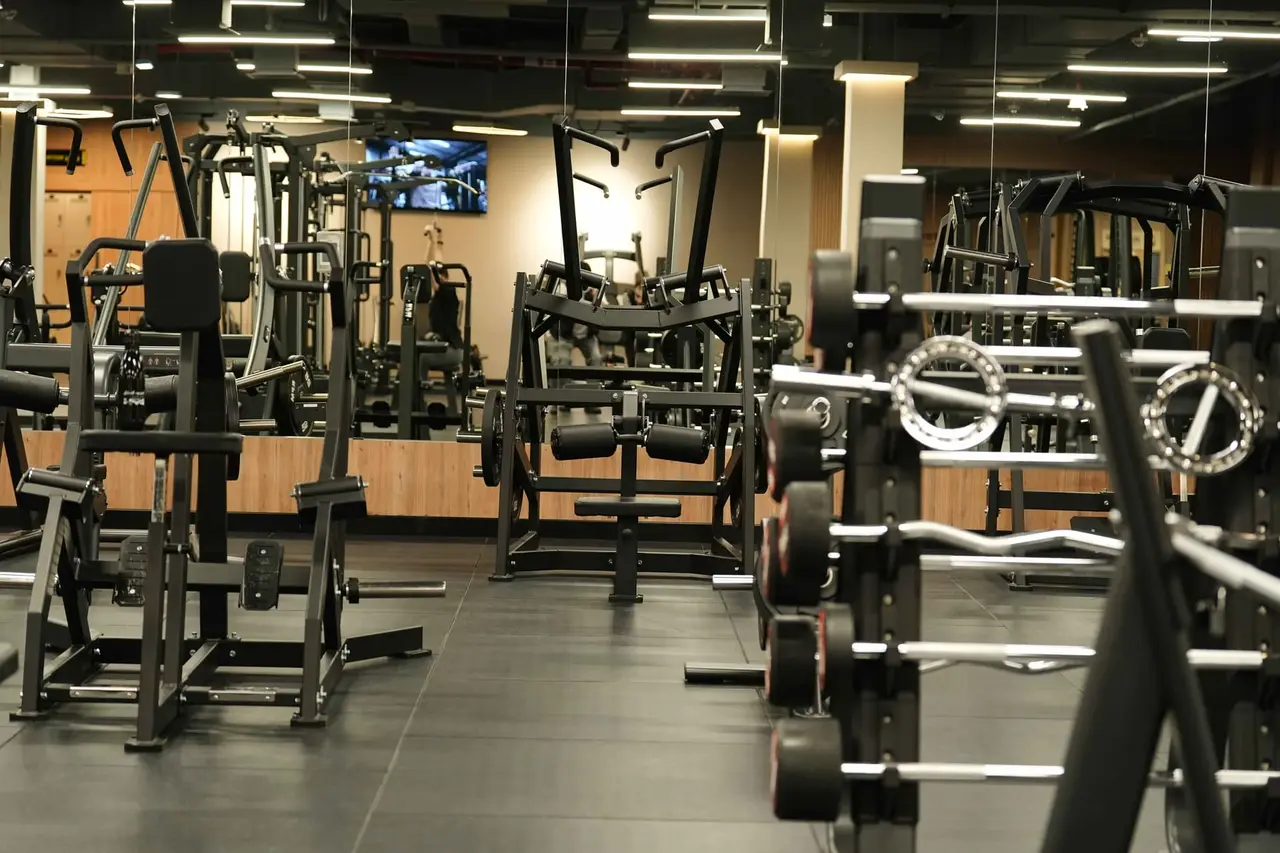
RPM is one club, on Level 4 of AD HUB Sports Complex in Al Manhal. For the strength half of this plan, the floor photos show what you need: a plate-loaded pulldown and multi-station cable towers for vertical pulls and rows, plus dumbbells and benches. A pull-up bar and an assisted machine are not confirmed, so ask the team where you could hang and lower, and whether bands are available. Women training in the Ladies section, which has its own strength equipment, should ask which of these stations it holds.
A coach can check your hang position and your lowering, and set your pulldown loads. Ask about coaching on a free guided tour.
Sources
- Johnson D, Lynch J, Nash K, Cygan J, Mayhew JL. Relationship of lat-pull repetitions and pull-ups to maximal lat pull and pull up strength in men and women. Journal of Strength and Conditioning Research, 2009
- Halet KA, Mayhew JL, Murphy C, Fanthorpe J. Relationship of 1 repetition maximum lat-pull to pull-up and lat-pull repetitions in elite collegiate women swimmers. Journal of Strength and Conditioning Research, 2009
- American College of Sports Medicine, position stand: Progression models in resistance training for healthy adults (2009)
Questions, answered.
Can I get my first pull-up just by doing pulldowns?
Possibly, but the 2009 swimmer study concluded the two exercises should not be substituted for one another. Adding hangs, holds and slow lowering trains the movement the pulldown cannot.
Are chin-ups easier than pull-ups?
Many people find the underhand grip easier at first, but the studies here did not compare grips. Either one is a real rep of pulling your own body weight.
Should I practise on the bar every day?
No. Your grip and forearms need recovery days too, and ACSM's advice for newcomers is two or three training days a week, which leaves room for them.
What if there is no bar where I train?
The pulldown, rows and inverted rows still build the strength. Holds and slow lowering need something to hang from, so ask the team what is available before you plan around it.