What the slope changes
On a flat belt, most of your effort moves you forward. Tilt the belt and each step also raises your body a little, which asks more of the legs and hips and lifts your breathing and heart rate at the same speed. That is the appeal: harder cardio without running, and with one foot always on the belt. For the treadmills and the rest of the cardio row, see RPM's cardio floor.
Two small studies from the same research group put this to the test. In 2011, 12 adults with obesity walked at several speeds and slopes. Walking at half their brisk pace up a moderate incline cost a similar, moderate amount of energy, while peak knee moments fell by about a fifth to a quarter. A 2014 follow-up with adults with and without obesity found lower compressive force at the knee early in each step on the slow uphill walk.
Both studies were small and measured single sessions in a lab. They do not show that incline walking prevents joint problems. If you have knee or hip pain, ask a doctor or physiotherapist which kind of walking suits you.
To see how much a given slope adds, the treadmill calories calculator runs your speed and grade through a published walking equation and shows the same session on the flat beside it. Its figures, like the console's, are estimates.
Four incline sessions to rotate
| Session | How it runs | Effort out of 10 | Good for |
|---|---|---|---|
| Steady climb | Five minutes flat, then one incline held for 20 to 30 minutes, then five minutes flat | 5 to 6, still talking in full sentences | Your main weekly walk |
| Hill repeats | After a flat warm-up, three minutes steeper then two minutes flat, five or six times | About 7 on the climbs, 4 on the flat | Harder work once steady climbs feel routine |
| Ladder | Raise the incline a step every two minutes for ten minutes, then come down the same way | Rising from 4 to 7, then easing | Variety, and finding your level without guessing |
| Long indoor walk | Forty-five to sixty minutes at a low incline, in blocks with a water break | 4 to 5 | Replacing an outdoor walk in summer |
WHO's 2020 guidelines describe moderate effort as usually a 5 or 6 on a scale of 0 to 10, and vigorous effort as a 7 or 8. They suggest adults build up 150 to 300 moderate minutes a week, or 75 to 150 vigorous ones.
The steep, slow half-hour walks popular on social media sit at the top of the ladder. Count them as a goal to build towards, not a first session.
Building up without overdoing it
WHO advises starting with small amounts of activity and increasing gradually. On an incline, lengthen the walk first and steepen it later, changing one setting at a time.
| Stage | Sessions in the week | What to change | Move on when |
|---|---|---|---|
| 1 | Two or three steady climbs of 20 minutes at a low incline | Add five minutes when a session feels easy | Thirty minutes at 5 out of 10 feels routine |
| 2 | Two steady climbs and one ladder | Raise the steady incline by one step | You can still talk through the whole climb |
| 3 | Two steady climbs and one set of hill repeats | Add a repeat, or a step on the climbs | You recover well between sessions |
Calves and shins usually feel incline work first. Ease off if they ache for days, and keep the speed down while the slope goes up.
If you have a heart, lung or joint condition, or you are pregnant, ask your doctor before starting harder incline sessions.
Handrails: a light touch or none
A 2006 study of 10 healthy adults aged 38 to 60 compared walking with the arms swinging naturally, with the hands resting on the rails and with the rails gripped. At the same speed and grade, gripping lowered heart rate, oxygen uptake and perceived effort, and resting the hands lowered them to a lesser degree. The authors warned that this makes a training programme less predictable.
- Swing your arms as you would on a hill outside.
- If you find yourself leaning back on the rails, the incline is too steep or the belt too fast. Lower one of them.
- Touch a rail lightly if you need it for balance, especially while changing settings.
- Clip the safety key to your clothing and stand astride the belt while it starts.
- Look ahead rather than down at your feet.
Summer walks, moved indoors
From May to September, heat and humidity raise the strain of exercising outdoors, so follow official heat guidance. The summer running guide sets out that advice for people who run. Incline walking gives walkers the same way out: the habit carries on indoors, and the slope supplies the challenge.
If your summer walks are loops of a mall, the Khalidiyah Mall page shows how walking days and gym days share a week. Incline sessions add the one thing a flat corridor lacks, which is a climb. Swap one mall loop a week for a steady climb, and keep the rest.
If your treadmill shows grade and you want it in degrees, or the height you climbed, the treadmill incline calculator converts it.
Incline walking at RPM
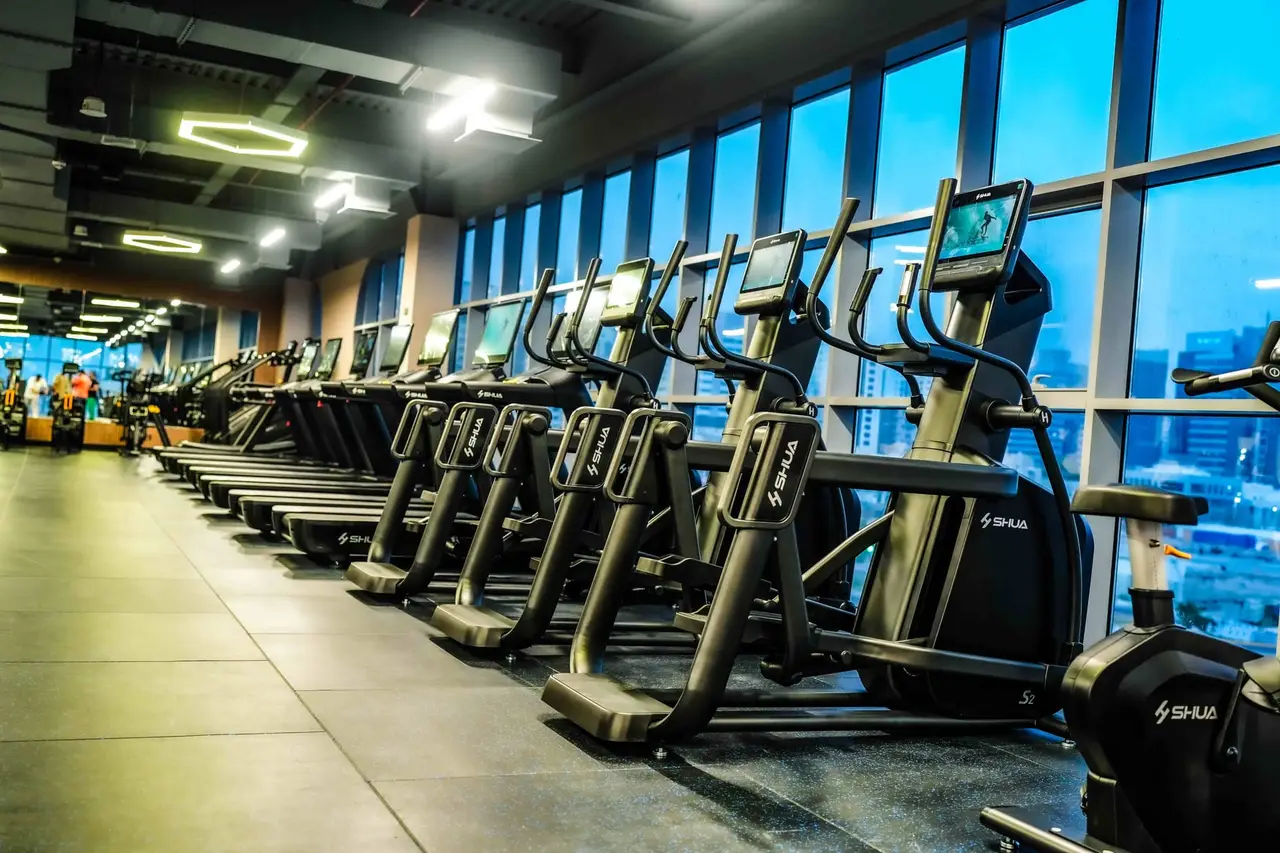
RPM is one club, on Level 4 of AD HUB Sports Complex in Al Manhal, with free on-site parking at AD HUB and a lift to Level 4. Its photos show a row of treadmills by tall windows, with cross-trainers and an upright bike beside them. The incline range of those treadmills is not confirmed, so ask the team how steep they go and whether they display grade.
- The women-only Ladies section has its own cardio equipment. Ask which machines it has.
- A coach can set your starting incline and fit walking around strength sessions. Engine adds coached programming, and Atelier is built around one-to-one coaching.
- Book a free guided tour at the hour you would walk, and see how busy the treadmill row is then.
Sources
- Ehlen KA, Reiser RF, Browning RC. Energetics and biomechanics of inclined treadmill walking in obese adults. Medicine and Science in Sports and Exercise, 2011
- Haight DJ, Lerner ZF, Board WJ, Browning RC. A comparison of slow, uphill and fast, level walking on lower extremity biomechanics and tibiofemoral joint loading in obese and nonobese adults. Journal of Orthopaedic Research, 2014
- Berling J, et al. The effect of handrail support on oxygen uptake during steady-state treadmill exercise. Journal of Cardiopulmonary Rehabilitation, 2006
- World Health Organization. WHO guidelines on physical activity and sedentary behaviour, 2020
Questions, answered.
Is incline walking as good as running?
It is a different session. Incline walking can reach moderate effort while one foot stays on the belt, and running reaches vigorous effort more easily. WHO counts both: 75 to 150 vigorous minutes a week match 150 to 300 moderate ones.
How many calories does incline walking burn?
It depends on your body weight as well as the speed and slope, and every figure is an estimate. Use the calculator linked above, or the console, to compare sessions, not as a measurement.
Will incline walking help me lose weight?
It adds activity, which is part of the picture, but nobody can promise a result. Weight change depends on your whole diet and routine. Count incline walking as cardio towards WHO's weekly minutes.
Can I do incline walking every day?
Many people walk daily. Keep most sessions easy, limit the hard ones to one or two a week, and back off if your calves or shins stay sore.