Same goal, different loads on the body
| Treadmill | Upright or spin bike | |
|---|---|---|
| Your body weight | Carried with every step | Resting on the saddle |
| Landing | A footstrike on every running stride, much gentler when walking | None |
| Main muscles | Calves, thighs and hips drive you forward, with the trunk and arms working too | The thighs and hips push the pedals, while the upper body stays still |
| Skill | Walking and running, which you already know | Pedalling, simple once the saddle is set |
| Carries over to | Running and walking outdoors | Cycling outdoors and spin classes |
Neither is the better machine in general. One suits a runner with a race in the cooler months, the other a lifter on a heavy leg block, and many people use both through the week. To see them side by side at one club, look at RPM's cardio area.
Impact and joint comfort
Running is the high-impact end of the treadmill. Walking on it is far gentler, and raising the incline lifts the effort without breaking into a run. The bike removes landing altogether, which is why many people whose knees or hips dislike running choose it. If you have pain or an injury, ask a doctor or physiotherapist which suits you before you start.
- Bike set-up: at the bottom of the pedal stroke your knee should still be slightly bent. Then set the saddle forward or back, and the handlebars to a height that keeps your back relaxed.
- Treadmill set-up: clip the safety key to your clothing, start the belt at walking speed, and hold the rails only lightly if at all.
- Changing machine mid-plan: swap one session at a time, because the effort will feel different at first.
Why the numbers on the screen differ
A 2009 review comparing cycling and running found that heart rate differs between the two at both maximal and submaximal intensities. Maximum oxygen uptake also depends on the activity: most studies found runners reached higher values on a treadmill, while cyclists reached similar values on a bike and a treadmill. Training in one also carried over more from running to cycling than the other way round.
| Number | What it means across machines |
|---|---|
| Heart rate | Not interchangeable. If you train by heart-rate zones, set them separately for each machine |
| Effort out of 10 | Works on both. Moderate is talking but not singing, vigorous is a few words between breaths, as the NHS describes |
| Calories on the display | An estimate from the machine's own formula and the weight you enter, so compare sessions on the same machine only |
| Speed or watts | Useful for tracking progress on one machine, meaningless when compared with the other |
If you take heart medication or have a heart condition, ask your doctor how to judge effort before relying on heart-rate targets.
Running intervals on each machine
| Session | On the treadmill | On the bike |
|---|---|---|
| Short hard efforts | Six rounds of 30 seconds at a hard speed, 90 seconds walking | Six rounds of 30 seconds at high resistance and a fast cadence, 90 seconds spinning easy |
| Hill repeats | Eight rounds of one minute at a steep incline at walking or jogging pace, with flat recoveries | Eight seated climbs of one minute at heavy resistance, with light spinning between |
| Longer intervals | Four rounds of four minutes at a hard but steady pace, three minutes easy | The same timings, using resistance to set the effort |
| Steady tempo | Twenty minutes at an effort of about 7 out of 10 | Twenty minutes at the same effort, cadence held steady |
On a treadmill, incline intervals avoid waiting for the belt to change speed. Start each hard round's timer once the belt reaches the speed you set.
Keep hard sessions to one or two a week at first and make the rest easy. Spin bikes also allow standing climbs, which many classes use.
If you also lift weights
A 2012 meta-analysis of 21 studies found that adding endurance training to lifting reduced strength and muscle gains somewhat, and that running produced significant drops while cycling did not. The 2009 review adds that loss of maximal strength after long sessions was greater after running than after cycling. On heavy leg weeks, the bike is the lighter companion.
How to split lifting and hard cardio across a week is covered in the strength or HIIT comparison.
Choosing between them
| Your situation | Lean towards | Why |
|---|---|---|
| Training for a running race | Treadmill | It practises the movement you will race in |
| Knees or hips that dislike running | Bike, after advice if you have pain | No landing at all |
| A heavy lifting block for the legs | Bike | Cycling showed no strength cost in the 2012 meta-analysis |
| Easy days between hard sessions | Incline walking or easy spinning | Both keep the effort low |
| Motivated by group energy | Spin bike | Classes run on them |
| Starting from little exercise | Either, at a talking pace | WHO advises starting small and building up gradually |
A wider look at walkers, runners and the cross-trainer is in heart and lung fitness indoors. Through an Abu Dhabi summer, both machines keep your weekly minutes going indoors.
Treadmills and bikes at RPM
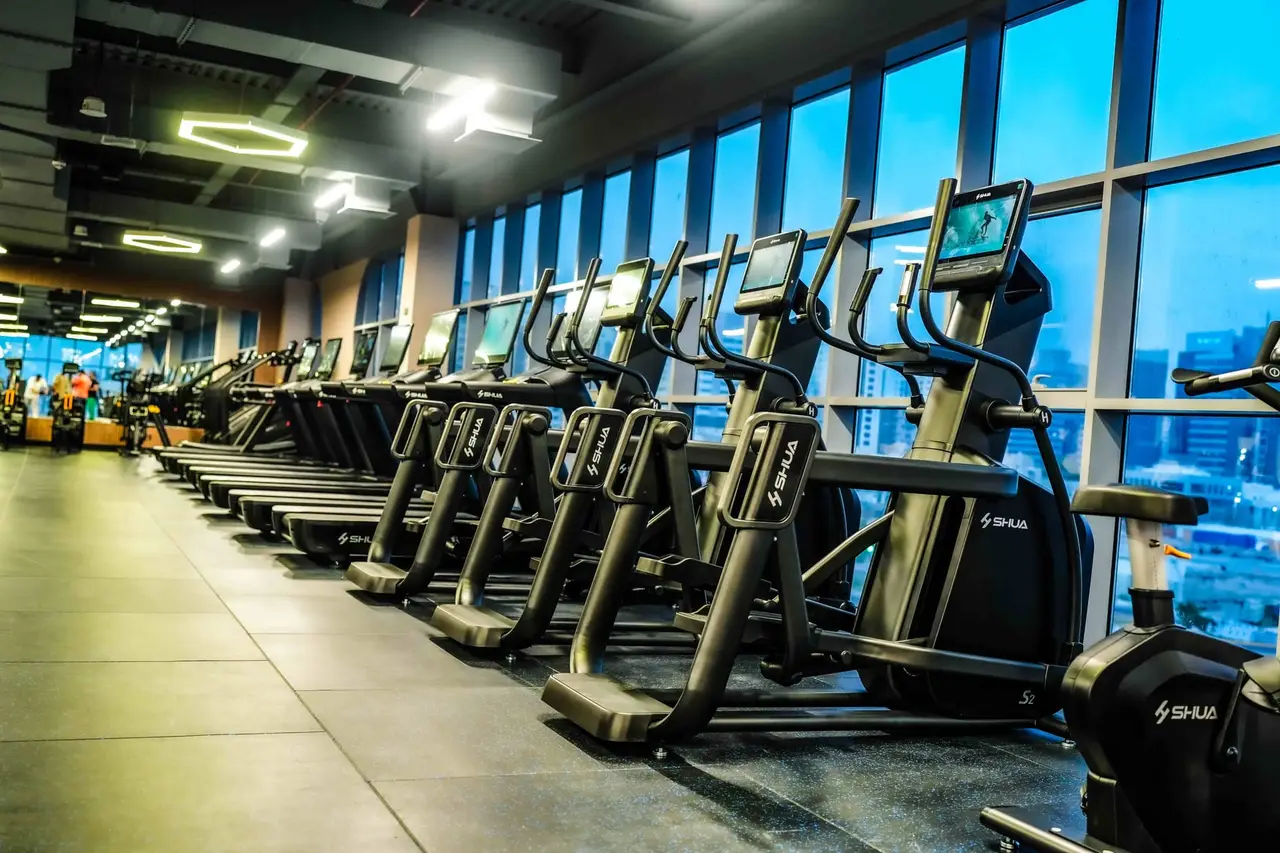
RPM is one club, on Level 4 of AD HUB Sports Complex in Al Manhal. The photos show treadmills, cross-trainers and an upright bike along tall windows, and spin bikes in the functional area. The women-only Ladies section has cardio equipment of its own.
- Group classes run in both sections and the timetable changes, so ask which spin classes are on at your hour.
- Ask a member of the team to check your saddle set-up on your first visit.
- Personal training covers conditioning, and Engine is the tier that adds coached programming if you want sessions planned for you.
Sources
- Millet GP, Vleck VE, Bentley DJ. Physiological differences between cycling and running: lessons from triathletes. Sports Medicine, 2009
- Wilson JM, et al. Concurrent training: a meta-analysis examining interference of aerobic and resistance exercises. Journal of Strength and Conditioning Research, 2012
- World Health Organization, WHO guidelines on physical activity and sedentary behaviour (2020)
- NHS, Physical activity guidelines for adults aged 19 to 64
Questions, answered.
Which burns more calories, the treadmill or the bike?
It depends on how hard and how long you work rather than the machine. Display figures are estimates, so compare your own sessions on the same machine rather than across the two.
Can I use the same heart-rate zones on both?
Not reliably. The 2009 review found heart rate differs between running and cycling at the same intensity, so set zones per machine or use the 0 to 10 effort scale.
Is the bike enough cardio on its own?
Yes for WHO's weekly targets, which count cycling as aerobic activity. Add some walking if you want practice on your feet.
Upright bike or spin bike?
The upright bike suits steady seated sessions. Spin bikes let you stand for climbs and suit classes and intervals.