Two very different movements
A rowing stroke has four parts. At the catch you sit tall with knees bent and arms long. The drive pushes the seat back, and the finish leaves you leaning slightly back with the handle at your lower ribs. The recovery returns you to the catch. Each stroke is a push with the legs that the trunk and arms pass on to the handle. A treadmill run is the opposite in feel: thousands of short, upright strides, each one a small landing.
Both count as aerobic activity towards WHO's weekly targets of 150 to 300 moderate or 75 to 150 vigorous minutes. For the machines confirmed at one club, see RPM's cardio area.
What each one trains
| Rowing machine | Treadmill | |
|---|---|---|
| Muscles | Almost all of them, according to the 2020 review: legs, trunk, back and arms in one stroke | Mainly the legs and hips, with the trunk holding you upright and the arms swinging |
| Impact | None, because you stay seated | A landing on every running stride, much less when walking |
| Upper body | Pulls on every stroke | Little work beyond the arm swing |
| Carry-over | Rowing on water and race stations that include a row | Running races, hiking and everyday walking |
| Common limiter | Technique and grip in the early weeks | How your joints handle running volume |
The 2020 review also describes how competitive rowing challenges the heart, lungs and circulation. For a gym user, that is the appeal: hard aerobic work spread across the whole body. Running gives you a more specific return. If your goal is a running race in the cooler months, there is no substitute for running.
The technique each one asks of you
Rowing is a skill. A 2004 review of rowing technique notes that rowing machines are commonly used for technique coaching, and that a coach watching and giving spoken feedback remains the main tool for improving a stroke. Book a short session with a coach before you push hard, and ask them to watch a set of strokes at your normal effort.
| Common rowing fault | What it looks like | What usually fixes it |
|---|---|---|
| Arms bending early | Elbows bend before the legs have finished pushing | Keep the arms long until the legs are almost straight |
| Seat shooting back | The seat moves but the handle barely does | Push the legs and hold the trunk firm, so the push reaches the handle |
| Rushing the recovery | The slide forward is as fast as the drive | Count roughly one beat on the drive, two on the way forward |
| Hunched at the catch | Shoulders round up towards the ears | Sit tall and reach from the hips, with relaxed shoulders |
Damper settings, foot straps and a ten-stroke condition test are in the rowing machine checklist.
Walking on a treadmill needs no coaching. Running on one asks for a relaxed, upright posture, light hands on the rails or none, and a start at walking speed before you build up.
Effort, pace and the monitor
| What you control | Rowing machine | Treadmill |
|---|---|---|
| How hard it feels | How hard you push each stroke | The speed and incline you set |
| Pace shown as | Time per 500 metres | Speed, or time per kilometre |
| Rhythm | Strokes per minute, often kept moderate for steady work | Your stride rate, which mostly looks after itself |
| Stopping | Let go of the handle and sit still | Step onto the side rails or slow the belt |
Use the same 0 to 10 effort scale on both. The NHS describes moderate effort as being able to talk but not sing, and vigorous effort as managing only a few words before pausing for breath. A rower that feels easy at a high stroke rate often means short, rushed strokes rather than fitness.
Who each one suits
| If you | Lean towards | Why |
|---|---|---|
| Want hard conditioning without running | Rower | No landing, and the whole body shares the work |
| Are training for a running race | Treadmill | It practises the movement you will race in |
| Are new to exercise | Treadmill walking first | No skill to learn, and the incline adds effort gradually |
| Want some upper-body work in your cardio | Rower | The arms and back pull on every stroke |
| Have back, hip or knee pain | Neither yet | Ask a doctor or physiotherapist which suits you |
For the bike as a third option, see the treadmill or bike comparison.
Using both in one week
- Runner's week: three treadmill runs, plus one rower session for upper-body conditioning on an easy day.
- Conditioning week: two rower interval sessions, one steady treadmill walk on an incline and two strength days.
- Summer week: when outdoor running stops, a rower session can replace one of the indoor runs, so the treadmill does not take every session.
- Start each new machine with shorter, easier sessions and build up, which matches WHO's advice to increase activity gradually.
Rowers at RPM: ask, then plan
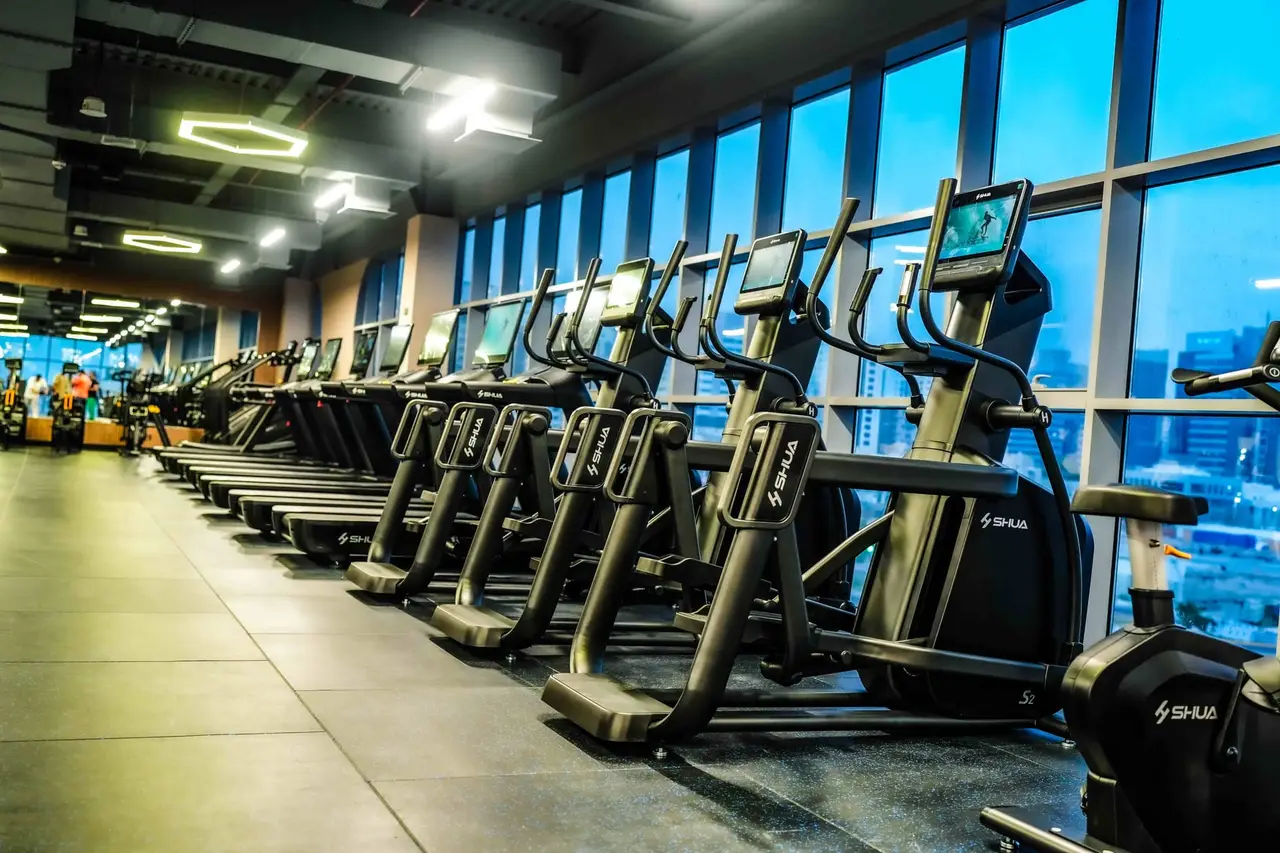
RPM is one club, on Level 4 of AD HUB Sports Complex in Al Manhal. The photos show treadmills, cross-trainers and an upright bike along tall windows, and spin bikes in the functional area. Rowers are not confirmed either way, so ask the team whether there are any, which section they are in, and whether classes use them at your hour.
- The cross-trainer works arms and legs together with no landing, if you want a lower-impact option on the cardio row.
- For hard pulling efforts, the functional area has battle ropes and a sled on the turf lane.
- The women-only Ladies section has cardio equipment of its own, so ask what it holds.
- Personal training covers conditioning, and a coach can teach the rowing stroke wherever a rower is available.
Sources
- Volianitis S, Yoshiga CC, Secher NH. The physiology of rowing with perspective on training and health. European Journal of Applied Physiology, 2020
- Soper C, Hume PA. Towards an ideal rowing technique for performance: the contributions from biomechanics. Sports Medicine, 2004
- World Health Organization, WHO guidelines on physical activity and sedentary behaviour (2020)
- NHS, Physical activity guidelines for adults aged 19 to 64
Questions, answered.
Does rowing burn more calories than running?
It depends on how hard and how long you work. Monitor readouts are estimates, so compare your own sessions on the same machine rather than across the two.
Is a rower suitable for beginners?
Yes, once the stroke has been shown to you. Start with short sessions at an easy effort and lengthen them as the movement settles.
Can rowing replace running for a runner?
It can carry aerobic work on days off your feet, but it does not practise running. Keep most of your sessions on the treadmill or the road if a race is the goal.
Should I row if my back hurts?
Ask a doctor or physiotherapist first. If you get the all-clear, have a coach check your stroke before you add effort.