Why compound lifts lead the programme
A back squat works the thighs and hips along with the trunk. A row works the upper back, the arms and the grip. Because each set covers several muscle groups, a handful of compound lifts can reach every major group that WHO's 2020 guidelines ask adults to strengthen on two or more days a week: legs, back, abdomen, chest, shoulders and arms.
They also demand the most skill and the most energy, which is why the ACSM position stand recommends sequencing a session to protect exercise intensity, with multiple-joint lifts before single-joint ones. For one club's strength floor, and what lifters check on a tour, see strength training at RPM.
The five patterns and their main lifts
| Pattern | Barbell lifts | Dumbbell or kettlebell versions | Machine versions |
|---|---|---|---|
| Squat | Back squat, front squat | Goblet squat, split squat | Leg press, hack squat |
| Hinge | Deadlift, Romanian deadlift | Kettlebell deadlift, dumbbell Romanian deadlift | Back extension |
| Press | Bench press, overhead press | Dumbbell bench and shoulder press, push-up | Chest press, shoulder press |
| Pull | Barbell row | One-arm row, chest-supported row | Pulldown, seated cable row |
| Carry | None in most gyms | Farmer's and suitcase carry | Sled push and drag on turf |
Every column is compound training. If you are still learning the free-weight versions, the free-weight ladder shows the order to climb them in.
Set-up checks, and what slips first when you tire
Most compound reps go wrong before they start. Run through the set-up column before every first rep, and watch the last column on the final reps of a set, because that is where fatigue shows.
| Lift | Set-up check | What tends to slip first |
|---|---|---|
| Back squat | Bar on the upper back, not the neck, feet planted at your usual width, a big breath held before you descend | Depth gets shorter, or the chest drops and the hips rise first |
| Deadlift | Bar over the middle of the foot, shins close, slack pulled out of the bar before it leaves the floor | The bar drifts away from the legs and the back loses its shape |
| Bench press | Eyes under the bar, feet flat, shoulder blades squeezed together and down | The bounce off the chest, or the hips lifting from the bench |
| Overhead press | Grip just outside the shoulders, glutes squeezed, ribs pulled down | Leaning back to finish the rep |
| Barbell row | Hinged to a fixed torso angle, bar hanging under the shoulders | The torso rises to help the bar up |
| Farmer's carry | Handles centred in the hands, shoulders set before the first step | Shoulders creep up and steps get short and fast |
When the last column appears, end the set there. The rep you did not grind out is the one that keeps your technique tidy for next time.
Ordering compound lifts within a session
- Start with the lift you most want to improve. Priority beats habit.
- Heavier before lighter: your low-rep work goes before your moderate-rep work, following the ACSM's higher-intensity-first advice.
- Big before small within the compound lifts: a squat before a split squat, a deadlift before a back extension.
- Pair a press with a pull, such as a bench press with a row, if time is short. One rests while the other works.
- Carries and sled work go last. They tax the grip and the trunk, and you need both for the main lifts.
- Isolation work such as curls and leg extensions follows the compound lifts, never the other way round.
Three sample orders. Swap any lift for its machine version if the rack is busy.
| Session type | Order |
|---|---|
| Lower body | Back squat, Romanian deadlift, split squat, leg curl, plank |
| Upper body | Bench press, barbell row, overhead press, pulldown, biceps curl |
| Full body | Deadlift, dumbbell bench press, one-arm row, goblet squat, farmer's carry |
Rest and rep ranges for compound sets
Rest is where many people cut corners on a busy floor. The ACSM position stand recommends 3 to 5 minutes between heavy sets in the 1 to 6 rep range for intermediate and advanced lifters, and 1 to 2 minutes for muscle-building work in the 6 to 12 range. For people new to resistance training it recommends loads in the 8 to 12 repetition range, two to three days a week.
- Use the rest. Load the next set, note the last one, and stay by the station.
- If someone asks to work in during a long rest, share the rack and alternate sets.
- When the after-office rush leaves every rack taken, switch to the dumbbell or machine column of the table above and keep the pattern rather than waiting.
If you are deciding whether a squat day belongs in the rack or on the leg press, squat rack versus leg press sets the two side by side.
Compound lifts across an Abu Dhabi year
- Early mornings and Friday afternoons are often quieter on strength floors than weekday evenings, though every gym differs. Check yours at the hour you would lift.
- In Ramadan, many lifters keep the compound lifts and trim the isolation work, with lighter loads and fewer sets until the month ends.
- Summer travel breaks the run of sessions. On return, restart the main lifts a step lighter and rebuild over the first sessions back.
Compound lifts at RPM
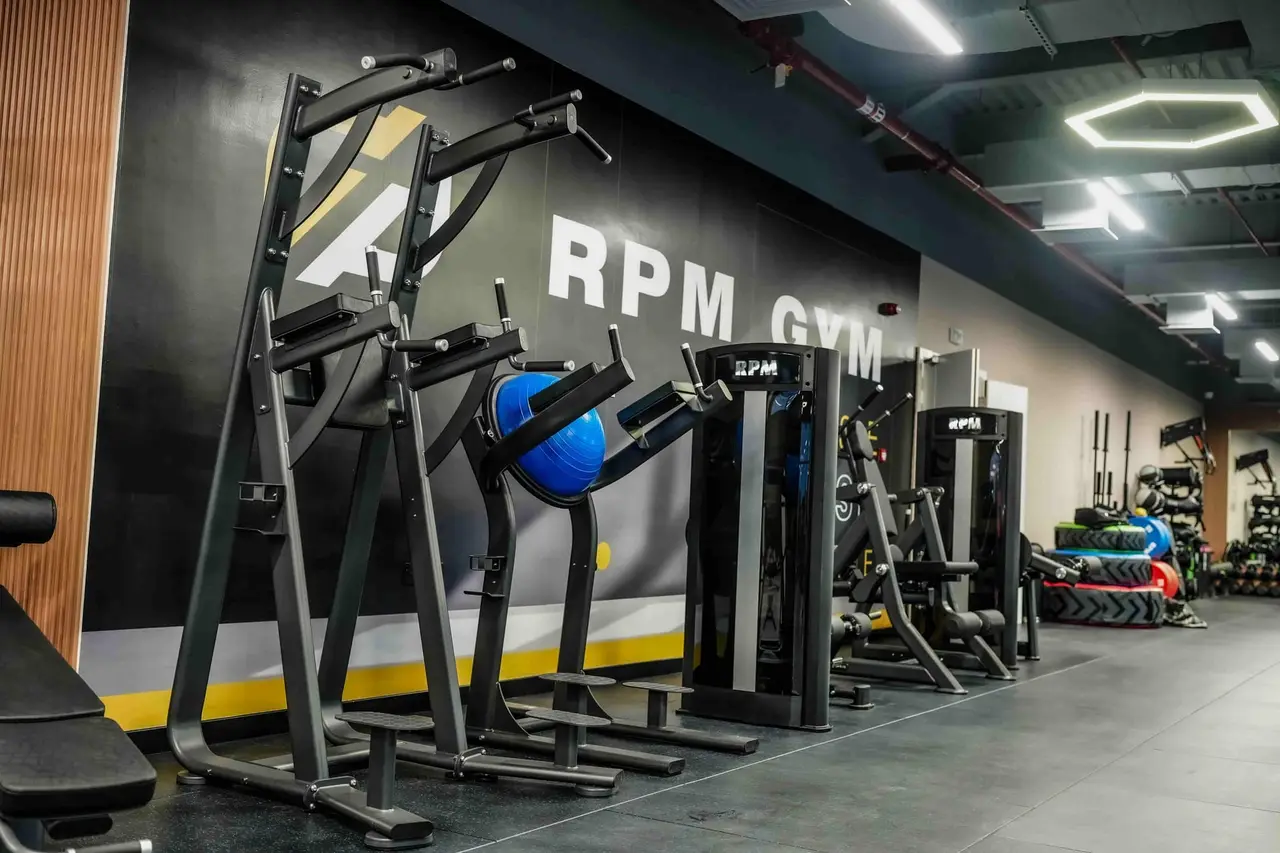
RPM is one club, on Level 4 of AD HUB Sports Complex in Al Manhal. Floor photos show a squat rack with colour bumper plates, benches, plates, dumbbells, a rack of fixed-weight barbells, plate-loaded machines including a leg press and a pulldown, and multi-station cable towers. Kettlebells and a turf lane with a sled for carries and drags are in the functional area.
- Not confirmed: a lifting platform, the number of racks and the rules on dropping weights. Ask on the free guided tour.
- The women-only Ladies section has its own strength equipment. Ask whether it includes a rack for barbell squats and presses.
- Roster roles that suit lift technique include Amer Khalil, bodybuilding and strength, in the Mixed section, and Coach Maria, strength and conditioning, in the Ladies section. Engine and Atelier include coaching, with details confirmed on enquiry.
Sources
Questions, answered.
Do I need a barbell to train compound movements?
No. A goblet squat, a dumbbell press and a leg press all move several joints at once. The barbell versions let you load heavier over time, which matters more as you advance.
Can I squat and deadlift in the same session?
Yes, many programmes do. Put the one you most want to improve first and keep the second lighter, or use a variation such as a Romanian deadlift after squats.
Are compound lifts enough on their own?
They cover most of the work, but the ACSM position stand includes both single- and multiple-joint exercises in its recommendations. Isolation work still earns a place after the main lifts.
What if I feel a lift in a joint rather than the muscles?
Stop that lift for the day and try its machine or dumbbell version. If the discomfort persists, see a doctor or physiotherapist before loading it again.