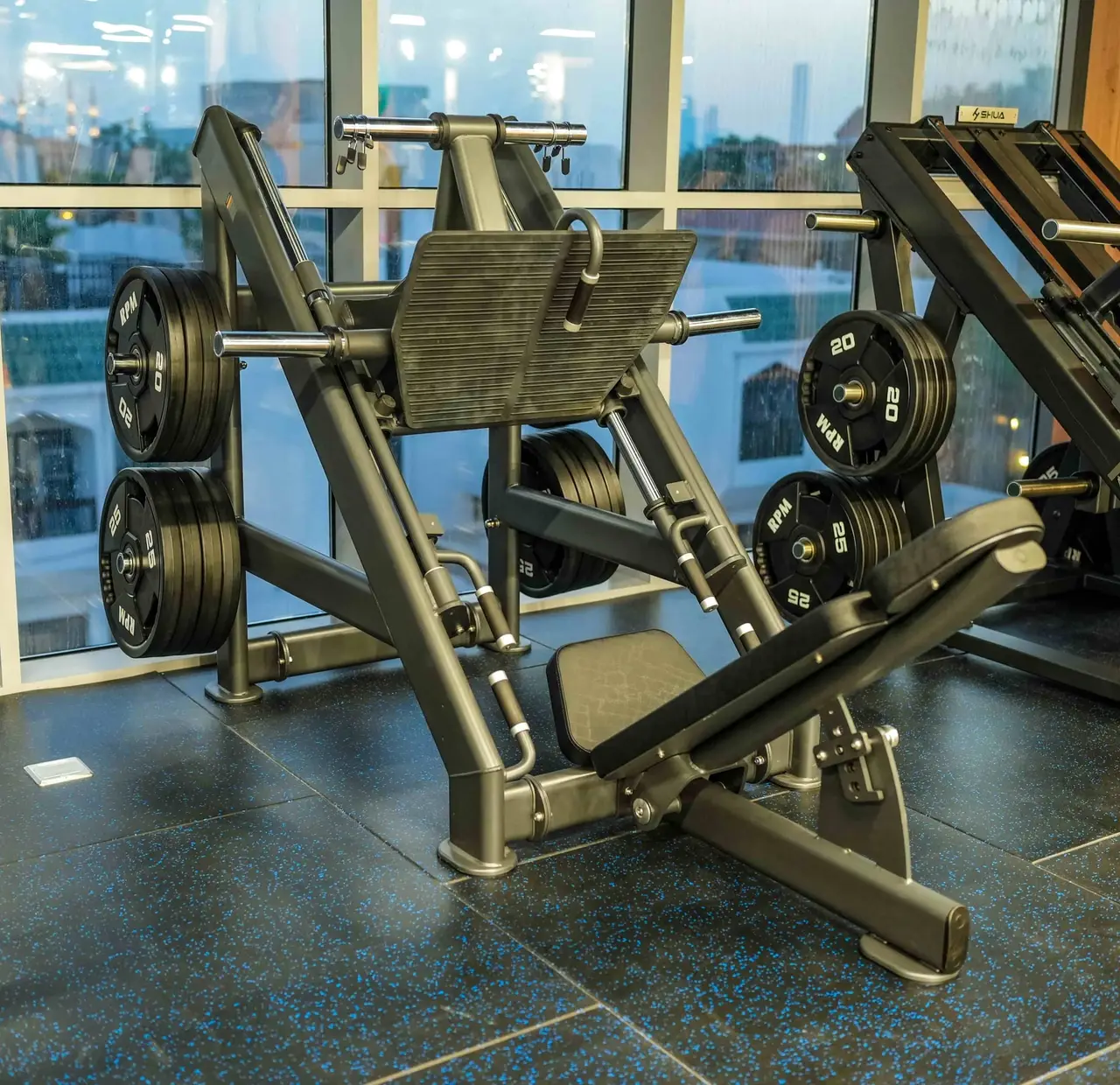
Two tools for the same pattern
A back squat in a rack puts the bar across your upper back and leaves you to balance it through every rep, with safety arms set just below your lowest point. A plate-loaded leg press puts you in a seat with your back on a pad and your feet on a platform that slides on rails. Both are squat-pattern lifts that work several joints at once. What changes is how much of the work your body has to organise for itself.
To see where each sits at one club, look through RPM's facilities. If you are judging a gym's racks before you join, the squat rack checklist covers rack types, safeties and how many you need.
What each one asks of you
| Back squat in a rack | Leg press | |
|---|---|---|
| Main muscles | Thighs and hips | Thighs and hips |
| Trunk and balance | Your trunk holds the bar upright and your feet keep you balanced | The pad and seat hold you, so balance plays little part |
| Where the load sits | On your upper back, travelling through the whole body | Through your feet, with your back supported |
| Skill to learn | Higher: where the bar sits, how you brace, how deep you go and the path of the bar | Lower: seat position, foot placement and depth |
| A rep you cannot finish | Lower the bar onto safety arms set at the right height | Lower the platform onto the safety stops |
| Training alone | Fine with safeties set and sensible loads | Straightforward, which is why solo lifters lean on it |
Leg-press numbers usually run far higher than squat numbers. The two are not comparable, so do not judge one by the other.
What two training studies found
A 2018 trial split participants into squat-only, leg-press-only and combined groups for 10 weeks, with two lower-body sessions a week of six sets at loads they could lift 8 to 12 times. The squat-only group gained more maximal squat strength than the leg-press group. Effect sizes favoured the squat and combined groups for jump height, and the leg-press and combined groups for dynamic balance, though those differences were not statistically significant. The authors conclude that both free weights and machines can improve functional outcomes, and that transfer may be specific to the task.
An earlier eight-week study in students found that squat training improved jump performance significantly, while the leg-press group's changes did not reach significance. Its authors recommend the squat when jump performance is the goal. Neither study looked at injuries, so neither tells you which is gentler on a particular body.
When each one is the better tool
| Situation | Better choice | Why |
|---|---|---|
| You want a stronger squat | Squat | Strength gains followed the exercise trained in the 2018 trial |
| Sport, jumping or sprinting matters to you | Squat | The squat groups led on jump measures in both studies |
| You train alone and want a hard leg set | Leg press | The path is fixed and the platform rests on stops |
| Your trunk is tired after deadlifts | Leg press | It loads the legs with your back on a pad |
| You want more leg work after squatting | Leg press | Extra volume without another round of balancing |
| The racks are full at your hour | Leg press | Keeps the pattern in your session without the queue |
If squatting or pressing causes pain in a knee, hip or the back, stop that exercise and see a doctor or physiotherapist before loading it again.
Using both in one programme
The ACSM position stand advises ordering exercises so that higher-intensity work comes before lower-intensity work. With two squat-pattern lifts in a week, that means the one you are prioritising goes first on its day, while you are fresh.
| Plan | Day one | Day two |
|---|---|---|
| New to barbells | Leg press, then goblet squats to practise the pattern | Leg press, then goblet squats with a little more weight |
| Squat is the priority | Back squat for heavy sets, then leg press for moderate sets | Leg press first for higher reps, then split squats |
| Leg size is the priority | Leg press for most of the sets, with squats as a lighter second lift | Back squat, then single-leg press for each side |
| Busy after-work floor | Whichever station opens up first, with the other second | Swap the order from day one |
For where these two sit among your other main lifts, compound lift training covers ordering and rest across a whole session.
Setting up each one before the first rep
- Squat: set the bar hooks at mid-chest height and the safety arms just below your deepest point, then put collars on both sides.
- Squat: walk the bar out in two or three short steps, so you finish each rep in the same place.
- Leg press: set the seat so that at the bottom your lower back stays flat on the pad.
- Leg press: place your feet flat on the middle of the platform, release the safety handles, and stop short of slamming your knees straight at the top.
- Both: start lighter than you think for the first working set, and write the settings down.
Abu Dhabi floors fill after office hours, and racks clear slowest because one lifter can hold one for half an hour. If you need the rack, check its queue at your usual hour on a visit before you plan your week around it.
Squat rack and leg press at RPM
RPM is one club, on Level 4 of AD HUB Sports Complex in Al Manhal. Floor photos show a squat rack with colour bumper plates and a plate-loaded leg press, alongside benches, plates, dumbbells and kettlebells for goblet and split squats.
- Ask how many racks there are and how busy they get at your hour. The photos do not show a hack squat or Smith machine, so ask about those too.
- The women-only Ladies section has its own strength equipment. Ask whether it includes a rack and a leg press.
- Engine adds coached programming and Atelier is built around one-to-one coaching, with inclusions confirmed on enquiry. The free guided tour is a walk-through, not a workout.
Sources
- Rossi FE, Schoenfeld BJ, Ocetnik S, et al. Strength, body composition, and functional outcomes in the squat versus leg press exercises. Journal of Sports Medicine and Physical Fitness, 2018
- Wirth K, Hartmann H, Sander A, et al. The impact of back squat and leg-press exercises on maximal strength and speed-strength parameters. Journal of Strength and Conditioning Research, 2016
- American College of Sports Medicine, position stand: Progression models in resistance training for healthy adults (2009)
Questions, answered.
Is the leg press a lesser exercise than the squat?
No. It is a different tool. The 2018 trial's authors conclude that both free weights and machines can improve functional outcomes, and many strong lifters keep the leg press in their plans.
Should a beginner squat with a barbell straight away?
There is no need. Many beginners start on the leg press and goblet squats, then move to the barbell once the squat pattern holds, ideally with a coach for the first sessions.
Can I do only the leg press and skip squats?
You can build leg strength that way. Strength tends to follow the exercise you train, though, so expect your squat to lag if you never practise it.
How deep should I go on the leg press?
As deep as you can while your lower back stays on the pad. If it peels away at the bottom, shorten the range or move the seat back.