What your trunk muscles actually do
The Canadian Society for Exercise Physiology defines the core broadly: the central skeleton of spine and ribs, plus every muscle that starts on it, even those that end in the hips or shoulders. Those muscles bend and turn the trunk, but much of their gym work is holding it still while your arms and legs move.
| Muscle group | Main job | Where you notice it |
|---|---|---|
| Rectus abdominis, the front of the stomach | Bends the trunk forwards and stops it arching back | Crunches, planks |
| Obliques, the sides | Twists and side-bends the trunk, and resists both | Side planks, carries with one bell |
| Transversus abdominis, the deep wrap | Tightens around the middle | Bracing before a heavy lift |
| Erector spinae and multifidus, along the spine | Straightens the back and holds it upright | Deadlifts, rows, back extensions |
| Glutes and hip muscles | Link the trunk to the legs | Hinges, lunges, carries |
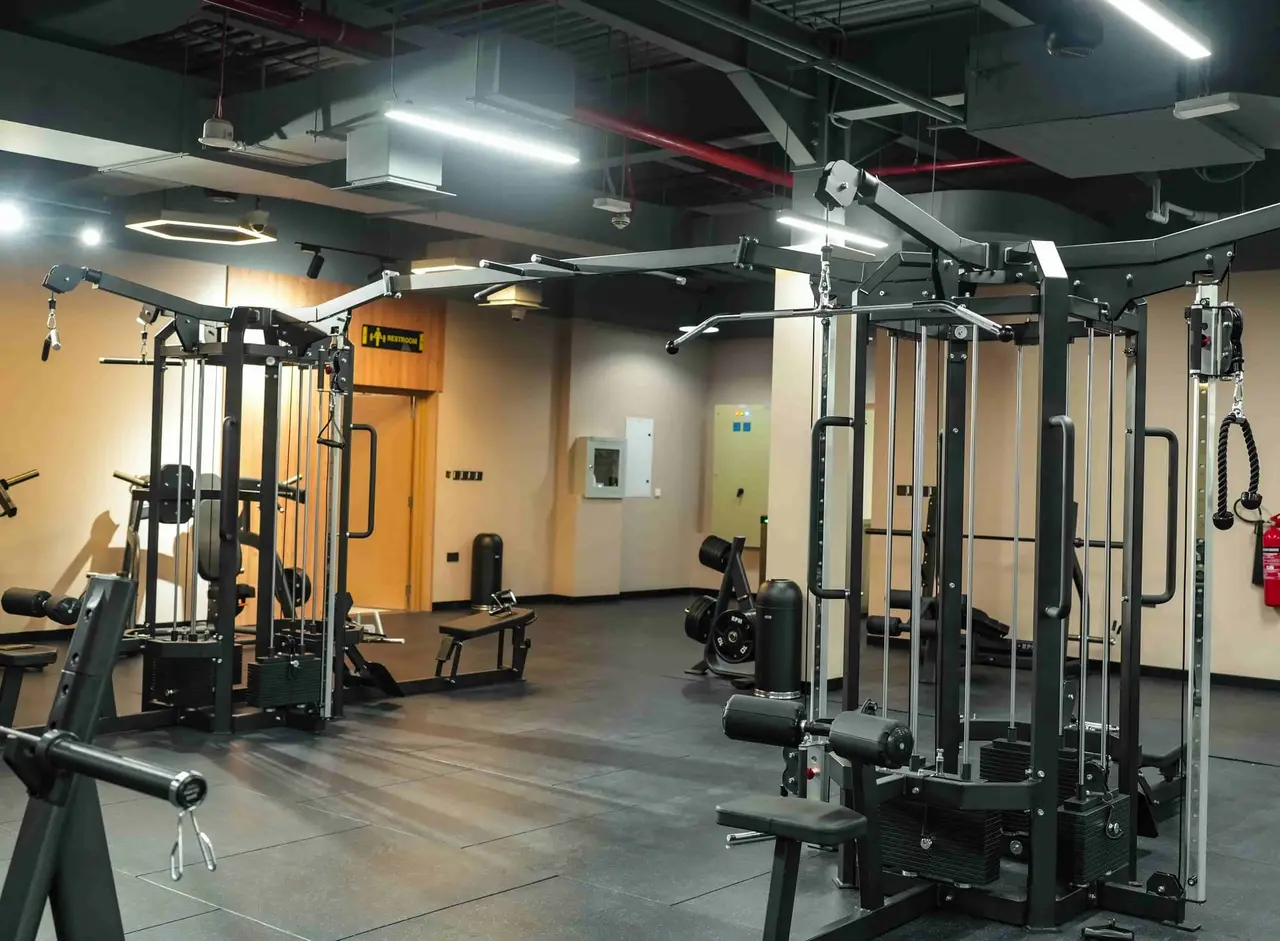
Much of this training happens on RPM's functional floor, with kettlebells, medicine balls and dumbbells, and at the cable towers on the main floor.
The big lifts already train your core
The 2010 position stand found that ground-based free-weight exercises such as squats and deadlifts can activate the core muscles as much as or more than exercises done on unstable surfaces. A 2020 systematic review found the highest activity in the front abdominal muscles, the outer obliques and the spinal muscles during free-weight exercises, while core stability exercises such as planks produced the highest activity in the inner obliques. A 2013 review advised trainers to focus on multi-joint free-weight exercises rather than core-only work.
These studies measured muscle activity in single sessions, not results over months, so use them as a guide to exercise choice. The position stand also found that abdominal bracing stabilises the spine better than drawing the stomach in, and breathing and bracing under the bar shows how lifters learn it.
Exercises that resist movement
Coaches often group targeted core exercises by the movement the trunk has to resist. Pick one or two from each row rather than ten from one.
| Category | The trunk resists | Start with | Harder version |
|---|---|---|---|
| Anti-extension | Arching backwards | Plank on the elbows, dead bug | Longer planks, slow rollouts if the gym has a wheel |
| Anti-rotation | Twisting | Pallof press at a cable tower, bird dog | Pallof press with a step out, or a longer hold |
| Anti-lateral flexion | Leaning sideways | Side plank from the knees | Full side plank, suitcase carry |
| Carries | All three, while you walk | Farmer's carry with two kettlebells | Suitcase carry with one bell, or a racked carry |
| Controlled rotation | Nothing: it trains the twist | Cable wood chop, light | Rotational medicine ball throws |
Throws for the trunk are set out in medicine ball and slam ball workouts.
- Plank: elbows under shoulders, ribs pulled down, glutes squeezed. End the set when your hips sag.
- Pallof press: stand side-on to the cable, hold the handle at your chest and press it straight out without letting it pull you round.
- Suitcase carry: one bell at your side, shoulders level, walk tall without leaning towards or away from it.
Where crunches fit
A crunch trains the trunk to bend forwards, the main job of the front abdominal muscles. That is a real function, so crunches, cable crunches and similar moves can stay in a programme. They cover one job out of several, though, and the reviews above point towards free-weight lifts and holds for the rest.
- Keep the movement slow and curl the ribs towards the pelvis rather than yanking on your neck.
- Use them as one exercise in a core block, not the whole block.
- Count good reps, and stop when the movement turns into a jerk.
If a core exercise causes pain, or you have back pain, an injury or a medical condition, or are pregnant or postnatal, see a doctor or physiotherapist before continuing.
Placing core work in your week
WHO advises muscle-strengthening activity for all major muscle groups on two or more days a week, and the trunk is one of them. A practical approach is a short core block at the end of two or three strength sessions, so the trunk is fresh for squats and deadlifts.
| Day | Main lifts | Core block, two or three sets each |
|---|---|---|
| Saturday | Squats and rows | Plank, Pallof press |
| Monday | Presses and pulldowns | Dead bug, side plank |
| Wednesday | Deadlifts or hinges and lunges | Suitcase carry, cable crunch |
Progress one thing at a time: a few more seconds, a few more reps, then a harder version from the table above.
Ramadan and the summer months often shorten sessions. When time is tight, keep the main lifts and one carry, which already loads the trunk.
Pilates for women in the Ladies studio
Pilates is another way to train trunk control and breathing. At RPM the studio is inside the women-only Ladies section, where reformer classes run. The studio photos show reformers, some with towers, trapeze-table frames and a ladder barrel, so ask which apparatus a session uses. How classes fit around lifting days is covered in Pilates for women who also lift.
Core training at RPM
RPM is one club, on Level 4 of AD HUB Sports Complex in Al Manhal. The training floor photos show multi-station cable towers for Pallof presses and chops, and the functional area in the Mixed section has kettlebells, medicine balls and dumbbells for carries and throws. The Ladies section has its own strength equipment as well as the Pilates studio.
- Ask whether the gym has an ab wheel, a stability ball or a back extension bench if your plan uses one.
- Coaching: coaches on the roster cover strength, conditioning and Pilates across both sections, and Engine is the tier that adds coached programming, with inclusions confirmed on enquiry.
- Book a free guided tour and look at the cable towers and functional floor at your hour.
Sources
- Behm DG, Drinkwater EJ, Willardson JM, Cowley PM. Canadian Society for Exercise Physiology position stand: the use of instability to train the core in athletic and nonathletic conditioning. Applied Physiology, Nutrition and Metabolism, 2010
- Oliva-Lozano JM, Muyor JM. Core muscle activity during physical fitness exercises: a systematic review. International Journal of Environmental Research and Public Health, 2020
- Martuscello JM, et al. Systematic review of core muscle activity during physical fitness exercises. Journal of Strength and Conditioning Research, 2013
- World Health Organization. WHO guidelines on physical activity and sedentary behaviour, 2020
Questions, answered.
Do I need to train my abs every day?
No. Your trunk works in every big lift, and two or three short core blocks a week fit WHO's advice on muscle-strengthening activity.
Are planks better than crunches?
They do different jobs. A plank resists arching, while a crunch bends the trunk forwards. The 2020 review found core stability exercises such as planks gave the highest activity in the inner obliques, so many people keep both.
Should I train my core on a balance ball?
The 2010 position stand advises against unstable surfaces as the main training mode for athletic conditioning, because they reduce force and power as well as range of motion. It sees a role for them within a varied programme, and for people who prefer not to use free weights.
How long should I hold a plank?
As long as your position holds. Several shorter holds with good form usually beat one long hold where the hips sag.