Get the real requirement first
Training for the wrong test wastes weeks. This page does not list official UAE police or military standards, because the recruiting body sets them and may share them with applicants directly. Go to the source: the recruiting body you are applying to.
- Which events are in the test, and in what order?
- How is each event scored, and what is the pass mark for your age group and sex?
- How much rest is allowed between events?
- What surface is it on, and what do you wear: trainers, boots or uniform?
- Is there a medical examination before the fitness test?
- When is it held, and can you retake it if you fall short?
Write the answers down. They become the plan's final stage, and until you have them the training stays general.
What fitness tests elsewhere usually include
A 2025 scoping review by Zhang and colleagues analysed 16 police fitness tests from the UK, the US, South Korea, the Netherlands, Australia, Canada and China. None came from the UAE. Nine were batteries of basic fitness items, and seven were obstacle courses built around duty tasks such as a foot chase, crossing obstacles, physical control and carrying someone to safety. The most common components were cardiorespiratory endurance, muscular strength and endurance, and agility, and the authors found no model that was right for every setting.
Most of the conditioning work below suits the turf lane, sled and kettlebells in RPM's functional area.
| Component | How tests in the review measured it | How to train it in a gym |
|---|---|---|
| Aerobic endurance | Timed runs over set distances, 12-minute runs, shuttle runs | Steady treadmill runs plus interval sessions, outdoors in the cooler months |
| Muscular endurance | Push-ups, sit-ups, pull-ups | Progressions towards full floor and bar reps, trunk exercises, hard sets |
| Power | Vertical jump, long jump | Squats, then low numbers of jumps with good landings |
| Agility | Shuttle runs and agility runs | Short shuttles and changes of direction on the turf |
| Job tasks | Carrying weights, dragging a dummy, running stairs | Kettlebell and dumbbell carries, sled drags |
Strength and endurance, trained together
It is tempting to prepare by running more, but the military research points to strength as well. A 2022 review by Vaara and colleagues found that carrying loads draws on both aerobic and muscular fitness, with maximal strength mattering more as the load gets heavier, while lifting tasks are strongly associated with maximal strength and power.
- Load carriage improved most when strength, aerobic and load-carriage training were combined.
- Maximal lifting capacity improved with strength training alone or with strength and aerobic training together.
- Repetitive lifting and carrying improved with strength training, aerobic training or both.
- The authors suggest that combined training at lower volume but higher intensity may be a practical route for recruits.
A preparation plan in three stages
| Stage | What you train | Weekly shape |
|---|---|---|
| 1. Base | General strength, an aerobic base, first push-up and pull-up progressions | Two or three strength sessions at loads you can lift 8 to 12 times, two or three easy runs |
| 2. Build | Intervals, plus carries and sled drags, with each likely event practised below maximum | Two strength sessions, one interval session, one carry and drag session, one easy run |
| 3. Sharpen | The official events in the official order, with the real rest periods | Two or three rehearsals spread over the final weeks, less volume in the last week |
No timeline is given, because it depends on your starting point and the test date. Start as early as you can. WHO's guidelines advise beginning with small amounts of activity and increasing gradually, and the loads in stage one follow ACSM's advice for novices.
Test yourself every few weeks in stage two on the events you expect, and log the results. Progress shows in the log, and a coach can use it to decide what to push next.
Practising the events honestly
- Count only full reps: chest to the agreed depth on push-ups, full extension at the bottom of a pull-up. Ask a training partner to judge.
- If you cannot yet do a push-up from the floor, follow the first push-up progression. For the bar, see training for your first pull-up.
- If you do not know whether the test uses sit-ups or planks, train both.
- If the test runs outdoors, ask where and when, and follow official heat guidance whenever you practise outside.
- If you have a medical condition, or pain during training, see a doctor or physiotherapist before you carry on.
Training for a test at RPM
RPM is one independent club, on Level 4 of AD HUB Sports Complex in Al Manhal. It has no link with the police, the armed forces or Rabdan Academy, and it does not set, run or mark any fitness test. What a coach can do is plan towards a standard you bring, with a date to aim for.
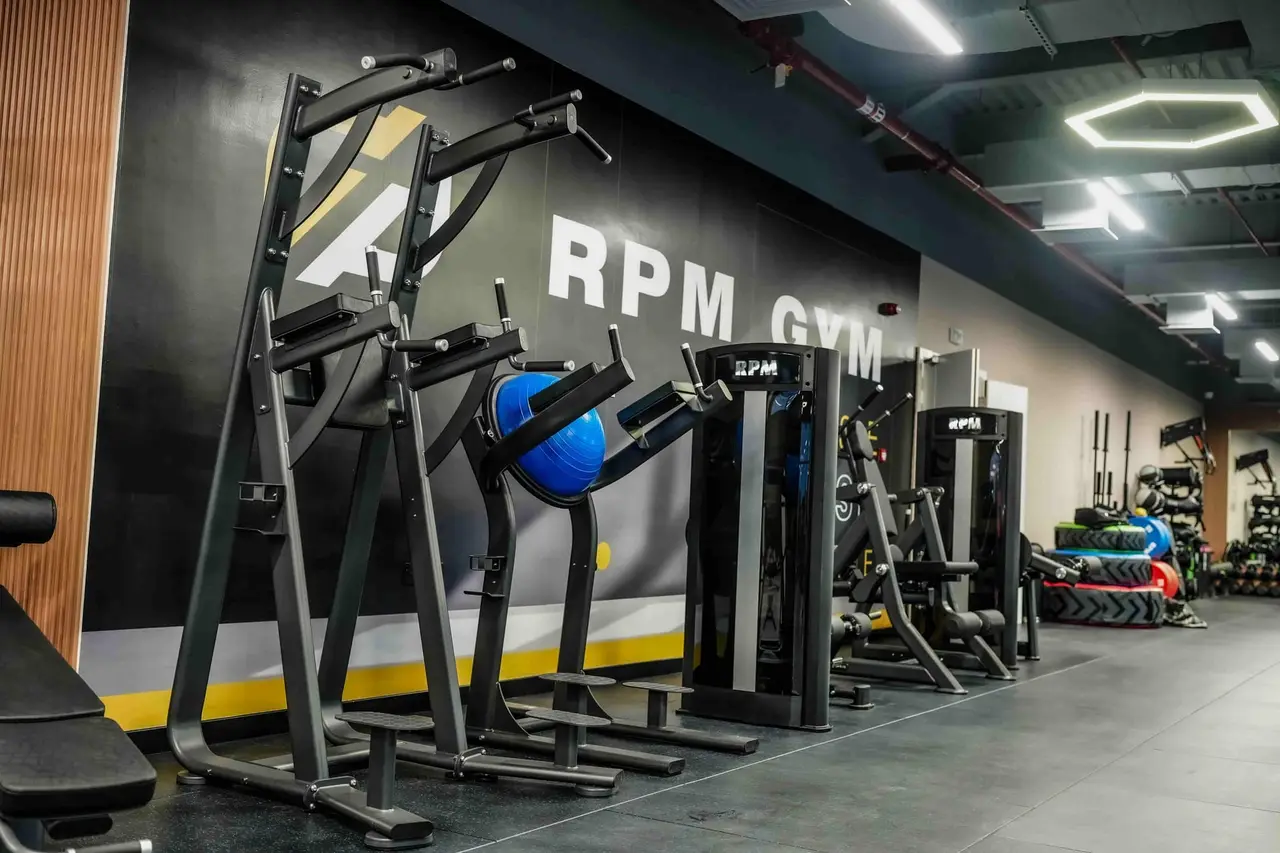
- The functional area has a turf lane with a sled, kettlebells, dumbbells, battle ropes, medicine balls and step boxes. The training floor has treadmills, a plate-loaded pulldown, cable towers and a squat rack.
- A pull-up bar is not confirmed, so ask before you plan your bar practice around it.
- Women preparing for a test can use the Ladies section, which is women-only, has its own strength and cardio equipment and is where the roster's female coaches work.
- A coach can write the plan through Engine, the tier with coached programming, or Atelier, which centres on one-to-one sessions. Confirm what each includes, then book the free guided tour at the hour you would train.
Sources
- Zhang Z, He J, Zhang X, Zhao L, Deng Y. Analysis of physical fitness tests for police officers in various countries: a scoping review. Frontiers in Physiology, 2025
- Vaara JP, et al. Physical training considerations for optimizing performance in essential military tasks. European Journal of Sport Science, 2022
- American College of Sports Medicine position stand. Progression models in resistance training for healthy adults. Medicine and Science in Sports and Exercise, 2009
- World Health Organization. WHO guidelines on physical activity and sedentary behaviour, 2020
Questions, answered.
Can RPM tell me the current test standard?
No. RPM does not set or mark any police or military test and cannot confirm what one involves. Get the current requirement from the recruiting body, then bring it to a coach.
Will following this plan get me through the test?
Nothing here promises a pass. A plan built on the real events, started early and logged honestly, gives you the clearest picture of where you stand.
Should I train in boots or with extra weight?
Only if the official test uses them, and then build up gradually. Ask the recruiting body what you will wear and carry on the day.
Is there a medical check before the fitness test?
Ask the recruiting body. If you have a medical condition, see your own doctor before you begin hard training.