What a full push-up asks of you
A full push-up starts in a high plank: hands under the shoulders or slightly wider, body in one straight line from head to heels. You lower until your chest is a fist's height from the floor, elbows angled back rather than flared out, and press back up without the hips sagging or leading. It works the chest, the front of the shoulders and the triceps, while the trunk holds the body rigid.
It is a real strength exercise, not a warm-up drill. In a 2017 trial, push-ups set to a load similar to a light bench press, adjusted with positions such as kneeling, increased strength and the thickness of the chest and triceps about as much as bench pressing did. For the floor and the equipment you would use alongside it, see strength training at RPM.
The progression ladder
A 2011 study measured how hard the hands push against the ground in six push-up variations. Push-ups with the hands raised on a box, and push-ups from the knees, produced lower forces than all the others, while raising the feet produced the highest. That gives you a ladder: the higher your hands, the easier the rep, and you climb down it as you get stronger.
| Level | Exercise | Where to do it | Move down when |
|---|---|---|---|
| 1 | Wall push-up, feet a step back from the wall | Any clear wall | Three sets of 12 feel controlled |
| 2 | Incline push-up, hands on a high box or the end of a bench | A bench on the training floor, or a tall step box | Three sets of 12 with a straight body |
| 3 | Incline push-up, hands on a low box or step | A low step box | Three sets of 12, chest touching the edge each time |
| 4 | Slow lowering from the floor, plus level 3 for sets | The floor, with a mat if you like | Three lowerings of about five seconds each, without dropping |
| 5 | Floor push-ups for single reps, rested between | The floor | Five good singles in a session |
| 6 | Floor push-ups for sets | The floor | Build towards three sets of several reps |
Kneeling push-ups are another way to reduce the load, and the 2011 study found they lowered it too. Many coaches prefer the incline because it keeps the full-body plank you will need on the floor.
Holds and slow lowering
The American College of Sports Medicine's 2009 position stand lists three kinds of muscle action for strength programmes: lifting a load, lowering it under control, and holding a position. A push-up progression can use all three. The lifting phase is the incline work, and two more drills fill the gaps.
- Plank hold at the top of a push-up: arms straight, body straight, glutes squeezed. Build towards holds of about 20 to 30 seconds.
- Slow lowering: start at the top on the floor and take about five seconds to lower your chest down. Drop to your knees at the bottom, return to the top, and repeat.
- If you cannot control the lowering for long, do it from a low box first.
- Keep both drills crisp. Three good efforts beat ten sloppy ones.
How often to practise, and one session
ACSM's position stand suggests two or three training days a week for people new to resistance training. The trials behind this guide used a similar rhythm: two sessions a week in the 2017 study and three in a 2018 study of progressive push-up variations, which improved bench press strength in moderately trained men over four weeks. Leave at least a day between sessions.
Put this at the end of a full-body session, or after the upper-body work in a routine such as the eight-week first strength routine.
| Part | What to do | Sets |
|---|---|---|
| Main sets | Push-ups at your current level, 8 to 12 reps | 3, resting a minute or two between them |
| Lowering | Slow lowering from the floor or a low box | 3 efforts |
| Hold | Plank at the top of a push-up | 2 or 3 holds |
Counting progress
Progress on a push-up ladder is easy to miss, because the box gets lower rather than a weight getting heavier. Write each session down.
- The level, including which box or bench height you used.
- Reps in each set, and whether your body stayed straight on the last ones.
- How many seconds each lowering took.
- Every four weeks, a short test: as many good reps as you can at your current level, once, at the start of a session.
The rule for moving down a level borrows from ACSM's advice for weights, which is to progress once you can beat your target by one or two repetitions. When every set reaches 12 with good form, move to the next level and drop back to about eight reps. People get there at very different speeds, so judge yourself against your own log, not a date.
Faults that hold people back
| Fault | What it looks like | Fix |
|---|---|---|
| Sagging hips | The middle drops towards the floor | Raise the hands to a higher box, squeeze your glutes, brace as if bracing for a light poke in the stomach |
| Half reps | The chest stops well short of the box or floor | Use a higher box and take the full range, rather than shortening the rep |
| Flared elbows | Elbows point straight out to the sides | Angle them back so your arms and body form an arrow from above |
| Head first | The chin reaches for the floor before the chest | Look at the floor a little ahead of your hands, neck in line with your spine |
| Uncomfortable wrists | Pressure at the base of the palm | Grip a pair of dumbbell handles on the floor, or make fists |
Pain in a shoulder, elbow or wrist that does not settle is a reason to stop and see a doctor or physiotherapist, not to push through.
After the first rep, and practising at RPM
Once floor sets come, raising the feet makes the push-up harder: the 2011 study found feet-raised push-ups produced the highest forces of all six variations. Weighted pressing is the other route, and compound lift training covers the bench press and how to order it in a session.
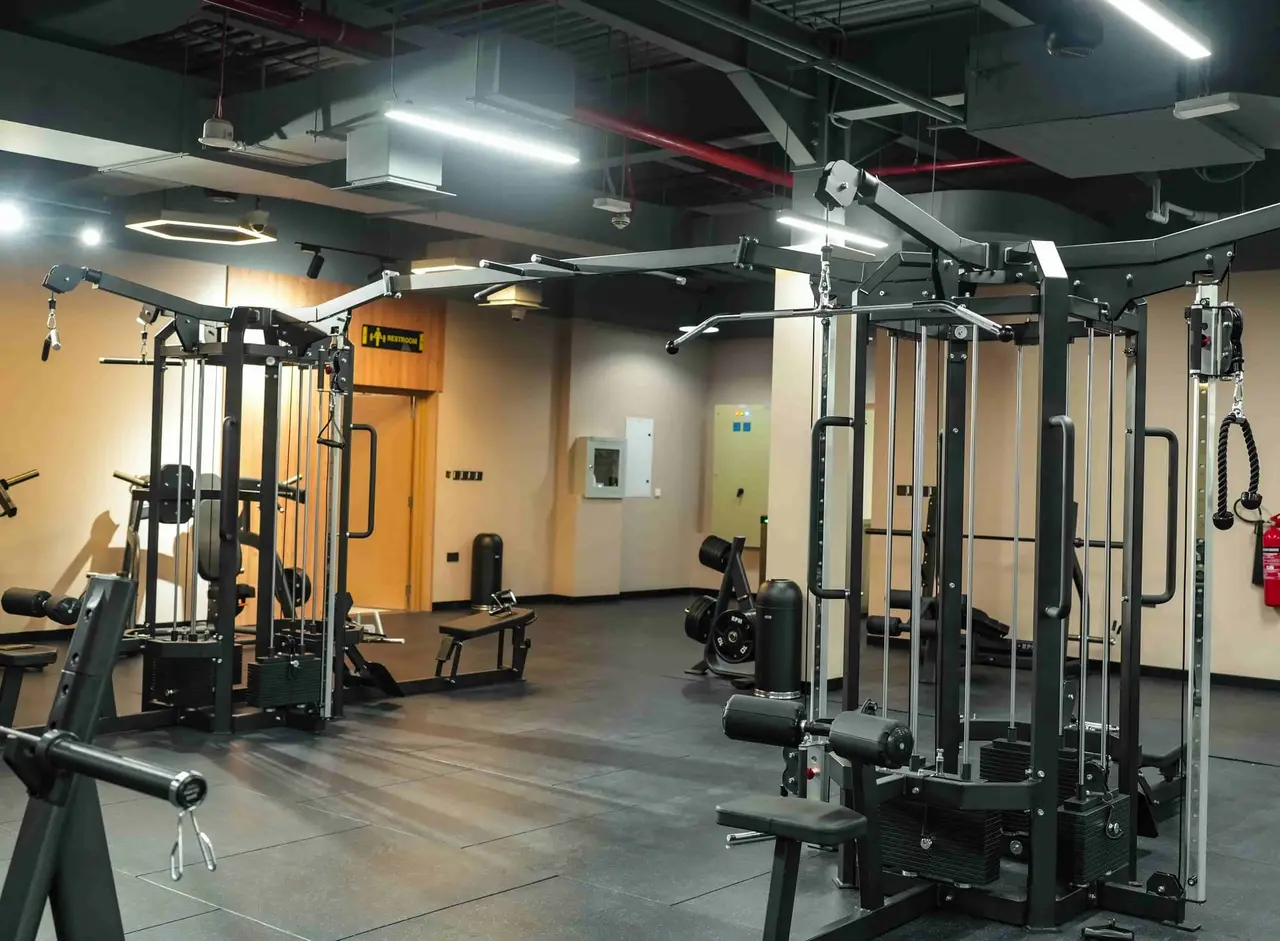
RPM is one club, on Level 4 of AD HUB Sports Complex in Al Manhal. Its floor photos show benches and dumbbells, and the functional area in the Mixed section has step boxes, which together cover every level of the ladder. The women-only Ladies section has its own strength equipment, so ask which benches and boxes sit there. A coach can check your form at each level, and a free guided tour shows you the floor first.
Sources
- Ebben WP, Wurm B, VanderZanden TL, et al. Kinetic analysis of several variations of push-ups. Journal of Strength and Conditioning Research, 2011
- Kotarsky CJ, Christensen BK, Miller JS, Hackney KJ. Effect of progressive calisthenic push-up training on muscle strength and thickness. Journal of Strength and Conditioning Research, 2018
- Kikuchi N, Nakazato K. Low-load bench press and push-up induce similar muscle hypertrophy and strength gain. Journal of Exercise Science and Fitness, 2017
- American College of Sports Medicine, position stand: Progression models in resistance training for healthy adults (2009)
Questions, answered.
Are knee push-ups or incline push-ups better for building up?
Both reduce the load, according to the 2011 study. The incline keeps the straight plank you need for a floor push-up, so many coaches start there, but either can work.
Are push-ups as good as the bench press for strength?
In the trials behind this guide, with men as participants, push-ups set to a comparable load built strength about as well as bench pressing. The bench press is easier to load in small steps once push-ups get easy.
Is the progression the same for women?
Yes. The 2011 study included men and women and found no gender differences in how the variations changed the load.
Should I practise push-ups every day?
There is no need. Two or three sessions a week with a day between them matches ACSM's advice for people new to resistance training, and gives the muscles time to recover.