What you are really comparing
Home equipment is an upfront purchase that you own, store and eventually sell. A membership is a running cost that buys access to far more equipment than any home could hold, plus whatever the gym adds, such as coaching, classes or recovery rooms. The decision usually turns on four things: space, range, money over time and whether you will train at home.
This guide is about buying kit. For women weighing home workouts against a private ladies gym, see that comparison. For the gym side at RPM, the membership page sets out the three tiers.
Home kit and a membership, criterion by criterion
| Criterion | Home equipment | Gym membership |
|---|---|---|
| Money | A large sum upfront, then additions as you get stronger | A monthly price for as long as you train |
| Range | What fits and what you can afford, often dumbbells, a bench and a bike | Racks, cable towers, plate-loaded machines and a row of cardio machines |
| Heavy lifting | Limited by space, flooring and neighbours | Built for it |
| Time | No trip and no parking | The trip there and back at your training hour |
| Summer | Needs an air-conditioned room, not a balcony | Cooling is the gym's cost |
| Coaching | Videos, apps or a trainer who visits | Coaches on the floor, if your tier or sessions include them |
| Interruptions | Family, deliveries and work calls | Few once you are through the door |
| Leaving Abu Dhabi | Sell it or ship it | Cancel on the contract's terms |
Space in apartments and villas
Where you live settles much of this before money comes into it.
- Studio or one-bedroom flat: a mat, bands, adjustable dumbbells and perhaps a folding bench, kept in a cupboard. Anything left out takes over the living room.
- Two or three bedrooms: a spare room can take a bench and a set of dumbbells, perhaps with a bike. A rack may fit, but building rules on noise and dropped weights limit what you can do with it.
- Villa: a spare ground-floor room, part of a garage or an outbuilding can take a rack and a platform. Garages and outbuildings get very hot in summer unless they are cooled, which adds a running cost.
- Balconies and gardens: usable for part of the year, but humidity can rust bare steel, and much of the summer is too hot to train outside.
Ask your building management about rules on deliveries, noise and heavy items before you buy anything you cannot carry up the stairs yourself.
Adding up the money over the years
Home kit looks cheap or dear depending on how long you keep it. Price both sides over the years you expect to stay, with letters standing in for real quotes.
| Line | Home equipment | Membership |
|---|---|---|
| Upfront | Kit now, K | Any joining fee, J |
| Each year | Additions as you get stronger, A, plus cooling the room in summer, C | Twelve months of membership, 12M |
| When you leave | Minus what you sell it for, R, or plus shipping | Nothing, if you leave on the contract's terms |
| Total over Y years | K + Y × (A + C) − R | J + 12M × Y |
Second-hand kit usually sells for well under what it cost, and heavy items can be slow to sell. Estimate R cautiously.
Who each one suits
Home equipment suits you if:
- you have a room or corner that can stay a training space
- your training is general fitness, conditioning or moderate dumbbell work
- the trip to a gym is what makes you skip, for example with young children or long office days
- you expect to stay long enough for the kit to pay for itself
A membership suits you if:
- you want to squat, deadlift and press heavy barbells for years
- you want machines, cables or a turf lane that no flat could hold
- you want coaching, classes or a women-only section
- you train better in a place used only for training
Catches, and questions to answer before buying
- Goals change. A rowing machine bought for cardio may gather dust once you decide to lift.
- The upgrade cycle. Each jump in strength can mean buying again: heavier dumbbells, more plates, a sturdier bench.
- Moving house. If you rent, each move means carrying the kit with you, and a rack and plates make that a heavy job.
- Running costs creep. Cooling a room through the summer, replacing worn cables and servicing a treadmill all add up.
- Without anyone watching, form errors go unnoticed. Book a few coached sessions before loading up at home, or have a trainer come to your home.
Before you buy, answer these:
- Which exercises in my plan need equipment I could not fit at home?
- What will it be worth, or cost to move, when I leave this home or the UAE?
- If I join a gym instead, what is the shortest term, and which areas does my tier cover?
Worked example: a villa and two early risers
Take a couple in a rented villa in Khalifa City with a spare ground-floor room. Both train at dawn before the school run, neither wants coaching, and their plans are full-body strength plus some cycling. They expect to stay at least four more years, so they price a rack, a barbell with plates, a bench, adjustable dumbbells and a spin bike against two memberships.
| Line | Home room | Two memberships |
|---|---|---|
| Upfront | K, plus rubber flooring | 2J |
| Each year | A + C | 24M |
| After four years | K + 4 × (A + C) − R | 2J + 96M |
| Travel each session | None | A drive each way at dawn |
| What they give up | Machines, cables and coaching | Training before the children wake |
On their quotes the home room is cheaper by the second year, and it fits the hour they train. They buy the kit, and each books a handful of coached sessions at a gym first to check their squat and deadlift. They also write down what would change the answer: a move to an apartment, a goal that needs machines, or one of them wanting classes.
RPM as the gym option
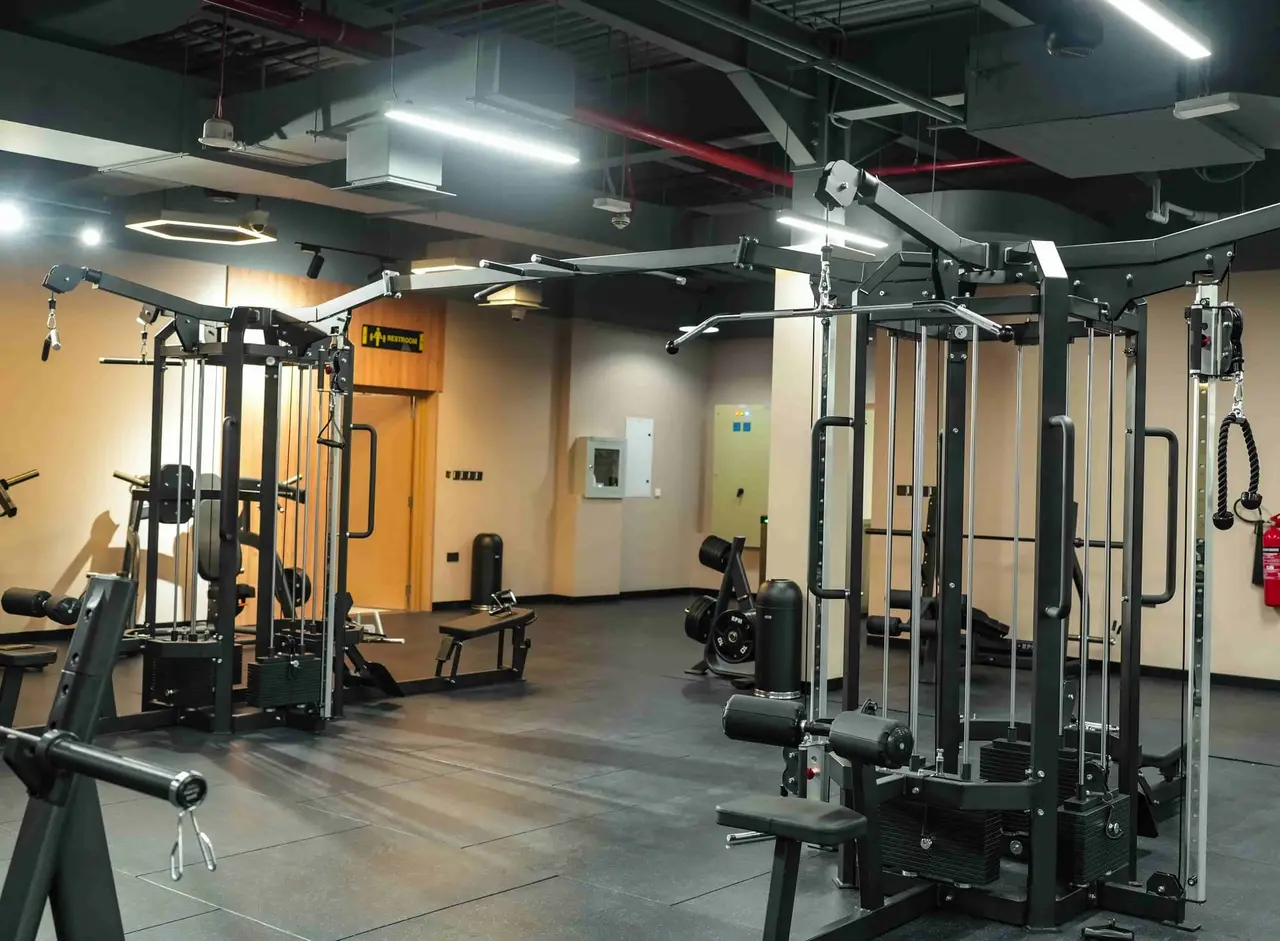
RPM is one club, on Level 4 of AD HUB Sports Complex in Al Manhal, with free on-site parking. Photos of the training floor show what a home rarely holds: plate-loaded machines such as a leg press and a pulldown, multi-station cable towers, a squat rack with colour bumper plates, treadmills, cross-trainers and spin bikes. The functional area adds a turf lane with a sled, kettlebells, battle ropes and heavy bags. See RPM's facilities for the rest.
There is a Mixed section, where men train, and a women-only Ladies section with its own strength and cardio equipment. Memberships come in three tiers. Floor is the training-floor tier, Engine adds coached programming, and Atelier is built around 1:1 coaching. Inclusions, the sections covered and prices are confirmed on enquiry, and a free guided tour lets you judge the floor against the room at home.
Questions, answered.
What is the most useful first piece of home equipment?
For most people, a pair of adjustable dumbbells, because they cover many exercises and fit in a cupboard. Add a bench once you know you will keep using them.
Does home equipment suit a beginner?
It can, for bodyweight work and light dumbbells. If barbell lifts are new to you, learn them with a coach before you buy a rack.
Is the gym in my building enough?
It can be, if it has the equipment your plan needs and is quiet at your hours. Check it at your training hour before ruling out both home kit and a membership.
Should I buy second-hand equipment?
It can make sense for simple items such as plates and dumbbells. Check welds and cables, test anything that moves, and avoid treadmills whose service history you cannot see.