Two gym profiles, and how to spot them
Walk onto most training floors and you can tell which way they lean. A free-weights gym gives most of its space to racks, benches, barbells, plates and a long dumbbell rack. A machine-focused gym fills the floor with rows of selector and plate-loaded machines, each built for one movement, with a smaller weights corner.
Both can be good gyms. They suit different people, and different stages of the same person's training. RPM's facilities page shows how one club divides its floor between the two.
What changes with the equipment
| Free-weights gym | Machine-focused gym | |
|---|---|---|
| Learning curve | Steeper: you control balance and the path of the bar, so technique takes coaching and practice | Gentler: the machine sets the path, so a seat adjustment and a short demonstration get you started |
| Progression | Long and open-ended: barbell lifts can keep progressing for years in small plate jumps | Steady early on with simple pin changes, though some machines top out for strong lifters |
| Supervision | Heavy pressing and squatting call for a spotter, safety arms or a coach on hand | Less need for a spotter, as most machines let you stop and rack the weight yourself |
| Training alone | Possible, with sensible weights and the rack set up properly | Straightforward, which is why many solo trainees like machines |
| Muscles worked | Big compound movements that use many muscles at once | Targeted work on one muscle group at a time |
| Busy hours | One lifter can hold a rack for half an hour | More stations, so turnover is usually quicker |
| Atmosphere | Often a lifting culture, with chalk and loud sessions | Often quieter, with a wider mix of ages and goals |
Who each profile suits
- New to training: machines let you learn effort and range of motion before balance enters the picture. Add free-weight lifts as a coach teaches each one.
- Following a strength programme: free weights, because the programme is built on barbell lifts.
- Training for physique: both, as machines and cables isolate muscles that barbell lifts leave under-worked.
- Returning after time off, or working around an old injury: machines often let you control range and load more precisely. If an injury is involved, get clearance from a doctor or physiotherapist first.
- Training alone at quiet hours: machines reduce the need for a spotter.
- Conditioning work: neither profile alone. Look for a functional area with a sled lane and open space.
Why most people need both
Does a good gym in Abu Dhabi need both free weights and machines?
For most people, yes. Free weights carry the big lifts that build strength over years. Machines and cables fill the gaps: they isolate muscles, let you keep training when you are tired or a rack is taken, and give beginners a simpler way in. A gym with only one of the two suits a narrow group, such as a powerlifting team or someone who will never lift a barbell. Check that both are there in usable numbers at your hour, not as a token corner.
A normal week shows why. A sensible strength session might open with a barbell squat, move on to a leg press or dumbbell lunges, and finish with a machine or cable exercise for the hamstrings. Each tool does a job the others do less well.
What people overlook when choosing
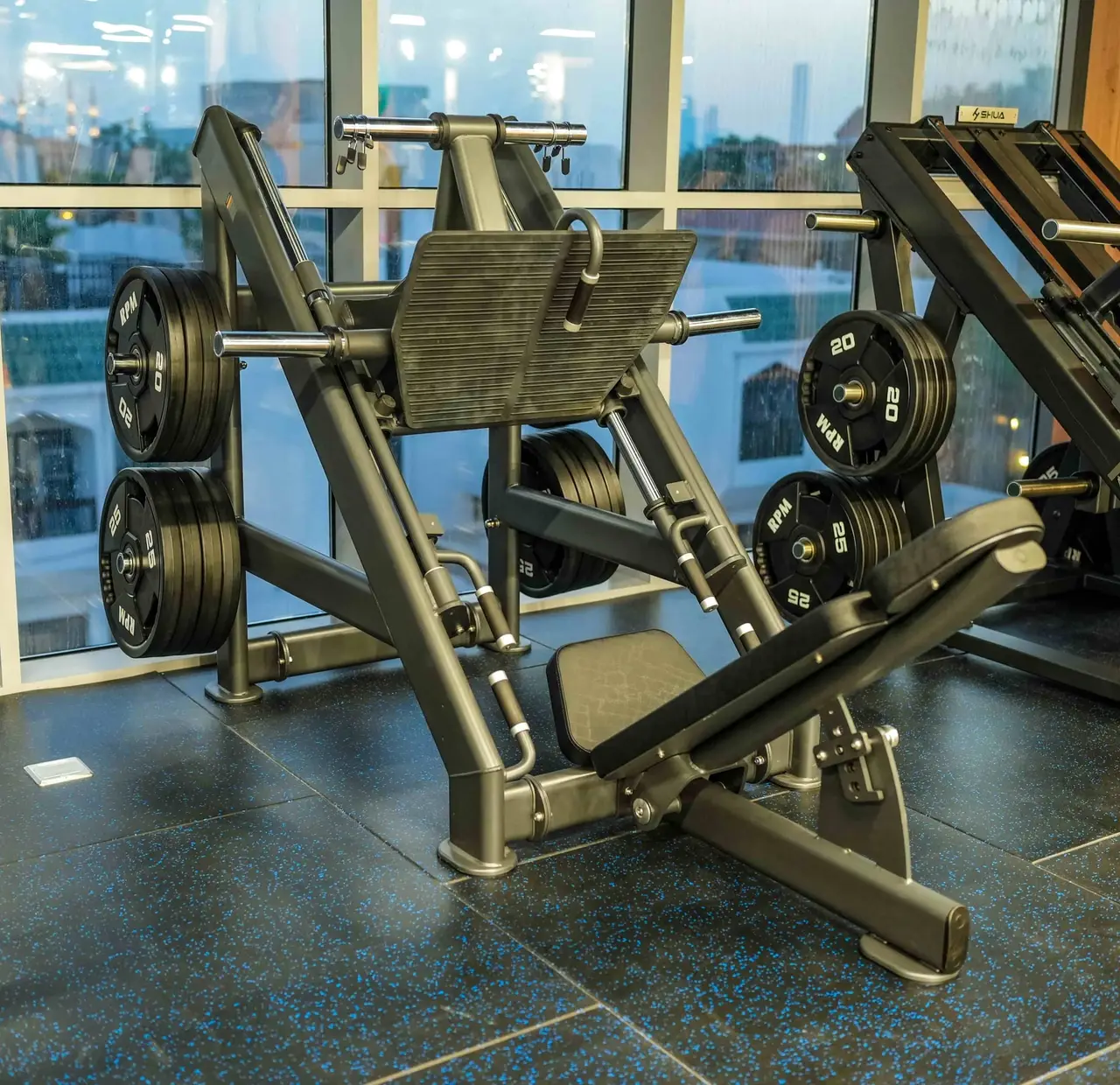
- Plate-loaded machines sit in between. They move like machines but load like barbells, which suits lifters who want heavy work without a spotter.
- Count what you would use at your hour. Three racks shared by twenty people is a different gym from three racks shared by five.
- Dumbbell range matters more than it looks. Check the heaviest pair, and whether the small jumps are there.
- Cables are the bridge. A good set of cable towers covers dozens of movements in little space.
- House rules shape free-weight training. Ask about deadlifts, dropping weights and chalk before you join.
- Women-only spaces vary. If you train in a ladies section, check it has free weights as well as machines, rather than cardio and a few stations alone.
For a full checklist of what a lifting floor needs, see what a serious lifter should look for.
One lifter's move from machines to a barbell plan
Take a reader in his late thirties who has trained on machines in his apartment building's gym for two years. Progress has slowed, and a coach suggests a barbell programme. The building gym has one rack, usually taken after work.
| What he checks | Gym A: machine-focused | Gym B: free weights first |
|---|---|---|
| Racks available after work | One, often taken | Several, with a short wait at peak |
| Machines for accessory work | Plenty | A good selection, plus cable towers |
| Coaching to learn the lifts | Not offered | A few paid sessions available |
| Atmosphere | Quiet | Busier and louder |
He keeps the building gym for easy days and joins Gym B, booking three coached sessions to learn the squat, bench press and deadlift. Machines still appear in every session, after the main lift. Six months on, he trains mostly at Gym B and uses the building gym when traffic makes the drive pointless.
RPM's floor in this comparison
RPM mixes the two profiles. It is one club on Level 4 of AD HUB Sports Complex in Al Manhal. Photos of the training floor show a squat rack with colour bumper plates, benches, plates, dumbbells and fixed-weight barbells, next to plate-loaded machines such as a leg press and a pulldown, and multi-station cable towers. The functional area adds a turf lane with a sled, plus kettlebells and more dumbbells.
The women-only Ladies section has its own strength and cardio equipment, so women can lift there without using the Mixed floor. Men train in the Mixed section. The roster includes coaches for strength and for physique work, so ask about a few sessions if you are moving on to free weights, and read about strength training at RPM. Count the stations you would use on a free guided tour at your usual hour.
Questions, answered.
Are free weights better than machines for building muscle?
Both build muscle when you train hard enough and progress over time. Free weights work more muscles per lift, and machines make it easier to push one muscle hard on its own. Most physique plans use both.
Can I get strong using only machines?
Stronger, yes, especially early on. If your goal is a heavier squat, bench press or deadlift, you will need to practise those lifts with a barbell, ideally with coaching.
Are machines easier for beginners?
They are an easier start, because the machine guides the movement. Ask staff to set each one up with you, and learn the free-weight basics with a coach when you are ready. What beginners should look for has a wider checklist.
Do I need a spotter for free weights?
For heavy bench pressing and squatting, use a spotter or set the rack's safety arms. Most dumbbell and lighter barbell work you can do alone. Ask about the gym's house rules as well.