What your back muscles do
Your back is several muscle groups with different jobs. The lats, the broad muscles down the sides of your back, pull the arms down and back. The upper back muscles draw the shoulder blades together and hold them steady. The long muscles beside the spine keep your back in one shape when you hinge forward under load.
WHO's 2020 guidelines advise adults to do muscle-strengthening activity for all the major muscle groups on two or more days a week, and the back is on its list beside the legs, chest, shoulders, arms and abdomen. A plan that only presses and squats leaves it out. For the floor and the stations you would use, see strength training at RPM.
Three movements, and exercises for each
| Movement | Exercises | Kit RPM's floor photos show | Coaching point |
|---|---|---|---|
| Vertical pull | Plate-loaded pulldown, cable pulldown | A plate-loaded pulldown and multi-station cable towers | Pull the bar or handles to the upper chest, elbows driving down |
| Horizontal pull | Seated cable row, one-arm dumbbell row, chest-supported dumbbell row | Cable towers, dumbbells and benches (ask whether one sets to an incline) | Lead with the elbow and finish with the shoulder blade drawn back |
| Horizontal pull with a bar | Barbell row, inverted row under a bar set in a rack | Fixed-weight barbells, and a squat rack for the inverted row (ask first) | Torso angle fixed for the whole set |
| Hinge | Romanian deadlift | Fixed-weight barbells or dumbbells | Hips travel back, spine keeps its shape, weight kept against the legs |
Ask the team which of these stations sit in the women-only Ladies section, which has its own strength equipment. Technique for the hinge is covered in compound lift training.
Choosing a row: what one study found
A 2009 study compared three rows in seven healthy young men. The inverted row produced the highest activation of the lats, the upper back and the hip extensors, with lower activation of the muscles beside the lumbar spine and the lowest load on the lower back. The standing bent-over row activated the whole back strongly but placed the largest load on the lower spine. The one-arm cable row asked the trunk to resist twisting.
- If your lower back tires before your upper back on bent-over rows, a row where the bench or the floor supports you puts that work elsewhere.
- A standing one-arm cable row adds a trunk challenge, so expect lighter loads than on a seated row.
- Seven participants is a small sample, so read the study as a guide to the trade-offs, not a ranking.
Grip width on the pulldown
Many people believe a wide grip works the lats harder. A 2014 study of 15 men tested three grip widths, from one to two times shoulder width, and found similar lat activation across all of them, with heavier six-rep loads on the two narrower grips than on the widest. A 2025 study of 40 trained men compared seven pulldown variations and also found no significant difference in lat activation.
- Choose a grip in that range that feels comfortable on your shoulders and lets you pull the full distance.
- A medium grip may let you handle a little more load, which helps when you come to add weight.
- Leaning far back turns the pulldown into a row. The 2025 study found more rear shoulder activity with the torso tilted back.
Balancing pulls with presses
A common rule of thumb is to do at least as many pulling sets as pressing sets each week. It is a planning habit rather than a finding from the studies above, but it keeps the back from becoming the muscle group you never quite get to.
- Pair them: a row after each press, or a pulldown after each overhead press, so neither gets skipped when time runs out.
- Count both sides in your log at the end of the week.
- If your sessions are short, put a pull first on alternate days.
How many sets a week
A 2017 meta-analysis of 15 studies found a graded dose-response between weekly sets and muscle growth: more sets went with larger gains, each extra set adding a little. When weekly sets per muscle were grouped as fewer than 5, 5 to 9, and 10 or more, the trend favoured the higher groups. The American College of Sports Medicine's 2009 position stand recommends loads you can lift 8 to 12 times for newcomers, rests of one to two minutes for muscle-building sets, and a load increase of 2 to 10 per cent once you beat your target by one or two repetitions.
One way to cover the back across two full-body sessions. Add your pressing and leg work around it.
| Session | Back exercises | Sets and reps |
|---|---|---|
| A | Pulldown, then one-arm dumbbell row | 2 to 3 sets of 8 to 12 each |
| B | Seated cable row, then Romanian deadlift | 2 to 3 sets of 8 to 12 each |
That is six to nine pulling sets a week, in or above the meta-analysis's middle band, plus the hinge. Add a set only when you recover well and your loads are still rising. The study did not single out the back and does not tell you how much you can recover from.
New to lifting altogether? The eight-week first strength routine builds the pulldown and seated row into two full-body sessions from week one.
Back training at RPM
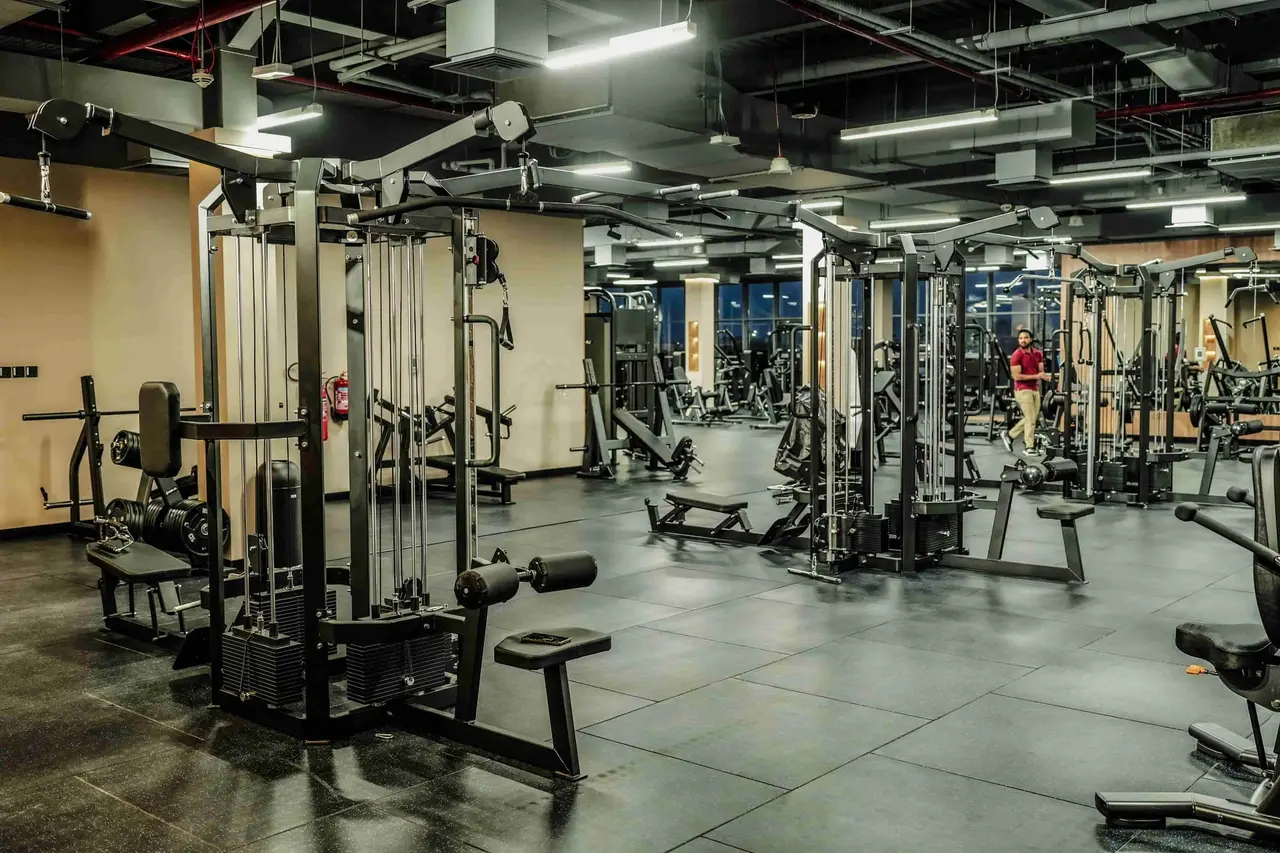
RPM is one club, on Level 4 of AD HUB Sports Complex in Al Manhal. Its floor photos show a plate-loaded pulldown, multi-station cable towers, dumbbells, a rack of fixed-weight barbells, benches and a squat rack with colour bumper plates, which covers every movement in this guide. The women-only Ladies section has its own strength equipment, so ask which stations are there.
- A coach can check your row and hinge technique and set your starting loads. Atelier is the tier built around one-to-one coaching, with prices confirmed on enquiry.
- Ask on a free guided tour how busy the pulldown and cable towers are at the hour you train.
- Back pain, or pain during any of these exercises, is a reason to see a doctor or physiotherapist before you continue.
Sources
- Fenwick CM, Brown SH, McGill SM. Comparison of different rowing exercises: trunk muscle activation and lumbar spine load. Journal of Strength and Conditioning Research, 2009
- Andersen V, Fimland MS, Wiik E, Skoglund A, Saeterbakken AH. Effects of grip width on muscle strength and activation in the lat pull-down. Journal of Strength and Conditioning Research, 2014
- Buonsenso A, Di Fonza D, Di Claudio G, et al. Electromyographic analysis of back muscle activation during lat pulldown exercise: effects of grip variations and forearm orientation. Journal of Functional Morphology and Kinesiology, 2025
- Schoenfeld BJ, Ogborn D, Krieger JW. Dose-response relationship between weekly resistance training volume and increases in muscle mass: a systematic review and meta-analysis. Journal of Sports Sciences, 2017
- American College of Sports Medicine, position stand: Progression models in resistance training for healthy adults (2009)
- World Health Organization, WHO guidelines on physical activity and sedentary behaviour (2020)
Questions, answered.
Do I need pull-ups to train my back?
No. The pulldown trains the same vertical pull and lets you set the load in small steps, so it suits anyone who cannot yet lift their own body weight.
Should rows or pulldowns come first?
Either. Put the one you most want to progress first, while you are fresh, and alternate the order between sessions if you like.
Can back training fix my posture?
It builds strength, but it cannot promise a change in posture. A posture concern that comes with pain belongs with a doctor or physiotherapist.
Are deadlifts necessary for a strong back?
No. A Romanian deadlift with dumbbells is a hinge too, and rows and pulldowns cover the rest. Heavy barbell deadlifts are one option among several.