What a lifter gets from a Pilates class
Lifting trains you to move a load and add to it over months. Pilates trains something else: slow movement through a range, with your attention on where the ribs, pelvis and spine sit while the arms and legs work. A 2012 systematic review of 119 papers found broad agreement on what Pilates is. Its authors described it as a mind-body form of exercise that focuses on strength, core stability, flexibility, muscle control, posture and breathing, done on a mat or on specialised equipment.
Most of that list lines up with parts of training that heavy sets cover only indirectly. Pilates at RPM explains the studio and who can book it. This page covers what the classes bring to a lifting week.
| Pilates element | What the class asks | How a lifter can use it | What it does not do |
|---|---|---|---|
| Breathing | Steady breaths timed to each movement | Noticing your ribcage and trunk while your limbs move | It is a different skill from bracing for a heavy set, which your coach teaches under the bar |
| Trunk control | Keeping the pelvis and spine still, or moving them one segment at a time | Low-load practice of positions you hold in squats, hinges and presses | It never tests your trunk at the loads your lifts reach |
| Range of movement | Slow work at the end of hip, shoulder and spine ranges | Time in deep hip bends and overhead reaches without a bar | It carries no promise of a deeper squat |
| Control on one side | One leg or one arm at a time, slowly | Spotting a side that wobbles more, to mention to your coach | It does not replace loaded split squats or rows |
Neither the review nor this guide says Pilates will raise your lifts. For what trials found on flexibility and strength, read Pilates for mobility and strength.
Where classes go around your heavy days
Your lifting carries the progression, so the heavy days stay fixed and the classes move around them. The American College of Sports Medicine's 2009 position stand suggests three or four lifting days a week for intermediate lifters and four or five for advanced ones. That leaves limited room, so plan each class as a lighter session, never as an extra hard day.
- Good fit: the day after an upper-body session, or a rest day when you feel fresh.
- Usually fine: later on a day you lifted lightly, with a class that spares the muscles you trained.
- Think twice: the day before heavy squats or deadlifts, if the class is built on leg springs and bridging.
- Swap or skip: the day of a lift test, and any day when soreness from your last leg session is still building.
Full week layouts from three to six days are in scheduling reformer classes around strength days. The rule here is shorter: protect the sessions that move your numbers.
The springs are not your next barbell
Lifters tend to judge a session by the load, and on the reformer that habit misleads. Springs can resist a movement or support it, and on some exercises a lighter spring makes the work harder, because the carriage moves more freely and you have to control it yourself.
- Write down the spring settings the instructor gives you, but read them as notes, not targets to beat.
- Judge progress by control: slower lowering, a steadier pelvis, and the same quality on your weaker side.
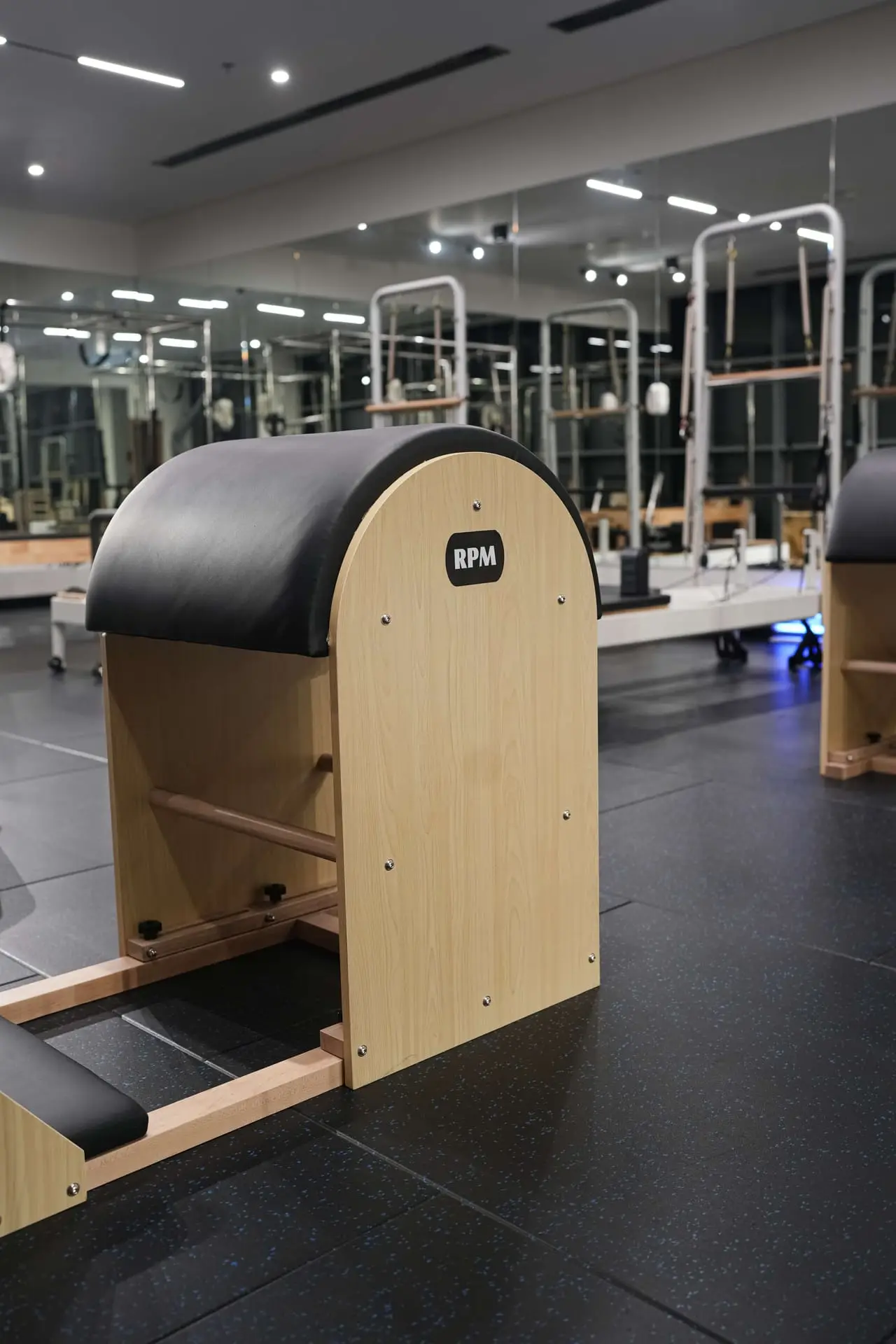
- The studio photos at RPM show reformers, some with towers, plus trapeze-table frames and a ladder barrel. Ask which apparatus a class uses.
Briefing the instructor as a lifter
A lifter starts from a different place from a beginner, and a short brief at your first class saves weeks of guessing.
- Your lifting days, so the instructor knows what your legs and back did yesterday.
- Positions that feel restricted in your lifts, such as squat depth or arms overhead. The class can work through those ranges, though nobody can promise they change.
- Whether you want the class to feel like recovery or like training.
- Whether you would rather not have hands-on corrections. Verbal cues work too.
- Any pain, injury, pregnancy or medical condition. Those go to a doctor or physiotherapist first, and the instructor should hear what they advised.
What Pilates will not replace
- Progressive loading. The ACSM position stand advises adding 2 to 10 per cent to a load once you can complete one or two repetitions more than your target. A class does not do that for you.
- Your lifting warm-up. Lighter ramp-up sets rehearse the first lift itself, which yesterday's class cannot. See how to warm up before a gym session.
- Aerobic work. WHO's 2020 guidelines advise adults to do 150 to 300 minutes of moderate aerobic activity a week, or 75 to 150 minutes of vigorous activity, or a mix. An easy class will not cover that.
- Medical care. A pain that keeps returning needs a doctor or physiotherapist, not more classes.
WHO also advises muscle-strengthening activity for all the major muscle groups on two or more days a week. Your lifting already covers that, so the classes add to a complete week rather than patching a gap.
Worked example: four lifting days and one class
Take a woman who has lifted for two years on an upper and lower split: lower body on Saturday and Tuesday, upper body on Sunday and Wednesday. She wants more time on trunk control and overhead positions, and has one open slot on Thursday after work.
Thursday sits two days from each lower session, so a full-body reformer class fits there. She asks the instructor for hip and overhead work at an easy effort, and logs each class in her lifting notebook with a line on how the next Saturday felt. After six weeks her Saturday numbers are still climbing, so the class stays. Had Saturday felt flat week after week, she would have moved the class to Monday and checked again.
Lifting and Pilates in RPM's Ladies section
RPM is one club, on Level 4 of AD HUB Sports Complex in Al Manhal. Its women-only Ladies section holds the Pilates studio, where reformer classes run, and has its own strength and cardio equipment, so a woman can lift and take a class without leaving the section.
- On the roster, Giana Suleiman Daqnoush is the Pilates and aerobic coach and Coach Maria holds the strength and conditioning role in the section.
- Ask whether your tier covers the Ladies section, and whether Pilates sessions are included or sold separately. Floor, Engine and Atelier inclusions and prices are confirmed on enquiry.
- Men train in the Mixed section and cannot use the studio.
A free guided tour for women shows the studio and the strength equipment in one visit.
Sources
- Wells C, Kolt GS, Bialocerkowski A. Defining Pilates exercise: a systematic review. Complementary Therapies in Medicine, 2012
- American College of Sports Medicine, position stand: Progression models in resistance training for healthy adults (2009)
- World Health Organization, WHO guidelines on physical activity and sedentary behaviour (2020)
Questions, answered.
Will Pilates make my lifts go up?
None of the sources behind this guide shows that. Pilates trains control and range at low loads, while lifts climb through progressive loading. Judge the classes by how your lifting days feel and what your log says.
Should I keep Pilates during a heavy block?
Yes, at an easy effort. Many lifters choose stretch-led or upper-body classes in their hardest weeks and drop the class nearest a lift test.
Is Pilates enough core training for a lifter?
It is one option. Heavy squats, hinges and carries also work your trunk under load, so many lifters keep both and let Pilates cover the slower, more controlled work.
I lift in the Mixed section. Can I use the studio?
Women can, if their tier covers the Ladies section. Ask the team to confirm which sections your membership includes before you book classes.