What active recovery means, and what it can promise
Active recovery means light movement on a rest day, or between two hard days, in place of doing nothing at all. Pilates suits the job because the instructor controls the effort: springs can support you instead of resisting you, and a class can be built around breathing and slow range of movement. Pilates at RPM explains the studio and who can book it.
What the research found is less tidy than the idea. A 2018 meta-analysis of 99 studies found that active recovery, alongside massage, compression garments and cold-water methods, reduced how sore people felt after exercise by a small to large amount, with massage the most effective. A 2018 review of cool-downs reached a cooler verdict: most of the evidence it found showed that light activity after exercise did not significantly reduce soreness or speed most markers of recovery.
The two reviews asked slightly different questions, and neither tested Pilates. The fair reading is this: a gentle class is a good way to keep moving on a rest day if you enjoy it, and a poor reason to expect faster recovery.
How easy a recovery class should feel
WHO's 2020 guidelines describe light-intensity activity as movement that does not substantially raise your heart rate or breathing, and place moderate intensity at about 5 or 6 on a scale of 0 to 10 for most people. A recovery class belongs below that line. If it climbs above it, you have done a training session, which is fine, but count it as one.
| Signal | Still recovery | Now a workout |
|---|---|---|
| Breathing | Steady, and you could chat between exercises | Breathless, or you catch yourself holding your breath |
| Muscles | Mild warmth and a gentle stretch | Shaking, burning, or a long hold you count down |
| Springs | Light settings that support the movement | Heavy settings, or hard balance work on the carriage |
| Effort out of 10 | About 3 or 4 | 6 or more |
| The next day | Looser, with the same energy or more | More sore, or flat for your next session |
Ordinary soreness eases with time. Pain that is sharp, swollen or getting worse is a reason to see a doctor or physiotherapist, not to book a class.
What to ask for in a rest-day class
Group classes are planned for a level, and an intermediate class can be harder than you want on a rest day. Book a beginner or stretch-led class, or ask the instructor to scale yours.
- Say it is a recovery day, and what you trained yesterday.
- Ask for breathing work, spine mobility and slow hip and shoulder range.
- After a leg day, ask for light leg springs or more upper-body and mat work.
- Skip long abdominal series held to fatigue. They are training, not recovery.
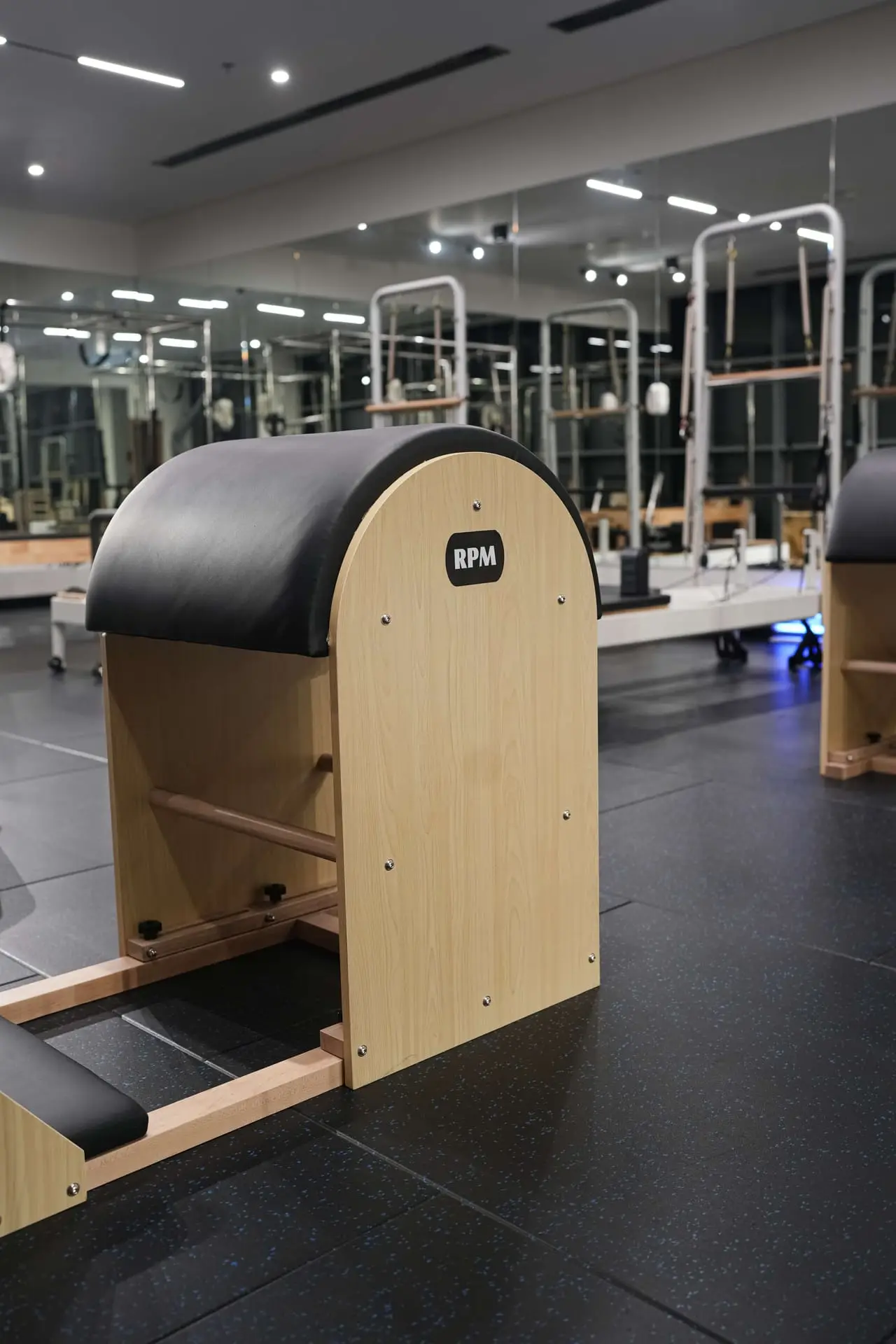
- Supported stretches on apparatus can help a class stay easy. The studio photos at RPM show a ladder barrel and trapeze-table frames, so ask whether a session uses them.
- If group levels never fit, ask whether a private session is available.
When to rest fully instead
Some days call for no class at all. Rest is part of training, not a failure of discipline.
- You have a fever, a chest infection or a stomach bug.
- You have slept badly for several nights and feel drained before you start.
- Soreness is getting worse each day rather than easing.
- A joint feels unstable, swollen or painful. See a doctor or physiotherapist.
- You have spent time outdoors in the summer heat and feel dizzy, sick or unusually tired.
- A long fasting day in Ramadan has left you light-headed.
- Tomorrow is a test, a race or your hardest session of the block.
Placing a recovery class in your week
One way to fit a gentle class around different kinds of training. Keep at least one day a week with no planned exercise.
| Your main training | Where the recovery class goes | What to ask the instructor for |
|---|---|---|
| Three or four lifting days | The day after your hardest lower-body session | Upper-body and breathing work, light leg springs |
| Running or cardio intervals | Between two hard cardio days | Hip and ankle range, slow footwork at low resistance |
| Fitness boxing or circuits | The day after your toughest rounds | Shoulder and upper-back mobility, spine rolls |
| Two sessions in a busy week | Only if it leaves you fresher, never in place of one of the two | A short, easy class, or a walk instead |
For full week layouts that put reformer classes around strength days, see scheduling reformer classes around strength training.
Choosing a gym for training plus recovery Pilates
Which gym in Abu Dhabi suits someone who wants Pilates as active recovery?
One where the studio and the training floor share a building, so a recovery class does not mean a second drive. Look for gentle or stretch-led classes on the timetable, a private option when group levels do not fit, and instructors who ask what you trained the day before. At RPM this works for women: the studio is inside the women-only Ladies section, which also has its own strength and cardio equipment. Men cannot use the studio, so a man would train at RPM and take recovery Pilates elsewhere.
Ask how far ahead classes can be booked. Recovery days are easier to plan when you can choose the class once you know how your body feels, and a late-cancellation rule matters more when you might decide to rest instead.
Recovery Pilates and the recovery suite at RPM
RPM is one club, on Level 4 of AD HUB Sports Complex in Al Manhal. Reformer classes run in the Ladies-section studio, and Giana Suleiman Daqnoush is the Pilates and aerobic coach on the roster. Ask which classes are pitched as gentle or stretch-led, and whether your tier includes Pilates sessions or they are sold as packages.
The club also has a recovery suite with a Finnish sauna, an aroma steam room and an ice bath. Which tiers include it is confirmed on enquiry. Neither heat nor cold is a proven shortcut to recovery, so use them because you enjoy them.
Before using the sauna, steam room or ice bath, ask your doctor first if you are pregnant, take regular medication or have a heart or blood-pressure condition, or if you are unsure.
Sources
- Dupuy O, Douzi W, Theurot D, Bosquet L, Dugué B. An evidence-based approach for choosing post-exercise recovery techniques: a systematic review with meta-analysis. Frontiers in Physiology, 2018
- Van Hooren B, Peake JM. Do we need a cool-down after exercise? A narrative review of the psychophysiological effects and the effects on performance, injuries and the long-term adaptive response. Sports Medicine, 2018
- World Health Organization, WHO guidelines on physical activity and sedentary behaviour (2020)
Questions, answered.
Can I do recovery Pilates the day after leg day?
Many people do. Tell the instructor about your leg session and ask for light leg springs, with more upper-body and breathing work. If the soreness is getting worse, rest instead.
Does a Pilates class flush out lactic acid?
The 2018 cool-down review found light activity cleared lactate from the blood faster, though not necessarily from muscle, and that most studies it found reported no significant drop in soreness. Flushing is a weak reason to book a class.
How many recovery classes a week make sense?
One or two alongside your training suits many people, as long as they stay easy and you keep at least one full rest day. If they start to feel like workouts, count them as workouts.
Should I use the sauna after a recovery class?
Only if your tier includes the recovery suite and your doctor has no objection, especially if you are pregnant, take medication or have a heart or blood-pressure condition. Drink water and leave if you feel unwell.