The evidence in one table
Two recent reviews answer the question most directly. One pooled trials of Pilates programmes in adult women. The other compared Pilates with other forms of exercise. Read them together and a fairly clear picture appears, with honest gaps.
| Question | What the review found | How firm |
|---|---|---|
| Does Pilates improve flexibility? | The 2026 review in adult women found a significant improvement in sit-and-reach flexibility | Its authors urge caution, because designs, programmes and study quality varied |
| Does it improve strength? | The same review found no significant pooled change in handgrip strength or vertical jump, though its narrative summary pointed to gains in strength and endurance | Uncertain: the pooled tests and the narrative point in different directions |
| Does it change lean mass? | No significant pooled effect on lean body mass | The same caveats apply |
| Is it better than other exercise? | The 2022 review of 11 randomised trials found no difference for strength, balance or flexibility | Very low to low certainty |
None of this says Pilates is a poor choice. It says Pilates trains these qualities about as well as other exercise does, with flexibility the clearest gain. For RPM's studio, who can book it and which formats to ask about, see Pilates at RPM.
What "mobility" and "flexibility" mean in these studies
WHO's 2020 guidelines define flexibility as the range of motion possible at a joint, and note that it is specific to each joint. That matters when you read a review. The flexibility result above comes from the sit-and-reach, a common test in which you sit with legs straight and reach towards your feet. It mostly reflects the back of the thighs and the lower back.
- A better sit-and-reach score tells you little about your shoulders or ankles.
- Mobility, as coaches use the word, adds control: moving yourself through a range, not only being pushed into it. Pilates works on that, but the reviews here measured flexibility.
- A 2012 systematic review of 119 papers described Pilates as focusing on strength, core stability, flexibility, muscle control, posture and breathing. Most of those were not what the trials measured.
Strength: what the trials could and could not show
Grip strength and jump height are easy to measure, which is why studies use them. Neither is what a Pilates class mainly trains, so a lack of change in those tests does not mean nothing changed. The 2026 review's narrative summary reported positive effects on muscular strength and endurance in individual studies, and the 2022 review found Pilates level with other exercise in every type of strength it measured.
WHO describes muscle-strengthening activity as exercise that increases muscle strength, power, endurance and mass. A class with demanding spring work can load your muscles hard. A gentle one may not, so ask the instructor how much of a class is pitched at real effort.
Can Pilates make you stronger?
Yes, to a degree, and in trials it did about as well as other exercise. The pooled tests in the 2026 review did not show it, though, so stay modest: Pilates can build strength, but the evidence does not show it building more than weight training.
Limits worth knowing before you rely on these results
- Few studies. Twelve in the 2026 review and eleven in the 2022 review, with about 540 women in the first.
- Mixed quality. The 2022 review rated its trials at a mean of 6 out of 10 on the PEDro quality scale, and graded the certainty very low to low.
- Varied programmes. The 2026 authors flag differences in study design, protocols and quality, so "Pilates" did not mean one fixed programme.
- One population. The 2026 review looked only at adult women, which suits RPM's women-only studio but limits how far the results travel.
- Tests, not daily life. A sit-and-reach score is not the same as reaching a high shelf in comfort.
What Pilates does not replace
Match the tool to the goal. Where Pilates falls short, the right column says what to add.
| Goal | What Pilates offers | What to add |
|---|---|---|
| Strength you can measure and keep adding to | Resistance from springs and body weight, harder in limited steps | Weights, increased in small steps: ACSM advises 2 to 10 per cent once you beat your target by one or two repetitions |
| More muscle size | No pooled change in lean mass in the 2026 review | ACSM recommends higher-volume, multiple-set resistance programmes for this goal |
| Range at the hips and lower back | The clearest positive finding | For many people, regular classes are enough |
| Heart and lung fitness | Usually a moderate or easy effort | WHO's 150 to 300 weekly minutes of moderate aerobic activity, or 75 to 150 of vigorous |
| A stiff or painful joint that limits daily life | Not a substitute for an assessment | A doctor or physiotherapist first |
Checking whether it works for you
Reviews describe averages. Your own record tells you more, so track a few measures that match what you want and check them every four weeks rather than every class.
- One reach test, done the same way each time, on the same day of the week.
- A balance hold on each leg, noting the steadier side.
- For strength, a written log of loads and repetitions on the gym floor, which shows progress more clearly than spring settings.
- A note of what feels easier in daily life, such as getting up from the floor or carrying shopping.
No review gives a timeline you can count on, and people differ. If a lifter wants to know where Pilates fits around heavy days, Pilates for women who lift covers it.
Pilates and strength work at RPM
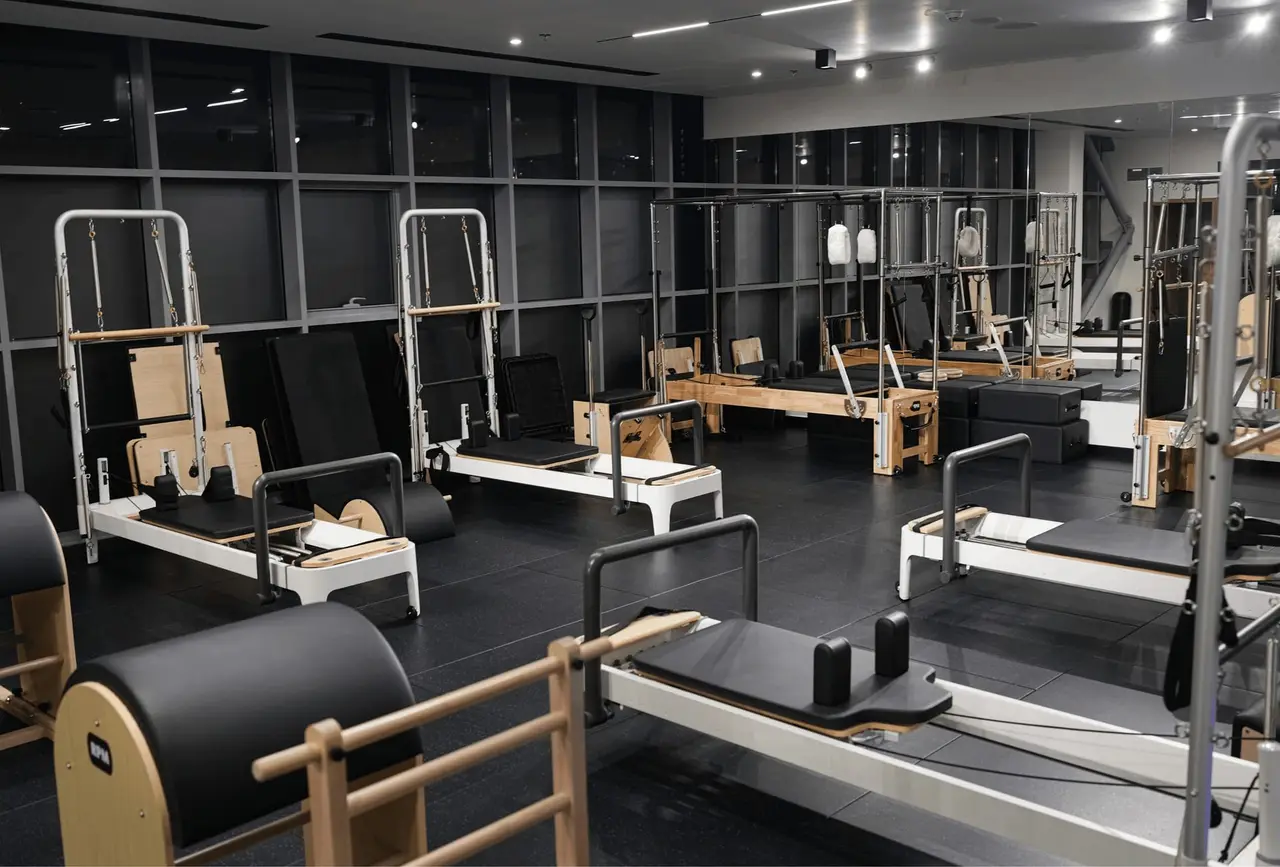
RPM's Pilates studio is inside the women-only Ladies section, on Level 4 of AD HUB Sports Complex in Al Manhal. Reformer classes run there, and the studio photos show reformers, some with towers, plus trapeze-table frames and a ladder barrel, so ask which apparatus a class uses. The section also has its own strength and cardio equipment for the weights side of the table above.
- Giana Suleiman Daqnoush is the Pilates and aerobic coach on the roster, and Coach Maria holds the strength and conditioning role in the Ladies section.
- Ask whether Pilates sessions come with your tier or as packages. Inclusions and prices are confirmed on enquiry.
- Men train in the Mixed section and cannot use the studio.
Sources
- Bajčetić Č, Rudović V, Novaković M, et al. Effects of Pilates programs on body composition, flexibility, muscular strength and other fitness components in adult women: a systematic review and meta-analysis. Sports (Basel), 2026
- Pinto JR, Santos CS, Souza Soares WJ, et al. Is Pilates better than other exercises at increasing muscle strength? A systematic review. Heliyon, 2022
- Wells C, Kolt GS, Bialocerkowski A. Defining Pilates exercise: a systematic review. Complementary Therapies in Medicine, 2012
- American College of Sports Medicine, position stand: Progression models in resistance training for healthy adults (2009)
- World Health Organization, WHO guidelines on physical activity and sedentary behaviour (2020)
Questions, answered.
Is reformer Pilates better than mat Pilates for strength?
The review summaries cited here do not separate results by apparatus, so they cannot settle it. Springs let an instructor add resistance in steps, which many women find useful. Ask which format suits your goal.
How soon will I notice more flexibility?
The reviews give no timeline you can rely on, and people respond differently. Test one measure every four weeks and judge from that.
Will Pilates build muscle?
The 2026 review found no pooled change in lean body mass. If muscle size is a goal, ACSM describes multiple-set resistance training at higher volumes for it.
I am over 65. Does Pilates help with balance?
WHO advises older adults to do varied activity that emphasises functional balance and strength training on three or more days a week. Ask your doctor first, then ask the instructor whether your classes fit that advice.