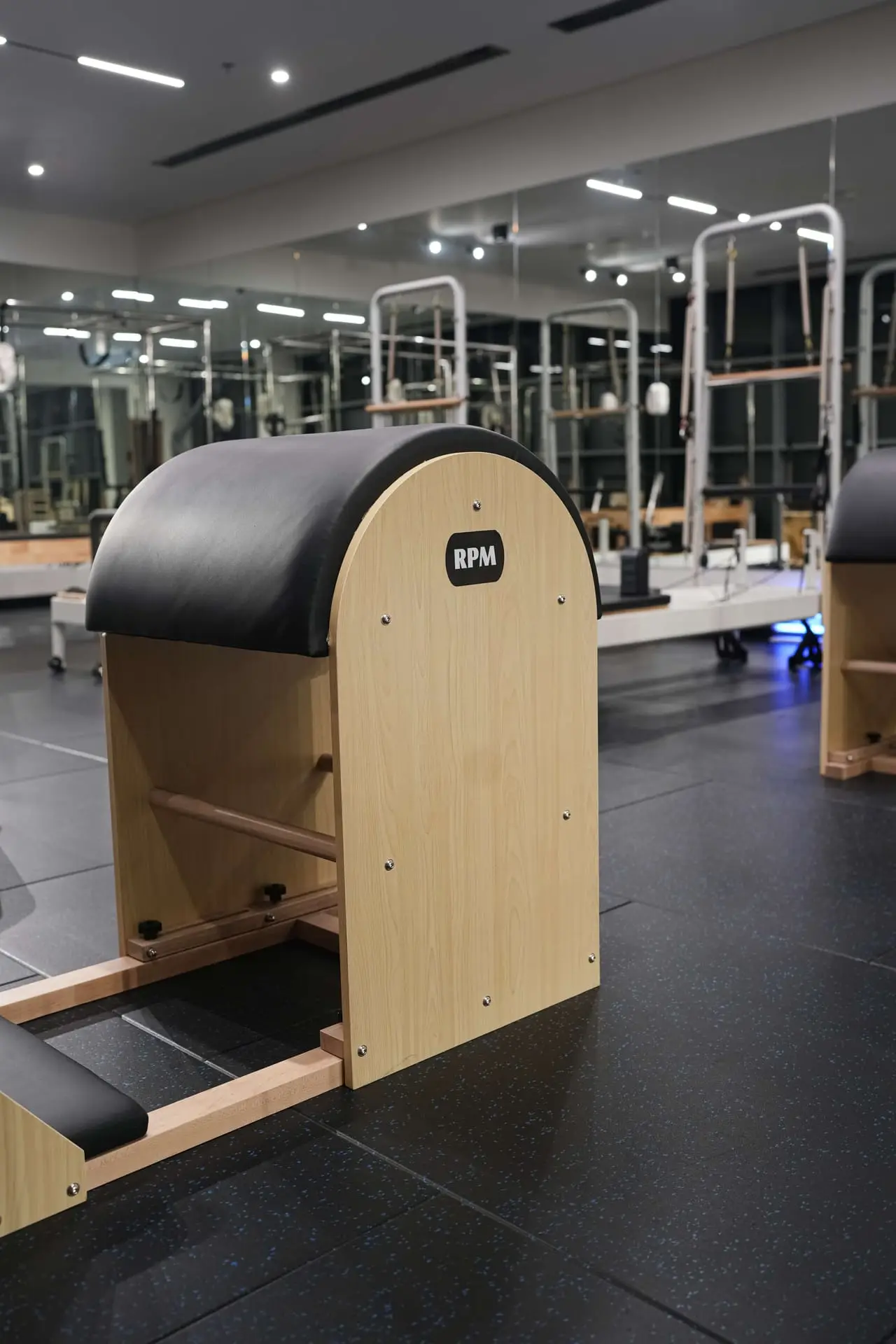
Two ways of training the same body
Pilates works through slow, controlled movement and breathing, with resistance from your own body on the mat or from springs on apparatus such as the reformer. Strength training moves an external load, such as dumbbells, cables or machines, and adds to it in small steps over weeks.
Plenty of people do only Pilates for years and are happy with it. The question is whether a Pilates-only week leaves out something you want. For RPM's studio and who can book it, see Pilates at RPM. If you already lift and are weighing up the reformer, read whether reformer Pilates is worth adding to gym training instead.
What each plan trains
| Pilates only | Pilates plus strength | |
|---|---|---|
| Where resistance comes from | Body weight, small props and apparatus springs | All of that, plus dumbbells, barbells, cables and machines |
| How it gets harder | Harder exercises, different springs, slower control | The same, plus weight added in small, recorded steps |
| Strength | Depends on how hard each class works you | Trained directly, with a number to beat each week |
| Mobility and control | A large part of most classes | Kept, as long as Pilates stays in the week |
| Alignment | A constant focus for the instructor | Also coached in lifts, through set-up and technique |
| Tracking progress | Exercises you can now control | A log of loads and repetitions |
| Time each week | Two or three classes | Usually one or two extra sessions |
A general comparison. If you are dealing with pain or a posture concern, see a doctor or physiotherapist rather than relying on any class.
What WHO advises, and where Pilates sits
WHO's 2020 guidelines advise adults to do muscle-strengthening activities at moderate or greater intensity that involve all the major muscle groups on two or more days a week. That sits alongside at least 150 to 300 minutes of moderate aerobic activity a week, or at least 75 to 150 minutes of vigorous activity, or an equivalent mix of the two. For adults aged 65 and over, WHO also advises varied activity that emphasises balance and strength training on three or more days a week.
WHO describes muscle-strengthening activity as exercise that increases muscle strength, power, endurance and mass, and gives strength and resistance training as examples. Its recommendations do not mention Pilates. Whether your classes count depends on how hard they work your muscles and whether the week covers all the major muscle groups, so ask your instructor. Two strength sessions are the simplest way to be sure.
A sample week for each plan
Here is one way each plan could look for someone who trains three or four days a week, built around the Saturday–Sunday weekend.
| Day | Pilates only | Pilates plus strength |
|---|---|---|
| Saturday | Pilates class | Pilates class |
| Sunday | Rest or a walk | Strength: full body, mostly machines and dumbbells |
| Monday | Pilates class | Rest or a walk |
| Tuesday | Rest or a walk | Pilates class |
| Wednesday | Pilates class | Rest or a walk |
| Thursday | Rest or a walk | Strength: full body, the same exercises as Sunday |
| Friday | Rest | Rest |
An example, not a prescription. If you are pregnant, postnatal, injured or managing a medical condition, get clearance from your doctor, midwife or physiotherapist before adding anything, and tell both your instructor and your coach.
Neither plan is built around aerobic work, so the walks, or other cardio, carry that part of WHO's advice. From May to September that usually means a treadmill, a mall walk or the cooler hours.
Starting strength work from a Pilates background
Years of Pilates give you a head start: you already know how to breathe and move with control. What is new is the external load, the rests between sets and the habit of writing numbers down.
- Start with machines and dumbbells, which are easier to set up, and leave heavier barbell lifts until a coach has checked your technique.
- Cover the main patterns: a squat or leg press, a hip hinge, a push, a pull and a carry.
- Choose a weight you could lift a few more times at the end of each set, and add a little only when every set feels steady.
- At first, keep strength days apart from your hardest Pilates classes.
- Book a few sessions with a coach to learn the lifts, then follow a plan alone.
If something hurts rather than feels worked, stop that exercise and have it checked by a doctor or physiotherapist before you carry on.
When Pilates on its own is the right call
- You have time for two sessions a week and would rather both were Pilates. A routine you keep is worth more than a plan you drop.
- You are returning after a long break and want to rebuild the habit first.
- Pilates is your break from a stressful week, and a weights floor would make it feel like work.
- Your instructor runs demanding, spring-heavy classes and you are happy with your progress.
None of these has to be permanent. Many people add a strength session after a few months, once their Pilates week has settled.
Worked example: three mornings after the school run
Take a reader who has done three Pilates classes a week for two years. With two young children, she wants more strength for lifting car seats and shopping, and she can train on three mornings after the school run. She does not want to lose Pilates.
| Option | Her week | What she gives up |
|---|---|---|
| Pilates only | Three Pilates classes | Measured strength work |
| Swap one class | Two Pilates classes and one strength session | One Pilates class |
| Swap and stack | Two Pilates classes, a short strength session after one of them, and one full strength session | One Pilates class, plus some extra time on one morning |
She picks the third option, because it gives her two strength sessions a week without a fourth morning. After two coached sessions to learn the lifts, she follows the plan alone, and after eight weeks she reviews her log and decides whether to keep the split.
Both under one roof at RPM, for women
At RPM, the Pilates studio sits inside the women-only Ladies section, which has its own strength and cardio equipment, so a woman can take a reformer class and lift in the same visit. Female coaches on the roster work there: Coach Maria is listed for strength and conditioning, and Giana Suleiman Daqnoush for Pilates and aerobic. Women whose tier covers the Mixed section can also use its training floor, described on strength training at RPM.
Men train in the Mixed section and cannot use the studio, so a man adding strength to Pilates would lift at RPM and keep his Pilates elsewhere. Of RPM's three tiers, Engine adds coached programming and Atelier is built around one-to-one coaching, with inclusions and prices confirmed on enquiry.
Sources
Questions, answered.
Will lifting weights make me bulky?
Muscle grows slowly, and how much depends on training, food and genetics. Two strength sessions alongside Pilates is a long way from a plan aimed at size, and you can adjust the plan at any point.
Can I get stronger with Pilates alone?
Yes, to a point, especially on apparatus with heavier springs. What Pilates makes harder is adding load in small, measured steps over months, which is where weights come in.
I am over 65. Does anything change?
WHO adds a recommendation for older adults: varied activity that emphasises balance and strength training on three or more days a week. Speak to your doctor before starting, and tell your instructor and coach about any condition you manage.
Do I need a personal trainer to start lifting?
Not for long, but a few sessions to learn the lifts and set starting weights are worth it. A female personal trainer is one option in RPM's Ladies section.