Judge your restart point before the first session
The usual mistake is choosing weights from memory, as if the break never happened. A better starting point comes from three facts: how long you were away, how active you stayed, and how long you had trained before the break. The American College of Sports Medicine's 2009 position stand groups anyone who has gone several years without resistance training with complete novices, and recommends novices train two or three days a week with loads they can lift 8 to 12 times.
| Your break | Restart as | First fortnight |
|---|---|---|
| Several weeks, and you stayed active | Your own programme, lighter | Fewer sets than before, and stop each set with three or four reps in hand |
| Several months, mostly inactive | A simplified version of your old plan | Two full-body sessions a week, mostly machines and dumbbells |
| Several years, or you only trained briefly before | A beginner, whatever you once lifted | A novice routine with loads you could lift well over 12 times |
These are starting points for a healthy adult, not a prescription. If you are unsure which row fits you, start in the row below.
A coach can find the right row faster than guesswork by watching a few warm-up sets. Personal training at RPM covers both the Mixed section and the women-only Ladies section, where female coaches on the roster work.
What a long break does, according to the research
A 2013 meta-analysis by Bosquet and colleagues pooled 103 studies of people who stopped resistance training. Stopping reduced every kind of muscular performance measured, from strength to power, and the longer the break, the larger the loss. The drop was bigger in people over 65 and, for maximal strength and power, in previously inactive people than in recreational athletes.
- What it means for you: a longer break, an older age and a less active break all point to a lower restart point.
- What it cannot tell you: how much you personally have lost, or how quickly it comes back. Those vary from person to person, which is why the plan below moves on how you respond rather than on dates.
- The World Health Organization's 2020 guidelines point the same way for every adult: begin with small amounts, then build up how often, how hard and how long you are active, a little at a time.
The first session back
Keep it short and finish feeling you could have done more. The aim is to learn how your body answers, not to test it.
| Part | What to do |
|---|---|
| Warm-up | Easy pedalling or a cross-trainer until you feel warm, then a practice set of the first exercise with a light load |
| Main work | Five or six exercises covering legs, a push, a pull and the trunk, on machines or with dumbbells |
| Sets and effort | Two sets of each, stopping with four or more reps still in reserve |
| Finish | Several minutes of easy movement, then write down every load and seat setting |
| Next two days | Note how stiff you feel and when it eases. That decides session two |
Leave maximal lifts, long conditioning finishers and new exercises for later. How to warm up before a gym session covers the opening minutes in more detail.
Rebuild one variable at a time
Think of three dials: how often you train, how much you do in a session, and how heavy it is. Turning all three at once is how restarts end in a sore, tired week and a long gap. Turn one, hold it until it feels routine, then turn the next.
| Dial | Starting setting | Turn it up when |
|---|---|---|
| Frequency | Two sessions a week | You have kept two a week without missing one, and recover between them |
| Volume | Two sets per exercise | Stiffness after a session has faded by the next one, so add a third set |
| Load | Four or more reps in reserve | Every set feels controlled at the top of the rep range, then add a small step |
If a turn of the dial leaves you flat for days, go back one setting for another week. Slower is still progress.
Writing each session down is what makes the dials visible. How to keep a gym training log shows what to record and how to read it.
Soreness, fatigue and when to stop
- Muscle stiffness for a day or two after the first sessions is common and usually eases as you keep training.
- Stiffness that has not faded by your next session is a reason to repeat the same session, not to add to it.
- A short illness during the restart is a reason to drop back a setting and build up again.
- Chest pain, dizziness, breathlessness out of proportion to the effort, or pain that is sharp or building: stop there and seek medical advice.
Work and sleep count as well. After a heavy fortnight at the office, or in the weeks when Ramadan changes your sleep, keep the same dial settings rather than turning one up.
Cardio and classes on the way back
- Bring cardio back the same way: short, easy sessions on a bike, cross-trainer or treadmill before longer or harder ones.
- In a class, let the coach know before it begins that you are coming back from a break, and take the lighter option on every station for the first few weeks.
- Save high-intensity formats, such as HYROX-style circuits or long boxing rounds, until weights and steady cardio feel routine again.
- In summer, move outdoor running indoors while you rebuild, so heat is not one more strain on top of the restart.
Restarting at RPM
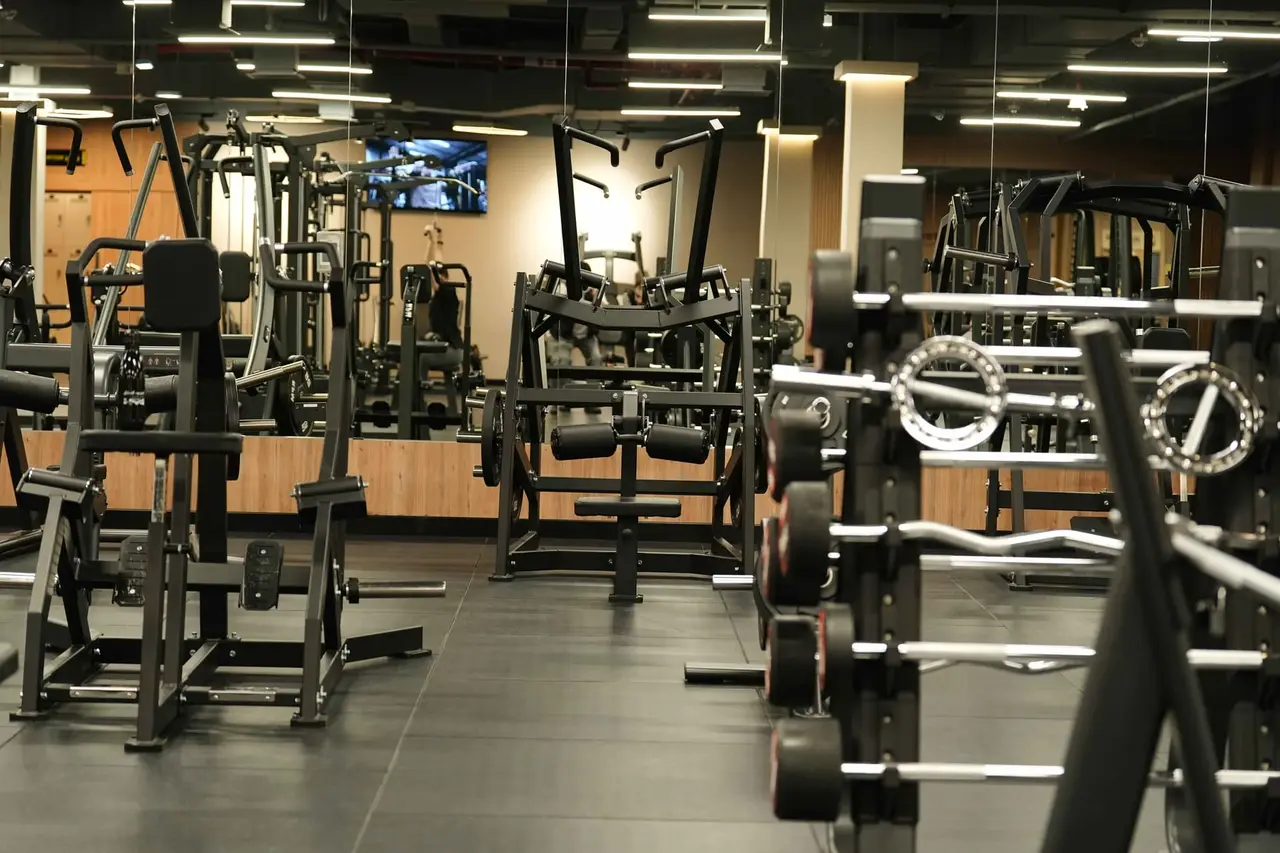
RPM is one club, on Level 4 of AD HUB Sports Complex in Al Manhal. The training floor photos show plate-loaded machines and cable towers next to dumbbells and a squat rack, so the early weeks on machines and the later return to dumbbells and barbells can happen on one floor. The Ladies section is for women only and has its own strength and cardio equipment.
Choosing where to restart is a separate question, covered in returning to the gym after a long break. If you want a coach to lead the return from the first session, personal training for people returning to the gym explains the assessment a coach starts with.
Sources
- Bosquet L, Berryman N, Dupuy O, et al. Effect of training cessation on muscular performance: a meta-analysis. Scandinavian Journal of Medicine and Science in Sports, 2013
- World Health Organization, WHO guidelines on physical activity and sedentary behaviour (2020)
- American College of Sports Medicine, position stand: Progression models in resistance training for healthy adults (2009)
Questions, answered.
Will I get back to my old numbers?
Nobody can promise that, or say when. The research above shows losses depend on how long you stopped, your age and how active you stayed, so judge progress against your own log rather than your old records.
Can I just run my old programme with lighter weights?
Often, yes, if you also cut the sets. A simpler version of a plan you know is easier to restart than a new one, and the familiar exercises make it easier to judge effort.
Should I restart with classes or on my own?
Either works. A class gives you a fixed time and someone expecting you. Training alone lets you control the dials more closely. Many returners do one of each per week.
How long does a restart take?
Plan in weeks, not days. When you are training as often as you want, with normal working sets and recovering well between sessions, the restart has done its job.