What WHO's advice asks of your week
The World Health Organization's 2020 guidelines are the most useful starting point for training for health, because they describe what to do rather than what to buy. For adults aged 18 to 64 they come down to four points.
- Muscle-strengthening activity at moderate or greater intensity that works all the major muscle groups, on two or more days a week. WHO names the legs, back, abdomen, chest, shoulders and arms.
- Between 150 and 300 minutes of moderate aerobic activity a week, or 75 to 150 minutes of vigorous activity, or a mix of the two.
- Less time sitting. Replacing sedentary time with activity of any intensity, light activity included, brings health benefits.
- Starting small, then raising the frequency, intensity and duration of activity gradually.
Adults over 65 get one addition: varied activity that emphasises balance and strength on three or more days a week. To see the floor this routine would run on, read strength training at RPM.
The routine on a calendar
Pick the column that fits your diary. Both keep strength days apart, with cardio or walking between them.
| Day | Two-day routine | Three-day routine |
|---|---|---|
| Saturday | Strength, full body | Strength, full body |
| Sunday | A long walk or an easy ride | Rest or a walk |
| Monday | Cardio, 30 to 40 minutes | Strength, full body |
| Tuesday | Strength, full body | Cardio, 30 to 40 minutes |
| Wednesday | Rest or a walk | Rest or a walk |
| Thursday | Cardio, 30 to 40 minutes | Strength, full body |
| Friday | Rest, or a walk after Friday prayers | Cardio or rest |
Brisk walking counts towards WHO's moderate minutes. From May to September, move walks indoors to a treadmill or a mall loop. The cardio machines are covered on RPM's cardio page.
One session, start to finish
- Five to eight minutes on a bike or cross-trainer, then one light set of the first exercise.
- A lower-body push, such as the leg press or a goblet squat.
- An upper-body pull, such as a seated cable row or a pulldown.
- A hip hinge, such as a kettlebell deadlift or a back extension.
- An upper-body push, such as a chest press machine or a dumbbell bench press.
- A balance finisher. WHO's own example is an upper-body exercise such as a biceps curl done standing on one foot. A farmer's carry also works.
- Two easy minutes on the bike, then a note of every load in your phone.
On effort, WHO asks for moderate or greater intensity. For a set, a practical reading is that the last two or three reps take real effort while your form stays tidy. If you could carry on for many more reps, the load is too light. If your form breaks, it is too heavy.
Twelve weeks, one change at a time
WHO's advice to raise frequency, intensity and duration gradually turns neatly into a 12-week plan. Change one of the three at a time, and hold each change for a few weeks before making the next.
| Weeks | What changes | What it looks like |
|---|---|---|
| 1 to 4 | Frequency: make sessions regular | Two strength sessions every week without a miss, at loads that feel moderate |
| 5 to 8 | Intensity: make sets harder | A little more weight whenever the top of a rep range feels easy, until the last reps are genuinely hard |
| 9 to 12 | Duration: add work | A third strength session if your diary allows it, or one more exercise per session and extra cardio minutes |
If a week falls apart, repeat it. WHO's good-practice statement applies here: some physical activity is better than none.
Check with a doctor first if this applies
WHO's guidelines are written for the general population. See your doctor before you start if you:
- have a heart condition, high blood pressure or diabetes
- are pregnant, have recently given birth or are recovering from surgery
- have joint pain, an injury or osteoporosis
- take medication that affects your heart rate or balance
Stop the session and get medical advice if you feel chest pain, faintness or unusual breathlessness. A coach can adapt exercises to what your doctor says but cannot give that clearance.
Training for health at RPM
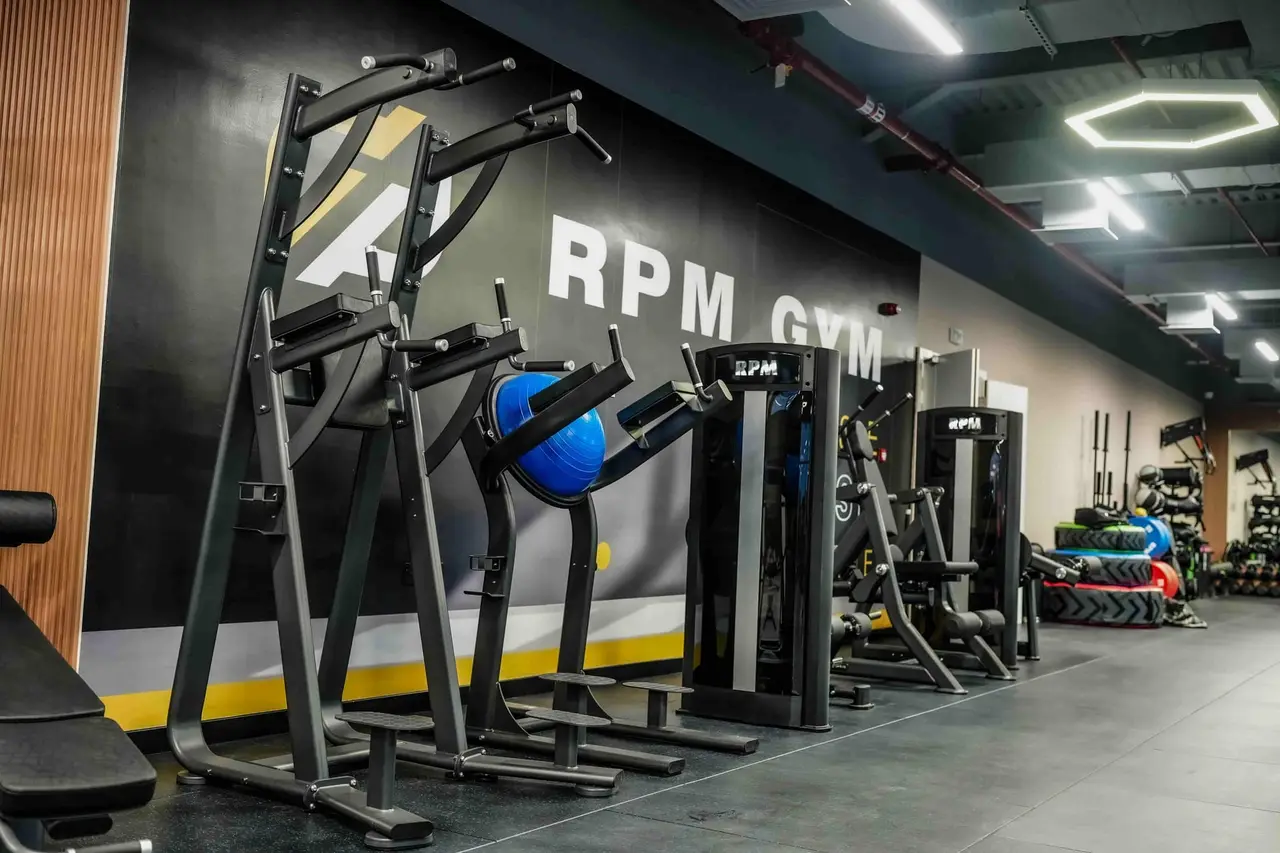
RPM's single club is on Level 4 of AD HUB Sports Complex in Al Manhal, with free on-site parking at AD HUB and a lift up to the floor. Each exercise in the session above has a home there. Floor photos show a leg press, a pulldown, cable stations, benches and dumbbells, while the functional area holds kettlebells and room for carries.
- The Floor tier covers the training floor, for people who will follow this routine alone.
- Engine adds coached programming, if you would rather have the routine written and reviewed for you.
- Roster roles that fit a health goal: Taha Ragab for general fitness and Issam Almasaalmeh for personal training in the Mixed section, and Coach Maria for strength and conditioning in the Ladies section.
- Group classes take place in the Mixed and Ladies sections alike. Ask which current sessions suit a beginner, as the timetable changes.
Early-morning and late-evening opening, with shorter Friday hours, leaves room for a session before or after the office. Current times are below.
| Days | Opening hours |
|---|---|
| Saturday to Thursday | 06:00–23:00 |
| Friday | 09:00–22:00 |
Hours can change, for example during Ramadan. Confirm with the team before a late or early visit.
Sources
Questions, answered.
Is two days a week really enough?
For the strength side, yes: WHO's guideline is two or more days of muscle-strengthening activity. A third day adds room to progress, but two sessions kept every week do more than three that keep slipping.
How is this different from training for a strength number?
A routine for health spreads moderate effort across every major muscle group. Chasing a one-rep max narrows the work to a few lifts. For movement patterns and the equipment that trains each one, see everyday strength.
Can I do this routine at home?
Much of it, with adjustable dumbbells and a sturdy step. A gym makes it easier to raise loads in small steps, and it keeps cardio indoors through the hot months.
I'm over 65. What changes?
WHO adds varied activity that emphasises balance and strength on three or more days a week. Build a balance exercise into each session, and speak to your doctor before you start.