What WHO asks of adults over 50, and over 65
WHO's 2020 guidelines draw the line at 65. From 50 to 64 you come under the adult recommendations. From 65 the older-adult recommendations apply, which keep the same aerobic and strength targets and add balance work. Both groups are told to start with small amounts and build up.
| Recommendation | Adults 18 to 64 | Older adults, 65 and over |
|---|---|---|
| Aerobic activity | 150 to 300 minutes moderate, or 75 to 150 vigorous, each week | The same |
| Muscle strengthening | Two or more days, all major muscle groups, moderate or greater intensity | The same |
| Balance and strength together | No separate target | Varied multicomponent activity emphasising functional balance and strength, on three or more days |
| Sitting | Limit it, and replace some with activity of any intensity | The same |
WHO adds that older adults should be as active as their functional ability allows and match their effort to their fitness. Nothing stops someone in their fifties building the balance habit early. RPM in Al Manhal is one gym to measure against the features below.
Gym features that make those targets practical
| You need | Look for | Why |
|---|---|---|
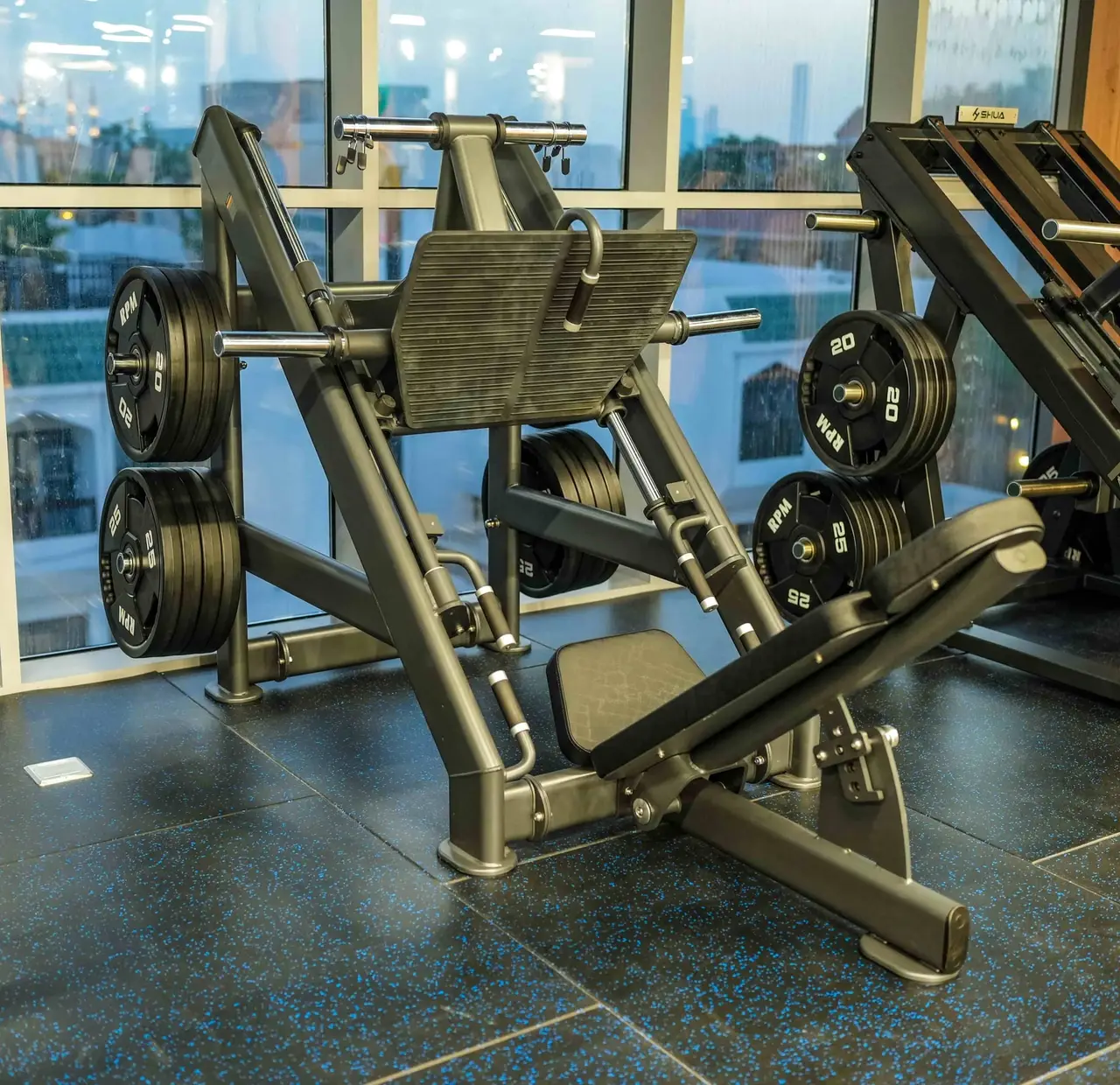
| Strength without complex lifts | Machines with a fixed path, such as a leg press and a pulldown | Big muscle groups loaded along a guided path while you learn |
| Small increases | Dumbbells that rise in small steps | Progress without big jumps in load |
| Balance practice | Open floor, low step boxes and something sturdy to hold | Room to stand on one leg or step without crowding |
| Gentle cardio | Upright bikes, cross-trainers and treadmills | Aerobic minutes without much jarring |
| Coaching at the start | A coach you can book for the first sessions | Someone to set seat heights, loads and a plan |
| An easy arrival | Parking on site and a lift | Fewer reasons to skip a session |
What a multicomponent session can look like
WHO's glossary describes multicomponent activity as a mix of aerobic work, muscle strengthening and balance training, such as walking plus lifting weights plus balance drills. Its examples of balance training include walking backwards or sideways, and standing on one foot during an upper-body exercise such as a biceps curl. Its list of functional exercises includes one-leg stands, chair stands, toe raises and stepping over obstacles.
A 45-minute session built on those ideas, for someone starting out:
| Block | What to do | Effort |
|---|---|---|
| Warm-up, 8 to 10 minutes | Easy pedalling, then marching on the spot and sideways steps | Easy enough to chat |
| Strength, about 20 minutes | Leg press, a pulldown or seated row, a dumbbell press on a bench, and chair stands | Moderate, which WHO describes as about 5 or 6 out of 10 |
| Balance, about 8 minutes | One-leg stands beside a rack, heel-to-toe walking, biceps curls on one foot | Steady, holding on when needed |
| Cardio, about 8 minutes | Cross-trainer or bike | Breathing harder but still able to talk |
Hold a rack or another sturdy support during balance drills until you feel steady. For the opening minutes in more detail, see how to warm up before a gym session.
Start lower than you think
WHO's good practice statements for older adults say to begin with small amounts of activity and build up gradually. The American College of Sports Medicine's 2009 position stand on resistance training gives novices two to three sessions a week at weights they can lift 8 to 12 times. It suggests adding load in small steps only once you can manage one or two more repetitions than planned.
- Begin with two sessions a week, a day or two apart.
- Leave several repetitions in hand on every set for the first few weeks.
- Change one thing at a time: an extra session, an extra set or a little more weight, never all of them at once.
- Note seat settings and loads, so each session starts where the last one ended.
Check with your doctor before you start if you have a heart, lung or joint condition, high blood pressure, diabetes or osteoporosis, take regular medication, or have been inactive for a long time, and stop any session that brings on chest pain, dizziness or unusual breathlessness.
What changes with age, and how to plan for it
- Recovery: many people find hard sessions take longer to bounce back from than they did in their thirties, so space strength days apart.
- Breaks: a 2013 meta-analysis of 103 studies by Bosquet and colleagues found that stopping resistance training reduced strength, with larger losses in people over 65. Keeping some training going through holidays and Ramadan counts for more than any single hard session.
- Balance: WHO asks people over 65 to train it on purpose, through multicomponent activity, rather than take it for granted.
- Heat: from May to September, keep walks and cardio indoors.
Over 50 at RPM
RPM is one club, on Level 4 of AD HUB Sports Complex in Al Manhal, with free on-site parking at AD HUB and a lift up. Men train in the Mixed section, which is open to men and women. The Ladies section is a separate women-only space with its own strength and cardio equipment and the Pilates studio.
The training floor photos show plate-loaded machines such as a leg press and a pulldown, cable towers and dumbbells, along with treadmills, cross-trainers and an upright bike for the cardio side. Coaches work across both sections, with female coaches in the Ladies section, and personal training at RPM describes the coaching on offer.
Floor covers the training floor, Engine adds coached programming and Atelier is built around one-to-one coaching. Prices and inclusions are confirmed on enquiry. Book the free guided tour at the time of day you would train. Women in their forties weighing up the Ladies section can also read what women over 40 should look for.
Sources
- World Health Organization, WHO guidelines on physical activity and sedentary behaviour (2020)
- American College of Sports Medicine, position stand: Progression models in resistance training for healthy adults (2009)
- Bosquet L, Berryman N, Dupuy O, et al. Effect of training cessation on muscular performance: a meta-analysis. Scandinavian Journal of Medicine and Science in Sports, 2013
Questions, answered.
Am I too old to start lifting weights at 60?
WHO's older-adult recommendations include muscle-strengthening work on two or more days a week, with no upper age limit. Start light, learn the movements on machines, and build up gradually.
Should I use machines or free weights?
Machines are an easy start because the path is fixed. Many people add dumbbells once they feel steady, since holding a weight in each hand also asks something of grip and balance.
Can my spouse and I train together?
In the Mixed section, yes, since it is open to men and women. Women can also use the women-only Ladies section. Check which sections each of your tiers covers.
Do I need a coach the whole time?
Usually not. A few sessions at the start to set up machines and a plan, then a check-in whenever you add something new, cover what most people need.