Judge the area by category, not by lift
Most people tour a free-weight area with a glance at the dumbbell rack and the racks. That shows what the gym bought, not whether it fits a plan that has to run for a year. Taking the area apart by category shows the gaps: big jumps between dumbbell pairs, plates only in pounds, one adjustable bench for the whole room, a chalk ban nobody mentioned.
This guide works through the equipment. If you would rather plan around your lifts, the guide to free weights, lift by lift asks where each exercise would happen. RPM's facilities page shows the one club in Al Manhal area by area.
Dumbbells: the range and the steps
The range is the first thing people check. The steps are what stalls them. A rack that runs from very light to very heavy but jumps in large steps through the middle leaves you stuck between two pairs for weeks. Look at your working range first, then at either end.
Think of the rack in three parts. Each serves a different person, and a gap in any of them shows up in someone's programme.
| Part of the rack | Who leans on it | Good sign | Warning sign |
|---|---|---|---|
| Light end | Beginners, warm-up sets, shoulder and arm accessories | Small steps from the lightest pair up, with doubles of the busiest pairs | One pair of each weight, taken whenever a class is on |
| Middle | Most presses, rows and lunges for most people | Steps small enough to add weight every few weeks | Big jumps between pairs, or pairs missing from their slots |
| Heavy end | Strong lifters on heavy rows and presses | Pairs past the heaviest set you expect to reach this year | The heaviest pairs parked in a corner, away from the benches |
Ask for the step size in kilograms rather than guessing. Some racks change step size partway up, which matters if your working weights sit right where it changes.
Check the rack at your training hour too. After office hours on weekdays, and after iftar in Ramadan, the pairs missing from their slots are the ones you would wait for.
Plates and collars
Plates set the smallest step you can take on a barbell and decide how much you can load on your own.
- Units. Plates in kilograms throughout make loading quick. A mix of kilograms and pounds turns every set into arithmetic.
- Change plates. Small plates let you add a little to a press or a squat. If the lightest plate on the floor is a big one, the bar jumps too far each time.
- Bumper plates. Full-size rubber plates keep the bar at the same height off the floor even with a light load, and spare the flooring. Whether you may drop them is covered under the rules below and in the guide to Olympic lifting platforms.
- Iron and urethane plates. Fine for loading machines and racks, as long as each one is clearly labelled and stored on a tree by the station that uses it.
- Collars. A pair for every loaded bar, kept where the bars live. Plates that creep along the sleeve during a set are a nuisance on a squat and worse on a bench press.
Bars beyond the standard barbell
A free-weight area needs more than one kind of bar, because one loaded barbell per rack runs out fast at peak.
- Standard barbells for the racks, with sleeves that turn, plus a lighter bar with a thinner grip for smaller hands and lighter starting loads.
- Fixed-weight barbells on a rack of their own. They take curls, rows and lunges away from the racks and need no loading.
- An EZ curl bar for arm work and lying triceps extensions.
- A trap bar, if your plan uses one for deadlifts or carries. It is a common gap, so ask.
- Somewhere to store bars upright or on wall hooks. Bars left leaning against a mirror get knocked over and bent.
Benches, and the floor around them
Count benches against dumbbells, not against the size of the room. If people stand holding a pair while they wait for an adjustable bench, the area is short of benches.
- Adjustable benches that lock firmly at each angle, with a seat that tilts so you do not slide down on an incline.
- Flat benches for rows, step-ups and hip thrusts, light enough to move or fitted with wheels and a handle.
- Rubber flooring across the whole dumbbell area, not only under the rack, so a pair set down at the end of a set lands on something forgiving.
- A clear strip of floor for walking lunges and carries that does not cut through the benches.
The rules of the free-weight area
Rules change how an area works more than a few extra pairs of dumbbells. Ask about each on your visit, and how strictly staff apply it.
| Rule | Suits free-weight training | Will slow you down |
|---|---|---|
| Re-racking | Pairs go back in order after every exercise, and staff tidy through the day | Pairs scattered across benches, so you hunt for your weight every time |
| Setting dumbbells down | Controlled lowering to the floor after a heavy set is accepted | Any sound from the floor draws a warning, so heavy sets feel unwelcome |
| Chalk | A clear answer, such as liquid chalk only, applied the same way to everyone | No stated rule, then a ban after you have joined |
| Moving weights | You may carry a pair to the turf for lunges and bring it back | Dumbbells must stay in one corner, even when that corner is full |
| Benches during classes | Classes have their own kit and their own space | A class takes the benches and the light pairs at peak hour |
A gym that cannot tell you its dropping or chalk rule on a tour is unlikely to apply one consistently later.
RPM's free-weight area: the photos and the gaps
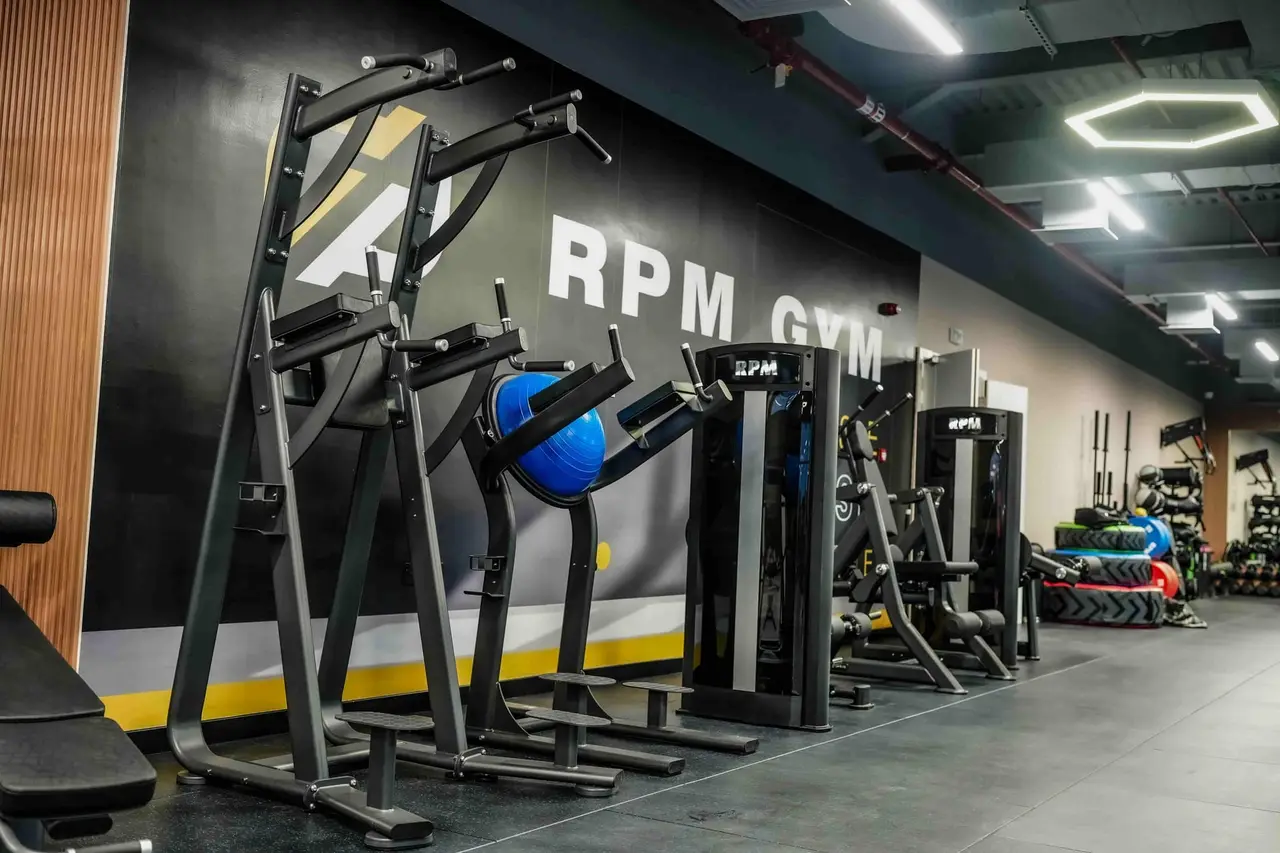
RPM is one club, on Level 4 of AD HUB Sports Complex in Al Manhal. Photos of its training floor show dumbbells, benches and plates, a rack of fixed-weight barbells, and a squat rack loaded with colour bumper plates. The functional area adds kettlebells and more dumbbells beside a turf lane.
Photos cannot give you the steps between dumbbell pairs, the lightest or heaviest pair, whether plates are in kilograms throughout, which bars are on hand or the rules on chalk and dropping. None of that is confirmed here, so take this page's categories on a free guided tour, a walk-through with a member of the team rather than a workout, ideally at your usual hour. Men train in the Mixed section. Women can also use the women-only Ladies section, which has its own strength equipment, so ask which free weights sit there and which sections your tier covers.
Questions, answered.
Are hex or round dumbbells better?
For most training it makes little difference. Hex heads stay put when you set them down and are easier to start a set from the floor, while round heads can roll. Matching pairs, firm heads and handles that grip matter more than the shape.
What if the dumbbells I need are always in use?
Ask whether the busiest pairs can be doubled, move the exercise to a barbell or cable for that block, or train at a quieter hour. If several of your pairs are always out, the rack is too small for its crowd.
Should a women-only section have its own free weights?
If you plan to train only there, yes. Check that it has a dumbbell range, benches and a bar that suit your plan. At RPM, women can see the Ladies section on their tour and ask which free weights it holds.
Is a free-weight area enough without machines?
For many plans it is, provided every category on this page is covered. Machines and cables speed up accessory work and give you options when the area is full. The machine audit covers what to check if you want both.