Count less, audit more
A tour that walks you past a long line of machines invites you to count them. The number tells you little. What matters is whether the machines cover the movements in your plan, fit your body, work properly and are open when you arrive. Four passes on a visit answer those questions, and each takes a few minutes.
This page is the audit. If you are still choosing between plate-loaded, pin-loaded and cable machines, machine types compared covers that first. RPM's facilities page shows the areas of the club in Al Manhal, so you can plan your passes before you go.
Pass one: the movement patterns
Start with movements rather than muscles. A plan built on machines needs each basic pattern loaded somewhere, and a gap in one pattern means a missing exercise every week.
Tick the patterns your plan uses, then find each one on the floor. For the same check by muscle group, see the body-part coverage table.
| Pattern | Machines that usually load it | Gap to watch for |
|---|---|---|
| Horizontal push | Chest press, plate-loaded flat or incline press | One press shared by every chest session in the room |
| Vertical push | Shoulder press | Handles that start too low or too far back for your arms |
| Horizontal pull | Seated row, chest-supported row | A single row machine that doubles as a resting seat between sets |
| Vertical pull | Pulldown, assisted pull-up | No assisted option, so pull-ups stay out of reach |
| Squat pattern | Leg press, hack squat | A leg press with its plates stored across the room |
| Hip hinge | Hip thrust or glute machine, back extension bench | Nothing at all, which leaves the hinge to barbells |
| Knee bend and straighten | Leg curl, leg extension | A combined machine that two people want at once |
| Trunk and calves | Abdominal crunch, rotary torso, calf raise | Calf work squeezed onto the leg press at peak |
Two machines for a pattern you rely on is comfortable. One is workable if it rarely has a queue at your hour. None means that pattern moves to free weights or cables, which is fine if you planned for it.
Pass two: does each machine fit your body?
Machines are built around an average body, and the adjusters are what make them fit everyone else. Sit in each machine your plan depends on, set it up and move a light weight slowly through the full range. If you cannot line the working joint up with the pivot, or a pad digs into your shin or your back, that machine is not really available to you.
Some body types run into the same problems on most floors. This is where to look.
| If you are | Where machines often fit poorly | What makes them fit |
|---|---|---|
| Tall or long in the leg | Knees hitting pads on rows and leg curls, a leg press sled that runs out of travel | Back pads that slide, long seat tracks, an ankle pad that moves along its arm |
| Shorter | Feet off the floor on presses, a pulldown thigh pad set too high, handles out of reach | Seats that drop low, foot bars, start positions you can bring forward |
| Broad across the shoulders | Narrow seats and fixed handles set too narrow | Machines with independent arms and a choice of grips |
| Light or new to lifting | Lever arms that are heavy before any plate goes on | Counterbalanced arms and a light first plate in the stack |
Women checking a women-only section should run the same test there. A section can hold the right machines and still have one press that does not adjust low enough.
Pass three: signs of upkeep on the machine floor
Testing every part of every machine is a job for its own visit, and the equipment condition guide goes through it piece by piece. For the audit, five minutes of looking shows how the machine floor is kept.
- The same machine out of order on two visits a week apart, or a sign with no date.
- Seat adjusters that need a second hand to move, a hint that nobody lubricates them.
- Grips worn smooth or wrapped in tape on the machines people use most.
- Empty plate horns while plates pile up on the floor beside the plate-loaded machines.
- Dust on the frames of rarely used machines, which shows where cleaning stops.
Pass four: the wait at your hour
A machine you queue for every session is a machine you do not have. In Abu Dhabi, weekday evenings after office hours are usually the tightest, and weekend mornings can be busy too. In Ramadan the busy stretch moves into the evening after iftar, and the summer heat sends outdoor walkers and runners inside. September and January bring new joiners, many of whom start on machines.
- Pick the machines your plan cannot do without.
- Note how long each takes to open up, and whether people let you work in.
- Watch for circuits that hold four or five machines at once.
- Ask whether staff step in when a machine is held for a long stretch.
RPM opens early in the morning and stays open late, with shorter Friday hours. The current times are below, so you can run this pass in your own slot.
| Days | Opening hours |
|---|---|
| Saturday to Thursday | 06:00–23:00 |
| Friday | 09:00–22:00 |
Hours can change, for example during Ramadan. Confirm with the team before a late or early visit.
RPM's machines: shown, and still to check
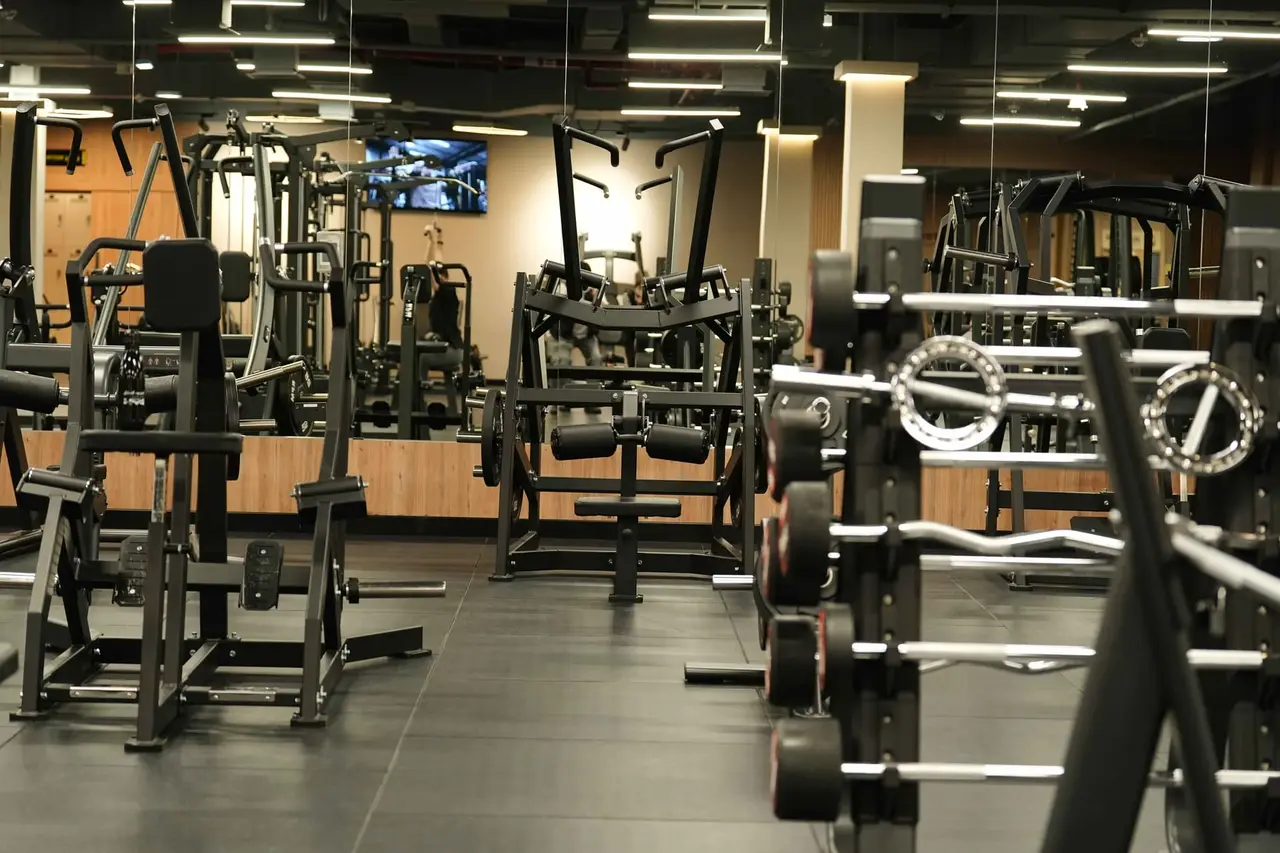
RPM has a single club, on Level 4 of AD HUB Sports Complex in Al Manhal. Photos of its training floor show plate-loaded machines, a leg press and a pulldown among them, along with multi-station cable towers. The Mixed section is where men train. The Ladies section is for women only and has strength equipment of its own.
The photos do not show which pin-loaded machines sit on either floor, how far each machine adjusts, how many of each there are or how servicing works. None of that is confirmed here. Take the pattern table on a free guided tour, a walk-through with a member of the team rather than a workout, and sit in the machines you would use most.
Questions, answered.
Is a bigger machine floor always better?
Not if the extra machines repeat patterns already covered. Ten chest machines and no leg curl make a weaker floor for most plans than a smaller one that covers every pattern.
What if a machine never fits me however I set it?
Ask a member of staff to set it with you. If it still does not fit, count it as missing and load the same pattern on another machine, a cable or free weights. Some makers build larger or smaller frames, so one brand may suit you more than another.
Should I check the machines in a women-only section separately?
Yes, if you plan to train there. Run all four passes in that section too, and ask whether your tier also covers the mixed floor in case a pattern is missing.
Can a coach set the machines up for me on my first visits?
Most gyms offer at least an introduction. At RPM, coaches on the roster work across both sections, and the team can tell you how coached sessions are arranged.