Why cables deserve their own check
One adjustable cable tower can load rows, presses, curls, pushdowns, face pulls, lateral raises and a long list of hip and trunk work. That is why cables are often the first station to run out at peak, and why a gym short of them feels busier than it is.
For how cables compare with plate-loaded and pin-loaded machines, machine types compared covers the ground. This page goes into the cable stations themselves. RPM's facilities page includes its cable zone, so you can see the towers before you visit.
Four kinds of cable station
Most gyms mix two or more of these. Know which one you are looking at, because each serves a different number of people.
| Station | What it is | What it does well | Where it falls short |
|---|---|---|---|
| Adjustable column | One or two pulleys that slide up and down a column | Any angle from the floor to overhead, for one arm or both | Often geared, so the stack number reads heavier than the pull feels |
| Crossover | Two towers facing each other across a gap | Flyes and standing work with a handle in each hand | Takes a lot of floor, and one person ties up both towers |
| Multi-station tower | Several stations around one frame, such as a pulldown, a low row and high and low pulleys | Serves several people at once if each station has its own stack | Fixed heights, and some stations share a stack |
| Single-purpose machine | A seated row or pulldown built as its own machine | Quick to set up for one movement | Does one job only |
The attachment shelf
Handles decide which exercises a tower can actually do. A gym can own excellent columns and still leave you doing everything with one bent bar because the rest of the attachments have wandered off.
The common attachments, and what you lose without each one.
| Attachment | Used for | Without it |
|---|---|---|
| Single handles, in pairs | Rows, presses and raises with one arm | Most single-arm work stops |
| Rope | Triceps pushdowns, face pulls, hammer curls | Pushdowns move to a bar, and face pulls disappear |
| Straight or angled bar | Pushdowns, curls, upright rows | Two-handed work switches to the rope |
| Wide pulldown bar | Pulldowns with a wide grip | The pulldown station is out of action |
| Close-grip row handle | Seated rows, close-grip pulldowns | Rows with single handles, which feel different |
| Ankle strap | Kickbacks, hip abduction, leg raises | Hip work moves to machines or bands |
Check that the attachments live on a rack beside the towers, that the popular ones come in more than one set and that the clips close properly. Ask whether ankle straps are kept at the desk, as some gyms do.
Stacks, steps and the pulley ratio
The number on the pin is not the load you feel. Many adjustable columns are geared at 2:1, so the pull feels roughly half the stack weight, and some are geared further still. Two towers set to the same pin can feel very different, which is why it pays to log the station as well as the number.
- Read the labels. Some stacks show kilograms, some pounds and some only plate numbers, which turns switching towers into guesswork.
- Try the lightest setting. Lateral raises and small shoulder work need a gentle start, and on some stacks the first plate is already too much.
- Try your heaviest pull. On pulldowns and rows, strong lifters can reach the bottom of the stack. If you are within a plate or two of it now, the station will cap you within months.
- Look at the step size. Big jumps between plates stall progress on small muscles, so ask if half-step weights are kept for the stacks.
- Feel the pull. A smooth, even pull through the whole range matters more than the brand, and the equipment condition guide describes what a worn cable feels like.
Stations against the crowd
Count stacks, not handles. A tower with four stations sharing two stacks serves two people at a time, however many handles hang from it. Then watch the towers at the hour you train. In Abu Dhabi that usually means weekday evenings after office hours, or late evenings after iftar in Ramadan, when cables carry everyone's warm-ups as well as their main work.
What you see at your hour, and what it tells you.
| What you see | What it means |
|---|---|
| Every column busy and people hovering | Cables are the bottleneck here, so plan dumbbell swaps for your cable work |
| One person holding a whole crossover for single-arm work | Columns are short, or nobody asks to share |
| Two stations on one stack, one standing idle | Only half the stations you counted can be used at once |
| Attachments piled on the floor | A tidying problem more than a shortage, though you will still hunt for handles |
| People working in between sets | A floor where even a busy station keeps moving |
Cable towers at RPM: what to test on a tour
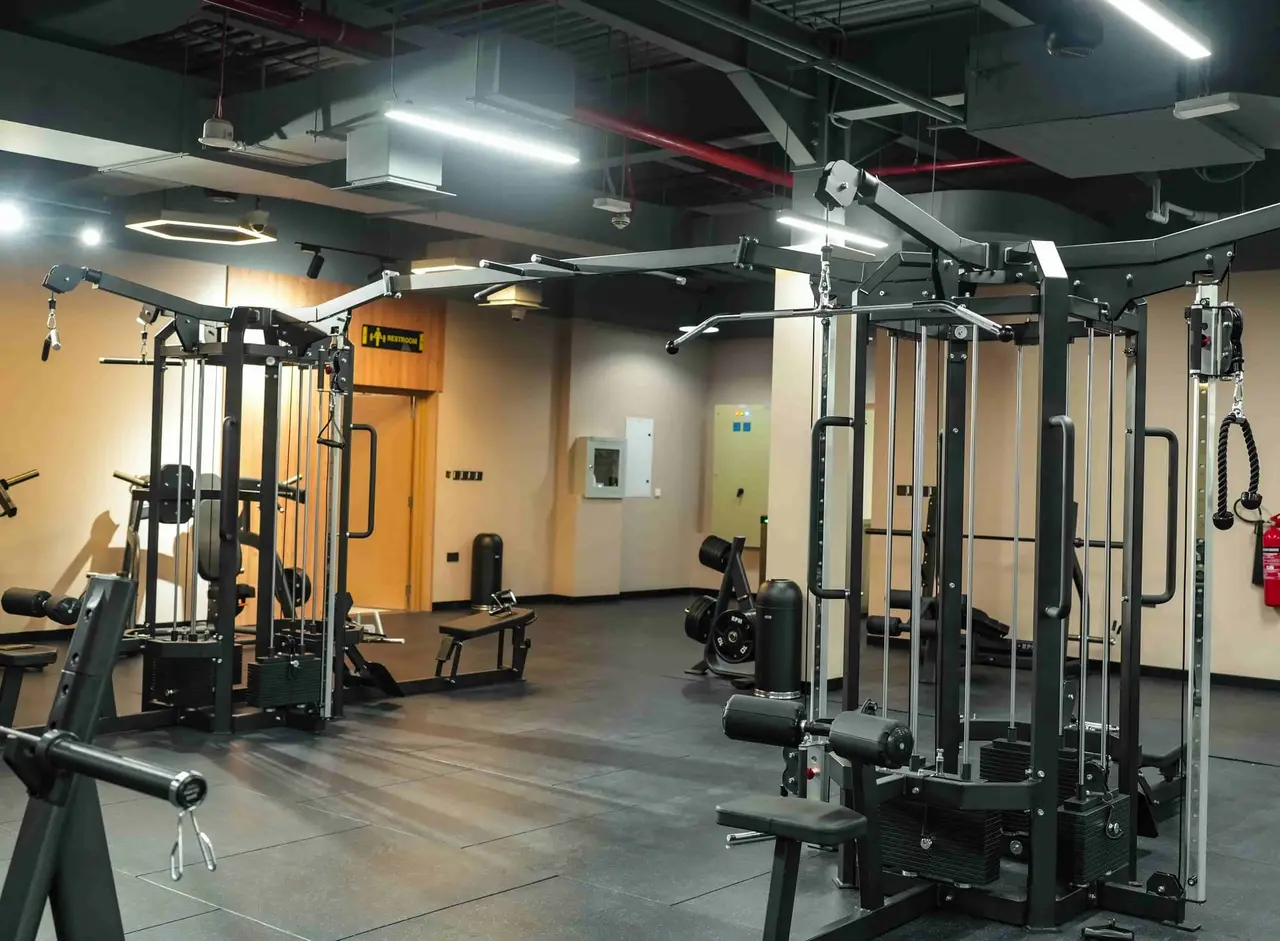
RPM trains everyone at one club, on Level 4 of AD HUB Sports Complex in Al Manhal. Photos of its training floor show multi-station cable towers set among benches, alongside plate-loaded machines that include a pulldown.
Photos cannot show how many stations there are, whether each has its own stack, which attachments are kept or how the stacks are labelled and geared. Those details are not confirmed here. On a free guided tour, a walk-through with a member of the team rather than a workout, try the lightest and heaviest settings you would use and look at the attachment shelf. Men train on the Mixed floor. Women planning to train in the women-only Ladies section, which has its own strength equipment, should ask whether a cable station sits there.
Questions, answered.
Can I bring my own cable attachments?
Many gyms allow personal handles and ankle straps, but ask first, and keep them with you rather than leaving them on the rack.
How many cable stations does a gym need?
There is no fixed number. What matters is whether you can get a column within a few minutes at your hour. If you wait for cables every session, the gym has too few for its crowd, however many it owns.
Should a women-only section have its own cable station?
If you plan to train there, it helps a great deal, because cables cover much of the glute and shoulder work that many programmes lean on. Check that section's towers and attachments as you would on the mixed floor.
Can cables replace free weights?
For most accessory work, yes. For heavy squats, presses and pulls from the floor they cannot, so a plan built on those still needs racks and bars.