What a coach changes about size training
The method behind muscle gain does not change when you hire someone: enough hard sets, effort that ends within a few reps of failure, steady progression and recovery to match. Training for muscle size explains those levers for lifters who run their own blocks. A coach adds judgement, and catches four errors that are hard to see from inside a set.
- Sets that stop well short of failure because the lifter misreads how hard they were.
- Exercise choices that load a joint more than the muscle they were picked for.
- Extra volume spread across every muscle when only one has stalled.
- Pushing on through fatigue that the log already shows building up.
How one-to-one sessions are arranged at the club, and which coaches work in each section, is on RPM's personal training page.
Before week one: fitting exercises to your body
In the first one or two sessions, a good coach trials two or three variations for each muscle group and keeps the ones that pass a few tests. Limb length, old niggles and how you feel a movement all vary, so the same chest press will not suit everyone.
- By the last reps you feel the target muscle working, not a joint.
- The set-up can be written down and repeated: seat height, grip width, foot position.
- Your balance or grip does not give out before the muscle does. For isolation work, machines and cable stations often pass this test most easily.
- The station is usually available at the hour you train, so the plan survives a busy evening.
Inside a coached hypertrophy session
- The coach reads last week's numbers and sets a target for each exercise before you start.
- Lighter build-up sets on the first, biggest movement show whether anything feels off today.
- Compound work comes first. ACSM's position stand advises large-muscle and multiple-joint exercises before smaller, single-joint ones.
- After each working set the coach asks how many reps you had left, and compares your answer with what they saw.
- Heavy presses get a spot, so the final reps can be pushed further than you would dare alone.
- Rest is timed rather than guessed. ACSM suggests 1 to 2 minutes between sets for hypertrophy work, which it centres on loads you can lift 6 to 12 times.
- Single-joint exercises close the session, where machines and cables let you go harder without getting stuck under a bar.
- Next week's targets go into the log before you leave.
Reading effort from outside the set
Most lifters underestimate how many reps they had left. A coach reads the set as it happens and adjusts the next one.
| What the coach sees | What it usually means | Next set |
|---|---|---|
| Every rep moves at the same speed | Several reps were left in the tank | More reps, or a small step up in load |
| The last two reps slow down sharply | Roughly one to three reps left, the usual target | Keep it there |
| The range shortens or the body shifts to finish | Technique went before the muscle did | End the set at that point and lower the load |
| You report three left, but the last rep barely moved | Your sense of effort needs recalibrating | A machine set taken to the point where form breaks, so you feel the real limit |
A few weeks of this usually sharpens your own estimate, and that pays off on every session you train without the coach.
Decision points across a 12-week block
A coached block is less a fixed script than a series of reviews. These are the moments a coach should stop and look at the whole log.
| When | What the coach reviews | Possible calls |
|---|---|---|
| End of week 4 | Whether loads or reps rose on each exercise | Swap any exercise that has not moved, or that you never feel in the target muscle |
| End of week 8 | Hard sets per muscle against progress per muscle | Add a set only to muscles that stalled while recovery was fine |
| Any week two sessions stall in a row | Sleep, work stress and soreness notes | Hold or trim volume before adding anything |
| Week 11 or 12 | Fatigue across the block and the full log | A lighter week, a review against week 1 and a draft of the next block |
ACSM favours higher-volume programmes built on multiple sets when the aim is maximal hypertrophy. In practice a coach raises volume over a block in small steps, and only where your numbers show it is being used.
Measurements, food and the edges of a coach's job
- Your log is the first measure. Tape measurements and photos every few weeks, taken under the same conditions, add a slower second view.
- Nobody can promise how much size you will add or by when. Age, sleep, food and training history all play a part.
- What and how much you eat is part of the picture, but a meal plan belongs with a registered dietitian, especially if you have a medical condition.
- Ask a doctor or registered dietitian before taking any supplement, particularly if you take medication.
- In Ramadan, many coaches move sessions after iftar and hold loads steady for the month rather than chasing new ones.
Hypertrophy coaching at RPM
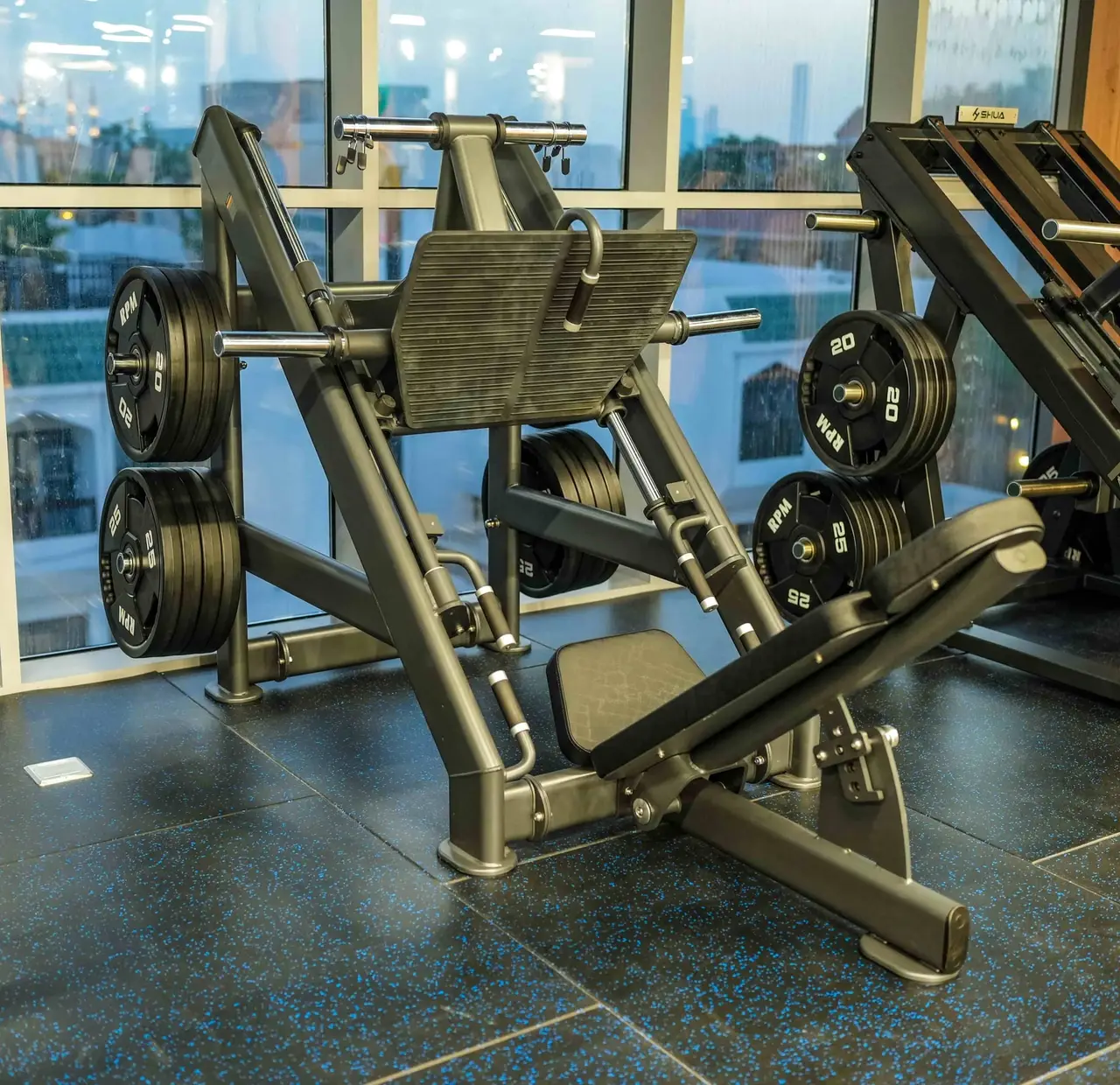
All of RPM's coaching happens at its single club in AD HUB Sports Complex, Al Manhal, where photos of the Level 4 training floor show plate-loaded machines such as a leg press and a pulldown, multi-station cable towers, benches, dumbbells, fixed-weight barbells and a squat rack with colour bumper plates. In the Mixed section, Amer Khalil's roster role is bodybuilding and strength and Awab Elsheikh's is physique and fitness classes. Coach Maria is listed for strength and conditioning in the women-only Ladies section, which has its own strength equipment.
- How will you judge how many reps I have left?
- Will you spot my heavy presses?
- When will you review my weekly sets, and on what evidence?
- Can I see the log between sessions?
Atelier is RPM's tier built around one-to-one coaching, and Engine adds coached programming. Prices and what each tier covers, including which sections, are confirmed when you ask. Ask each coach about their background directly, and use a free guided tour to see the machines your plan would lean on.
Sources
Questions, answered.
Do I need a coach at every session of a size block?
No. Many lifters see a coach once or twice a week and run the remaining sessions from the coach's plan, with the log shared between them. Coached days and solo days shows how those solo sessions are written.
How often should a coach change my exercises?
Rarely within a block. You cannot measure progress on a movement you only do a few times, so most coaches keep the main exercises for 12 weeks and swap only those that stall or never hit the target muscle.
Will a coach push me to failure on every set?
Usually not. Most sets end one to three reps short, with the closest efforts saved for machine and cable work at the end of a session.
Can a coach bring up one lagging muscle?
Yes. A common approach is to add sets for that muscle for a few weeks while holding the rest steady. If you are still choosing a gym for this goal, the muscle-gain gym guide checks a floor body part by body part.
Does a coached size block work the same for women?
The process is identical. Women at RPM can run it in the Ladies section, with its own strength equipment and a female strength and conditioning coach.