What a hypertrophy programme is trying to do
A hypertrophy programme asks one thing of each muscle: work hard enough, often enough, then recover before the next session. In WHO's 2020 glossary, muscle-strengthening activity covers training that raises skeletal muscle mass as well as strength, power and endurance, so size work belongs to the same family as strength work. What shifts is the emphasis: more sets, moderate loads and more than one exercise per muscle.
This page is about the method. If you are still choosing where to train, the muscle-gain gym guide checks a floor body part by body part, and the page on RPM's strength floor shows one club's kit.
Four levers you can pull
When progress stalls, one lever is usually stuck. Find which one before you change everything.
| Lever | What it means | How to adjust it | Common mistake |
|---|---|---|---|
| Volume | Hard sets per muscle per week | Add a set to a muscle that has stalled, not to every muscle every week | Counting easy warm-up sets as work |
| Effort | How close each set ends to failure | Finish most sets with one to three reps left, closer on machines and cables | Stopping when a set becomes uncomfortable rather than hard |
| Progression | Reps or load rising over weeks | Add reps within a range, then a small load step when you reach the top | Adding weight before technique has settled |
| Recovery | Sleep, spacing between sessions and eating enough | Avoid training the same muscle hard on back-to-back days | Adding sessions when the log says you need rest |
Counting your weekly sets
Volume is easiest to manage as hard sets per muscle per week. A hard set ends within a few reps of failure. Warm-ups and easy back-off sets do not count. Three hard sets of chest work on Saturday and three on Tuesday make six for the week, whether they came from a barbell bench press, a machine press or cable flyes.
There is no single right number. The ACSM position stand recommends multiple-set programmes with higher volume for maximising hypertrophy, and it links frequency to experience, from two or three training days a week for novices upwards. In practice, start each muscle at a modest number of hard sets, hold it for several weeks, and add a set only where progress stops.
Worked example: Saturday has three hard sets of pulldowns and two of dumbbell rows, Tuesday has three of seated cable rows. Your back gets eight hard sets that week. If the rows have not moved in a month and you are recovering well, the next step is a ninth set, not a new programme.
Effort: how many reps to leave in the tank
Coaches usually describe effort as reps in reserve: how many more good reps you had left when you racked the weight. Many coaches aim for one to three in reserve on most hypertrophy sets. Isolation moves on machines and cables can go closer, because a failed rep on a leg extension simply stops. Heavy barbell squats and presses are better kept a rep or two short, especially when you train without a spotter.
- You could hold a conversation through the last reps.
- Neither the load nor the reps on a lift have changed in a month.
- You never need the full rest period before the next set.
Two or more of those signs mean effort is the stuck lever. Push the last set of each exercise closer to failure for two weeks before you add any volume. The guide to free weights or machines explains which tool lets you push hardest.
A 12-week hypertrophy block
- Weeks 1 to 3, set the baseline. Pick one or two exercises per muscle, give each a rep range, and find loads that leave two or three reps in reserve. Log every set.
- Weeks 4 to 7, climb the range. Add reps session by session until every set reaches the top of the range, then take the smallest load step and drop back to the bottom. ACSM describes the same rule: a small increase in load once you can do one or two reps more than the target.
- Weeks 8 to 11, add volume where needed. A muscle that stalled gets one more hard set per session, and the last set of isolation work moves closer to failure.
- Week 12, back off. Cut your sets noticeably and keep the loads, then compare the log with week 1 and carry what worked into the next block.
Scale weight, tape measurements and photos move slowly and noisily. Your log of loads and reps is the first place to look for progress, and nobody can promise how fast size will follow.
Recovery between sessions, and food
Training only pays off if you recover from it. Arrange the week so a muscle trained hard is not trained hard again the next day. Three full-body sessions, or an upper and lower split over four days, both manage that.
- Sleep. Note your hours in the log next to your sets. If loads dip after short nights, that is your pattern to manage.
- Ramadan. Many lifters train after iftar and cut volume for the month, aiming to hold loads rather than add them.
- Summer. The walk from a hot car park can leave you dehydrated before the first set, so drink water before training as well as during it.
- Soreness. It is not a reliable scorecard. Heavy soreness after every session is a cue to check whether volume rose too fast.
- Food. What you eat is part of a muscle-gain plan, but working out how much and what belongs with a registered dietitian, especially if you have a medical condition.
Running a hypertrophy block at RPM
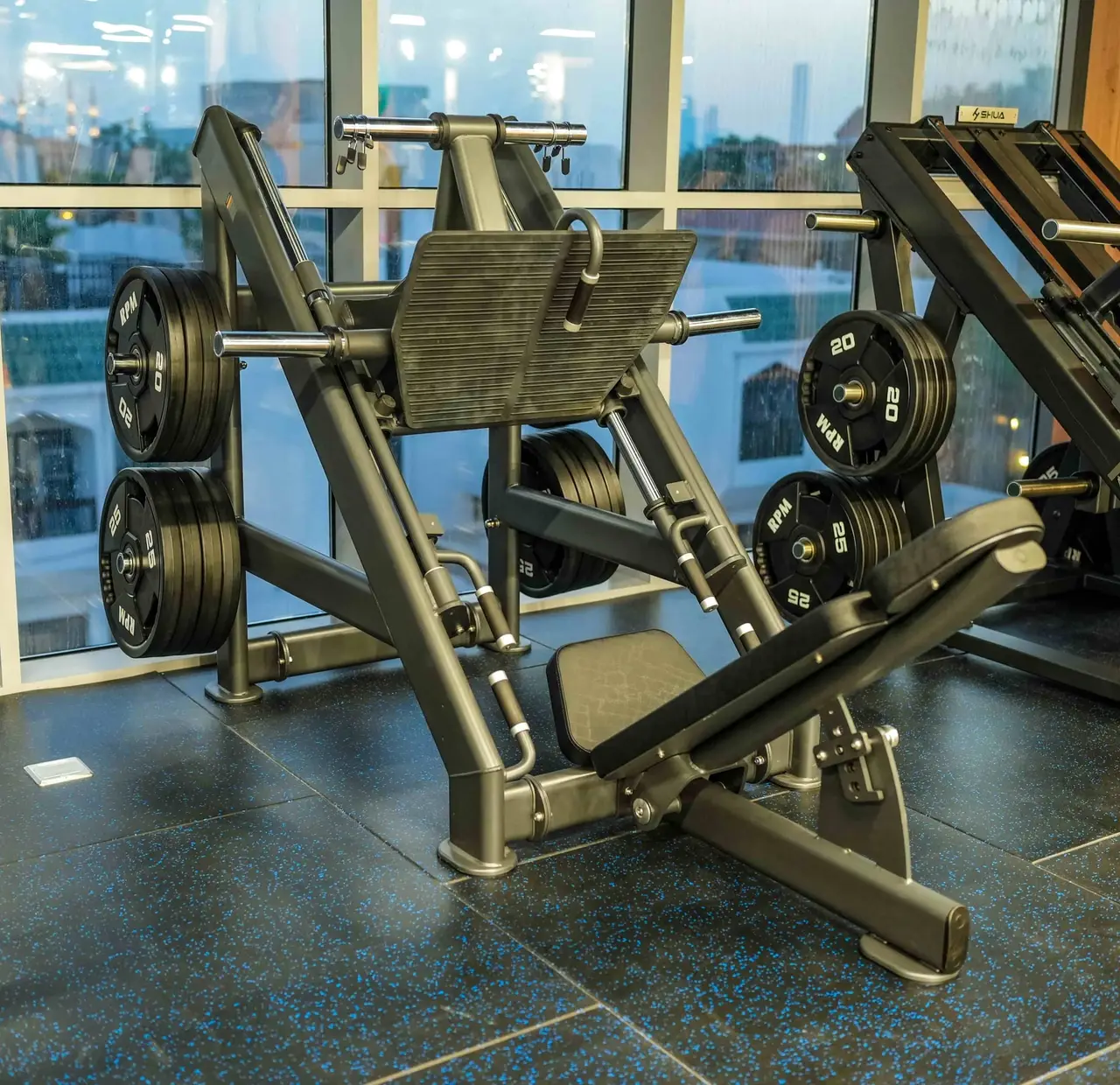
The club sits on Level 4 of AD HUB Sports Complex in Al Manhal, and it is RPM's only location. Photos of the training floor show cable towers with several stations, plate-loaded machines such as a leg press and a pulldown, benches, dumbbells, fixed-weight barbells and a squat rack loaded with colour bumper plates.
- Coaching: in the Mixed section, Amer Khalil's roster role is bodybuilding and strength, and Awab Elsheikh is listed for physique work and fitness classes. Coach Maria is the strength and conditioning coach in the Ladies section.
- Tiers: Floor covers the training floor, Engine adds coached programming, and Atelier is built around one-to-one coaching. The team confirms what each tier includes, and its price, when you enquire.
- Women: the Ladies section has its own strength equipment. Ask which machines and cables it holds, and whether your tier also covers the Mixed floor.
- Before you commit: on a free guided tour, ask to see any machine your split depends on.
Sources
Questions, answered.
How long before I notice muscle gain?
It depends on your starting point, age, sleep and food, so no honest coach can promise a timeline. Judge the first block by your log: rising loads and reps across 12 weeks show the training is moving in the right direction.
Do I need supplements to build muscle?
No supplement is needed to follow this method. If you are considering one, check it with a doctor or registered dietitian first, especially if you take any medication.
Should I train each muscle once or twice a week?
Splitting a muscle's weekly sets across two sessions keeps each session shorter and lets effort stay high on every set. Total hard sets and steady progression matter more than the split you choose.
Can women follow the same hypertrophy method?
Yes. Volume, effort, progression and recovery apply in the same way. A block can be built in the Ladies section using its own strength equipment.
Would a coach change this method?
The levers stay the same. A coach adds technique checks and adjusts volume from your log, which helps most when you stall. See personal training at RPM for how coaching runs in both sections.