What the evidence says about the choice
The 2023 review pooled thirteen studies of adults aged 18 to 60 who trained with free weights or machines for at least six weeks. Strength measured on free weights rose more after free-weight training, and strength measured on machines tended to rise more after machine training. When the two were compared directly, the review found no difference in dynamic strength, isometric strength, jump height or muscle size. Its authors conclude that the choice comes down to preference and goals.
For a beginner, that removes the pressure to pick the right side. Train on what you will use consistently, and practise the specific lifts you care about. To see the training areas at one club, look through RPM's facilities.
Stability: who controls what
Stability is the main practical difference. A machine takes some jobs off your hands, and free weights hand them back.
| Job during a rep | On a machine | With free weights |
|---|---|---|
| Keeping the path of the weight | The machine guides it | You guide it, which is the skill you are learning |
| Balance | Seat and pads hold you in place | Your feet, trunk and grip hold you in place |
| A rep you cannot finish | Let the stack settle back down | Set dumbbells down, or rely on safety arms in a rack |
| Working one side at a time | Possible on some machines with separate arms | Easy with dumbbells and kettlebells |
| Getting set | Seat height and pad position, noted once | Stance, grip and brace, repeated every set |
None of these makes one tool better. They decide what you have to think about while you are still new.
A mixed starting plan, pattern by pattern
The ACSM position stand recommends that strength programmes include both single- and multiple-joint exercises, and for people new to resistance training, loads in the 8 to 12 repetition range two to three days a week. This plan fits inside that and starts each pattern where the learning load is lowest.
| Pattern | Start on | Add free weights when | First free-weight version |
|---|---|---|---|
| Squat | Leg press | A bodyweight squat to a bench feels steady | Goblet squat to a box |
| Hinge | Free weights from day one, as machines rarely teach it | Straight away, kept light | Kettlebell deadlift from a raised block |
| Chest press | Chest press machine | You can hold a straight body in a push-up with hands on a bench | Dumbbell bench press |
| Pull | Pulldown and seated cable row | Your torso stays still on the cable row | One-arm dumbbell row |
| Overhead press | Shoulder press machine | Your ribs stay down when you reach overhead | Seated dumbbell press |
| Carry | No machine version | From the first session | Farmer's carry |
If you want to read a machine floor in detail, the guide to plate-loaded, pin-loaded and cable machines explains each type. For the dumbbells, plates and benches, the free-weight area checklist goes category by category.
Three beginners, three starting mixes
| Beginner | What shapes the choice | Starting mix |
|---|---|---|
| An engineer training alone after work, when the floor is busiest | No spotter, little patience for queues | Mostly plate-loaded and cable machines, with goblet squats and dumbbell rows in a quiet corner |
| A teacher booking a coach twice a month in a women-only section | Coached time is limited, so it goes on technique | Free-weight lifts learned with the coach, machines for the sessions in between |
| A new resident who wants to try HYROX-style events | Carries, sled work and lunges matter | Kettlebells and dumbbells early, machines for extra leg and back volume |
If you would rather follow a fixed routine that already blends both, the eight-week routine for complete beginners mixes machine and free-weight exercises within each session.
Signs it is time to shift the balance
- Towards free weights: the machine stack is nearly maxed, your goal names a barbell lift, or the machines never fit your body however you adjust them.
- Towards machines: your free-weight form keeps changing late in sets, you train alone with no safety arms set, or the dumbbell area is packed at your hour.
- Either way: you are bored. A change of tool that keeps you turning up is worth more than the perfect plan you skip.
Joint pain during a lift is a reason to stop that exercise, not to switch tools and push through. If it continues, see a doctor or physiotherapist.
Machines and free weights at RPM
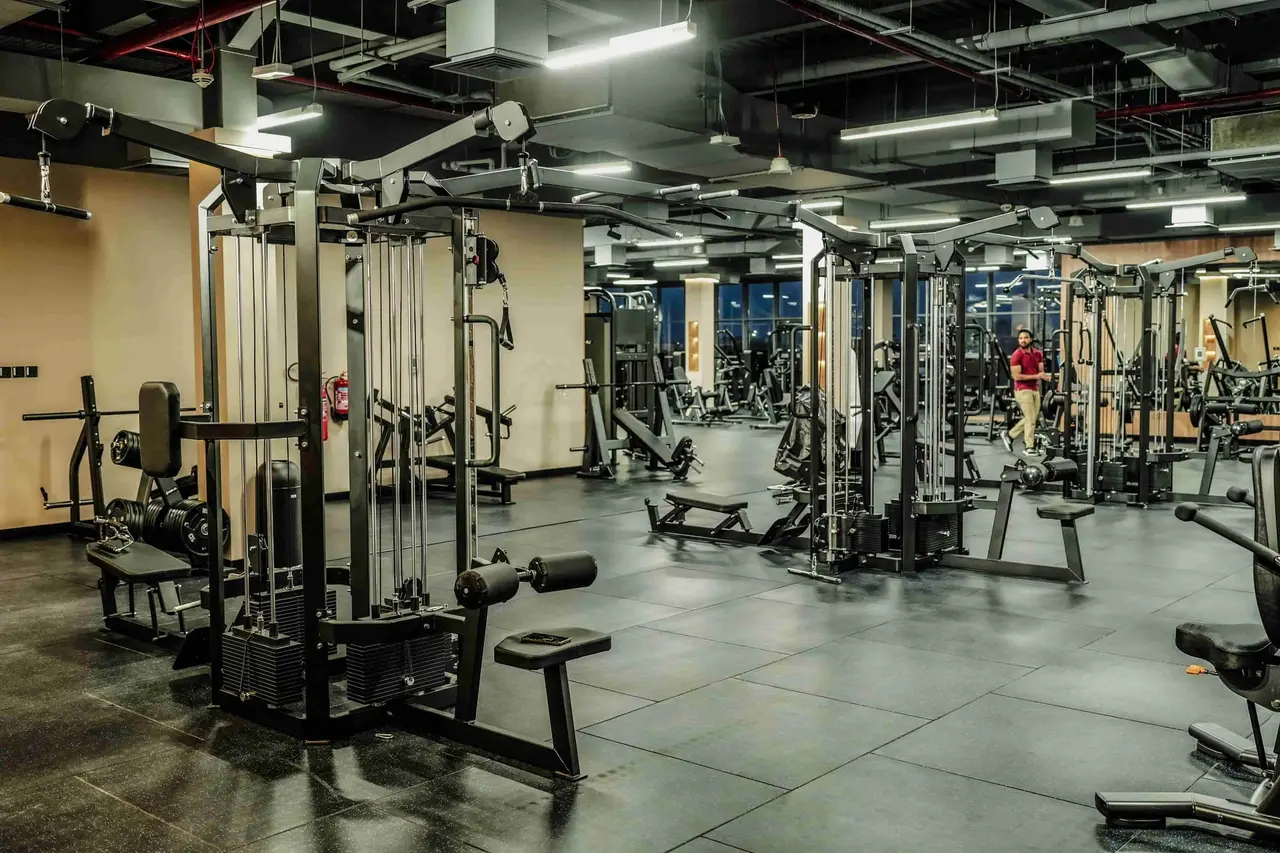
RPM is one club, on Level 4 of AD HUB Sports Complex in Al Manhal. Floor photos show plate-loaded machines including a leg press and a pulldown, multi-station cable towers, benches, plates, dumbbells, a rack of fixed-weight barbells and a squat rack with colour bumper plates. Kettlebells are in the functional area.
- Ask which pin-loaded machines are on the floor and how light the lightest dumbbells are, as the photos do not show either.
- The women-only Ladies section has its own strength and cardio equipment. Ask which machines and free weights it holds.
- Floor covers the training floor, Engine adds coached programming and Atelier is built around one-to-one coaching. Inclusions are confirmed on enquiry.
- The free guided tour is a walk-through with a member of the team, not a workout, so bring this plan and check each pattern's station.
Sources
- Haugen ME, Vårvik FT, Larsen S, et al. Effect of free-weight vs. machine-based strength training (systematic review and meta-analysis). BMC Sports Science, Medicine and Rehabilitation, 2023
- American College of Sports Medicine, position stand: Progression models in resistance training for healthy adults (2009)
Questions, answered.
Can I get strong using only machines?
Yes. In the 2023 review, machine training showed no difference from free weights for strength in direct comparison. Gains were specific to the equipment trained on, so if you later want a strong barbell squat, practise the barbell squat.
Do free weights build more muscle?
The same review found no difference in muscle size between the two when they were compared directly. So pick the tool you will train on consistently.
Do I need a spotter for dumbbells?
For most dumbbell lifts, no, because you can set the weights down. For heavier dumbbell pressing on a bench, ask someone to hand you the weights, or start a step lighter.
Should I avoid the barbell for the first months?
There is no need to avoid it, but there is no rush either. Many beginners reach the barbell through goblet squats and dumbbell presses, then learn the bar with a coach.