Five things to check before a runner joins a gym
Most runners join a gym because summer pushed their runs indoors or a coach told them to get stronger. Take this table on a visit at your usual running hour. For the floor at one club, see strength training at RPM.
| What to check | What good looks like | Why a runner cares |
|---|---|---|
| Strength floor | A squat rack, a leg press, dumbbells that rise in small steps and step boxes, all available at your hour | Two or three short sessions a week are the core of the plan below |
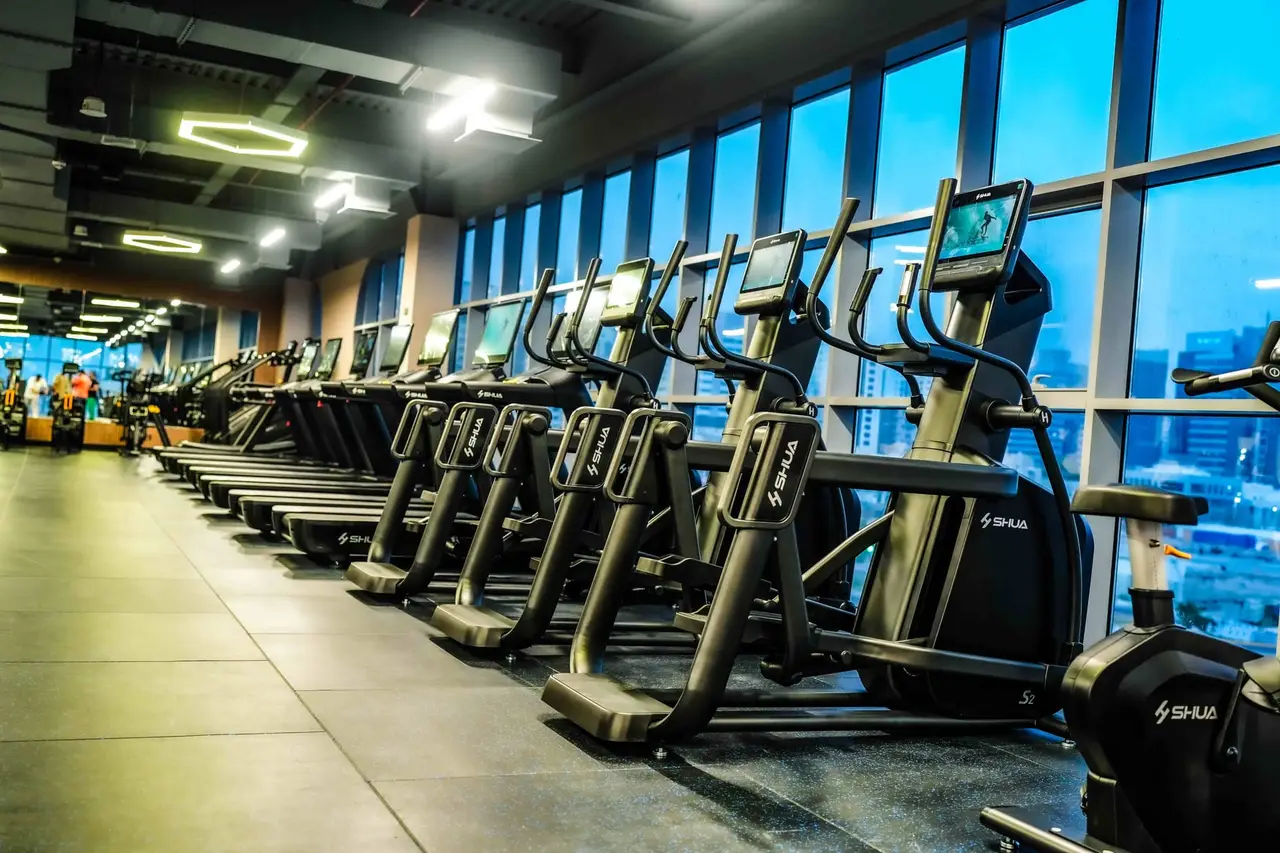
| Treadmills | Enough machines with an incline that one is open when you arrive | From May to September most runs in Abu Dhabi move indoors |
| Open floor or turf | A clear strip for drills, bounds and short sled pushes | Running drills and jumps need space to move |
| Recovery | Somewhere quiet to stretch, plus heat or cold if you want them | Hard runs and heavy lifting both need easy days around them |
| Coaching | A coach who asks about your race calendar before writing a plan | Strength work has to fit around your key runs |
What strength work does for distance runners
The clearest summary is a 2018 systematic review by Blagrove and colleagues. It took 24 studies of middle- and long-distance runners with at least six months of running behind them, who added heavy lifting, explosive lifting or plyometric jumps for four weeks or more, and compared them with runners who only ran.
| Measure | What the review found |
|---|---|
| Running economy, the oxygen cost of a given pace | Generally better, in most of the 20 studies that measured it, though not in all of them |
| Time trials over middle and long distances | Tended to improve |
| Sprint speed and other fast, anaerobic qualities | Tended to improve |
| Maximal oxygen uptake and blood lactate | Typically unchanged |
| Body composition | Typically unchanged, and not made worse by the strength work |
The studies were small and scored 4 to 6 out of 10 on the PEDro quality scale. The authors call the evidence good but not consistent across every study.
Their practical conclusion is two to three strength sessions a week with a variety of methods, which matches WHO's 2020 advice that adults do muscle-strengthening work on two or more days a week.
Heavy, explosive and plyometric: a runner's version of each
The review grouped the strength work into three kinds. A balanced plan uses all three, and starts with the first.
| Kind | Gym examples | How it is usually dosed |
|---|---|---|
| Heavy resistance | Goblet or back squat, Romanian deadlift, leg press, split squat, calf raises | For beginners, ACSM suggests loads you can lift 8 to 12 times. Experienced lifters go heavier, with three to five minutes of rest |
| Explosive resistance | Kettlebell swings, unloaded jump squats, medicine ball throws | Light loads moved fast for three to five sets, resting three to five minutes, as ACSM describes for power |
| Plyometric | Ankle hops, skips, bounds along the turf, low jumps off a step box | A small number of foot contacts, quality first, once a strength base is in place |
Running is done one leg at a time, so single-leg work earns a place. Single-leg strength training covers split squats and step-ups, and plyometric training sets out landings, contact counts and a jump progression.
ACSM advises adding load in small steps once you can manage one or two repetitions more than the target. For a runner, the aim is a stronger body that still runs well the next day.
Fitting two strength sessions around your runs
A common approach keeps easy days easy. Put strength work on the same day as a hard run, with the run first and a few hours between them if you can, or alongside a short easy jog. Keep heavy legs away from the day before your long run or a race.
One way to lay out the week for a runner building towards a half marathon in the cooler months:
| Day | Running | Gym |
|---|---|---|
| Saturday | Long run, on a treadmill in summer or outdoors once it cools | None |
| Sunday | Rest or an easy walk | None |
| Monday | Easy run | Strength A: squat, Romanian deadlift, calf raises, a trunk exercise |
| Tuesday | Intervals | None |
| Wednesday | Easy run | None |
| Thursday | Tempo run after work | Strength B: split squat, step-ups, hops and skips, a carry |
| Friday | Rest | Mobility, or nothing |
In the last week or two before a race, many coaches keep the lifts but cut the sets, so the legs arrive fresh. If running or lifting causes pain, see a doctor or physiotherapist before you carry on.
Treadmills for the hot months
From May to September the heat moves most runs indoors, and the treadmill becomes the machine you use most. Check how many are open at your usual hour and whether the incline goes high enough for hill repeats. Judge sessions by feel when you switch, because effort on a belt does not always match the road. The summer case in full, with a hot-month running week and official heat advice, is in gym cardio or outdoor running in summer.
- Long runs: split them into blocks with a water break if a long stretch on one belt drags.
- Hill work: set the incline exactly and log it, so progress is easy to read.
- Outdoor runs: heat and humidity raise the strain of exercise, so follow official heat guidance.
Recovering between hard runs
Recovery for a runner comes mostly from sleep and food, with easy days between the hard ones. A gym can add a quiet corner to stretch and, at some clubs, heat and cold. Count those as optional extras rather than a method, because the 2018 review did not test them.
At RPM the recovery suite has a Finnish sauna, an aroma steam room and an ice bath, and which tiers or passes include it is confirmed on enquiry. Heat and cold do not suit everyone, so if you are pregnant or have a heart or blood-pressure condition, ask your doctor before using them.
Running and lifting at RPM
RPM has a single club, on Level 4 of AD HUB Sports Complex in Al Manhal, with free on-site parking at AD HUB and a lift up. Its photos show treadmills, cross-trainers and an upright bike by tall windows, spin bikes, and a training floor with a squat rack and colour bumper plates, a plate-loaded leg press, dumbbells and benches. The functional area has a turf lane with a sled, and step boxes for drills and low jumps.
- Men train in the Mixed section, while women can also use the women-only Ladies section and its own strength and cardio kit. Ask which sections your tier covers.
- Of the three tiers, Floor gives you the training floor, Engine brings coached programming and Atelier centres on one-to-one coaching. The team confirms inclusions and prices.
- Book the free guided tour at the hour you usually run, and look at the treadmills and the rack while you are there.
| Days | Opening hours |
|---|---|
| Saturday to Thursday | 06:00–23:00 |
| Friday | 09:00–22:00 |
Hours can change, for example during Ramadan. Confirm with the team before a late or early visit.
Sources
- Blagrove RC, Howatson G, Hayes PR. Effects of strength training on the physiological determinants of middle- and long-distance running performance: a systematic review. Sports Medicine, 2018
- American College of Sports Medicine position stand. Progression models in resistance training for healthy adults. Medicine and Science in Sports and Exercise, 2009
- World Health Organization. WHO guidelines on physical activity and sedentary behaviour, 2020
Questions, answered.
Will lifting weights make me slower or heavier?
Not in the studies the 2018 review included. Body composition was typically unchanged by the strength work, while running economy, time trials and sprint speed tended to improve. Diet and total training load decide the rest.
Can bodyweight exercises replace the weights?
They are a start, but the review's studies also used heavy lifting, which needs a rack, a leg press or dumbbells.
Should I lift on the morning of my long run?
Better not. Keep heavy leg work away from your longest or hardest run and the day before it.
Is summer a good time to add a third session?
It can be. If the heat cuts your running, the lighter load leaves room for an extra strength session, which you can drop again in the cooler months.