What glute-focused training means
The gluteus maximus is one of the main muscles that extend the hip, the movement that drives you up out of a squat or forward from a hinge. Smaller glute muscles at the side of the hip help move the leg outwards and steady the pelvis when you stand on one leg. Glute-focused training gives those jobs extra weekly attention, mostly through exercises driven from the hip rather than the knee.
It is an emphasis, not a whole programme. WHO's 2020 guidelines advise muscle-strengthening activity for all the major muscle groups on two or more days a week, and they list the back, chest, shoulders and arms alongside the legs. A glute focus sits inside a full-body plan. For the women-only space where you can train it at RPM, see RPM's Ladies section.
Exercises that work the glutes hard
| Pattern | Examples | Kit to ask about | Coaching point |
|---|---|---|---|
| Hip thrust and bridge | Barbell hip thrust, band hip thrust, glute bridge | A stable bench, a bar pad, a barbell or a band | Chin tucked, ribs down, a brief pause at the top |
| Hinge | Romanian deadlift, conventional deadlift | A barbell or a pair of dumbbells | Hips travel back, spine stays long, weight kept against the legs |
| Split squat and lunge | Split squat, walking lunge | Dumbbells | Front heel stays down, knee tracks in line with the toes |
| Step-up | Forward and lateral step-ups | A box or a bench of a height you control | Drive through the whole foot of the top leg, lower slowly |
| Squat | Goblet squat, back squat | Dumbbells or a squat rack | Only as deep as you can control |
| Abduction | Cable abduction, band side steps | A cable tower with an ankle strap, or a band | Slow, with no swinging |
The 2020 review looked at loaded exercises built on hip extension and rated the first five patterns among those with very high gluteus maximus activation, with step-ups and their variations highest. Abduction was outside its scope, so its place here rests on common coaching practice. Activation measures how hard a muscle works during a rep, not how much it grows over months.
If you are pregnant, postnatal, or have hip or back pain, ask your doctor or physiotherapist before starting, and tell your coach what they said.
How many sets a week
A 2017 meta-analysis pooled 15 studies, with 34 treatment groups, to see how weekly training volume related to muscle growth. It found a graded dose-response: more weekly sets went with larger gains, and each extra set was linked with a small additional increase. When the authors grouped weekly sets per muscle into fewer than 5, 5 to 9, and 10 or more, the trend favoured the higher groups.
- Count hard sets only: sets that finish with no more than a few good repetitions left.
- Squats, lunges, step-ups and hinges count towards your glute total as well as hip thrusts, because the 2020 review found high glute activation in all of them.
- If you are new to lifting, start in the review's middle band and stay there until your sessions feel routine.
- Add one or two weekly sets only when you recover well between sessions and your loads are still rising.
Read the limits too. The meta-analysis did not single out the glutes, its studies were short term, and it does not tell you how many sets your body can recover from. More is better only up to the point you can sustain.
A two-day week with a glute emphasis
Two full-body sessions with the glute work first, while you are fresh. Rest two or three minutes between hard sets of the main lifts.
| Session | Main lifts | Upper body | Finisher |
|---|---|---|---|
| A | Hip thrust, 2 to 3 sets of 8 to 12. Split squat, 2 to 3 sets of 8 to 12 each leg | Seated cable row and dumbbell shoulder press, 2 to 3 sets each | Cable abduction, 2 sets of 12 to 15 each leg |
| B | Romanian deadlift, 2 to 3 sets of 8 to 12. Step-up, 2 to 3 sets of 8 to 12 each leg | Lat pulldown and dumbbell bench press, 2 to 3 sets each | Band side steps, 2 sets |
With two sets of each main lift the week lands at eight hard glute sets, in the review's middle band. At three sets it reaches twelve. A third session, such as squats and lunges, suits women who already lift: ACSM suggests two or three training days a week for novices and three or four at intermediate level.
Progressing the loads
The American College of Sports Medicine's 2009 position stand recommends loads you can lift 8 to 12 times for people new to resistance training, and an increase of 2 to 10 per cent once you can do one or two repetitions more than your target.
Worked example: you hip thrust 40 kg for three sets of 12. When all three sets reach 13 or 14 with good form, add 2.5 kg, an increase of about six per cent, and drop back to 8 to 10 repetitions. Small plates make this possible, so ask what the smallest ones are where you train.
Honest expectations
Glute training builds strength in the hips and some muscle over time. It cannot promise a particular shape. How your hips and legs look also depends on genetics, body fat and eating habits, and training does not control those.
- What you can expect to measure: heavier hip thrusts and hinges, more repetitions at the same load, and steadier single-leg work.
- What changes slowly and differently for everyone: muscle size and how clothes fit.
- What glute work cannot replace: training for the upper body, and the aerobic activity WHO advises each week.
For a full strength block built in three phases, see strength training for women.
Glute training in RPM's Ladies section
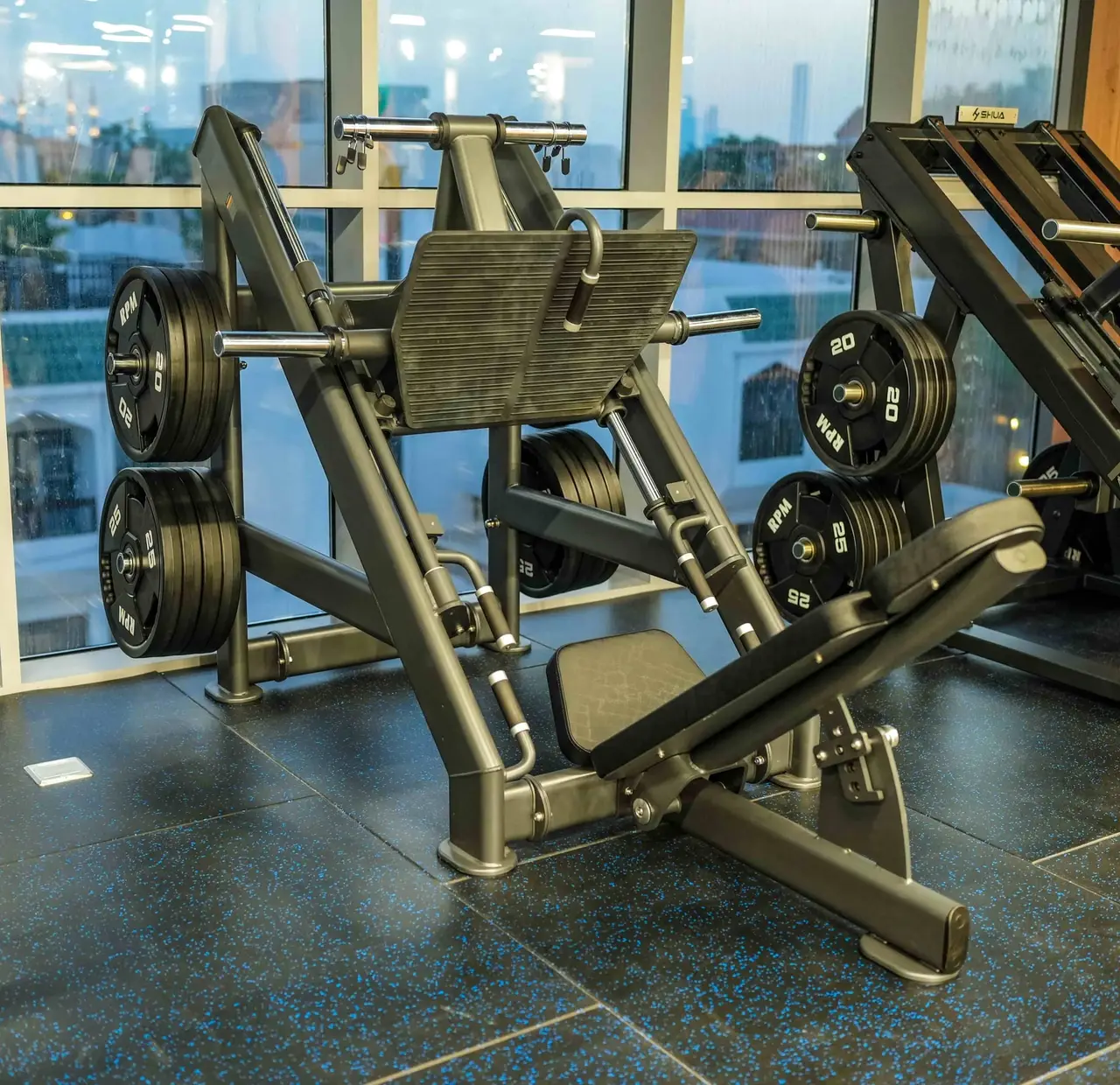
RPM is one club, on Level 4 of AD HUB Sports Complex in Al Manhal. Its women-only Ladies section has its own strength and cardio equipment, and Coach Maria holds the strength and conditioning role there on the roster. RPM does not publish an equipment list for the section. The club's training-floor photos show plate-loaded machines including a leg press, multi-station cable towers, benches, plates and dumbbells, and the functional area in the Mixed section has step boxes.
- Ask which of those sit inside the Ladies section, and whether a bench and bar pad are there for hip thrusts.
- Ask whether the cable towers have an ankle strap for abduction, and what the heaviest dumbbells are.
- Ask whether your tier covers the Mixed section too, if you want the functional area. Inclusions are confirmed on enquiry.
A free guided tour for women lets you check the set-up before you commit, and how to choose a ladies gym for weight training lists what to look for.
Sources
- Neto WK, Soares EG, Vieira TL, et al. Gluteus maximus activation during common strength and hypertrophy exercises: a systematic review. Journal of Sports Science and Medicine, 2020
- Schoenfeld BJ, Ogborn D, Krieger JW. Dose-response relationship between weekly resistance training volume and increases in muscle mass: a systematic review and meta-analysis. Journal of Sports Sciences, 2017
- American College of Sports Medicine, position stand: Progression models in resistance training for healthy adults (2009)
- World Health Organization, WHO guidelines on physical activity and sedentary behaviour (2020)
Questions, answered.
How many times a week should I train my glutes?
Two sessions suit many beginners, with the weekly sets split between them. ACSM's suggested frequency for people new to resistance training is two to three days a week.
Hip thrusts or squats: which is better for the glutes?
The 2020 review placed both among exercises with very high glute activation, with step-ups highest. Most plans use a thrust and a squat or lunge pattern rather than choosing one.
Will glute training make my legs bigger?
It aims to build some muscle, and the 2017 meta-analysis links growth to weekly volume. If you want strength more than size, tell your coach and keep the set count moderate.
Do I need resistance bands?
No, but they are cheap and useful for side steps, bridges and warming up the hips. A cable with an ankle strap does the same job for abduction.