The room and the machines are half the class
A reformer class depends on its apparatus far more than a mat class does. You lie, kneel or stand on a moving carriage held by springs, so the condition of each machine and the space around it shape every session. RPM's reformer Pilates page explains how the machine works. This guide is about judging a studio as a facility.
For instructors, class formats and the difference between a real studio and a corner of the floor, read what makes a gym good for Pilates. The checks below are the ones you make with your hands and eyes in the room.
A reformer check, end to end
- Carriage: push it along the rails by hand. It should glide quietly, without clunks, wobble or sticking points.
- Rails and wheels: clean, with no grit or hair making the ride rough.
- Footbar: move it through each position. It should lock firmly every time and stay put when you push against it.
- Straps and ropes: no fraying, and handles or loops that are clean rather than stiff with sweat.
- Headrest and shoulder rests: firm and padded, with no splits in the upholstery.
- Tower, on reformers that have one: the bars and springs held securely on their hooks, with nothing hanging loose.
Springs and hooks: what to ask
Springs supply the resistance and, at times, the support. A worn spring can feel uneven or lose tension, and a worn hook can let a spring slip at the wrong moment. You cannot judge that by looking, so ask.
- How often are springs and hooks inspected, and by whom?
- Is there a written record of checks and replacements?
- When was a set of springs last replaced?
- Does the instructor check the springs before each class?
- What happens to a reformer when a fault is found?
A good answer is specific: a named person, a schedule and a machine taken out of use until it is fixed. A shrug tells you just as much.
Space between the reformers
Reformers are long machines, and a studio that packs them tightly saves floor at your expense. Stand in the room and look at these.
| In the studio, look at | Why it matters on a reformer |
|---|---|
| The gap down each side of a machine | The instructor needs to stand beside you to change springs and adjust your position |
| Room at the head and the foot | Standing and kneeling work, and getting on and off, need clear space at both ends |
| Mirrors | A front or side mirror lets you check alignment without twisting round |
| Air and cooling | A packed studio in an Abu Dhabi summer gets stuffy fast, and you sweat onto shared upholstery |
| Where the other apparatus sits | Towers, chairs or barrels should have room of their own rather than squeezing the reformers |
| Storage for bags and shoes | Kit left between machines is something to trip over |
Class size and the instructor's reach
The point of a reformer class is supervised work on a machine that can be set up wrongly. The more reformers in the room, the less time the instructor has to check each spring setting and correct each person. Ask the maximum class size, not the usual one, and whether busy slots run at that maximum.
If you are new, ask about a private or two-person session first, so you learn the set-up before a full class. Check the instructor's training on the apparatus too, with the guide to checking a Pilates instructor's certification.
Booking: getting a reformer when you can train
A well-kept studio is no use if you cannot get a machine at your hour. Ask these before you buy a package.
| Booking rule | Ask | Why it matters to you |
|---|---|---|
| Release window | How far ahead do classes open for booking? | Popular after-work slots can fill as soon as they open |
| Waitlist | Is there one, and how are you told a place has come up? | A waitlist that moves is worth more than a class you can never join |
| Late cancellation | How late can you cancel without losing the session? | Rush-hour traffic in Abu Dhabi makes some late cancellations hard to avoid |
| Peak slots | Which times sell out first, weekday evenings or weekend mornings? | Shows whether your realistic hours are the contested ones |
| Ramadan and summer | Does the timetable change, and when is the new one published? | Class times may move, and a package bought for one schedule may not fit the next |
| Grip socks | Are they required, and can you buy them on site? | Arriving without them can cost you the class |
RPM's reformer studio
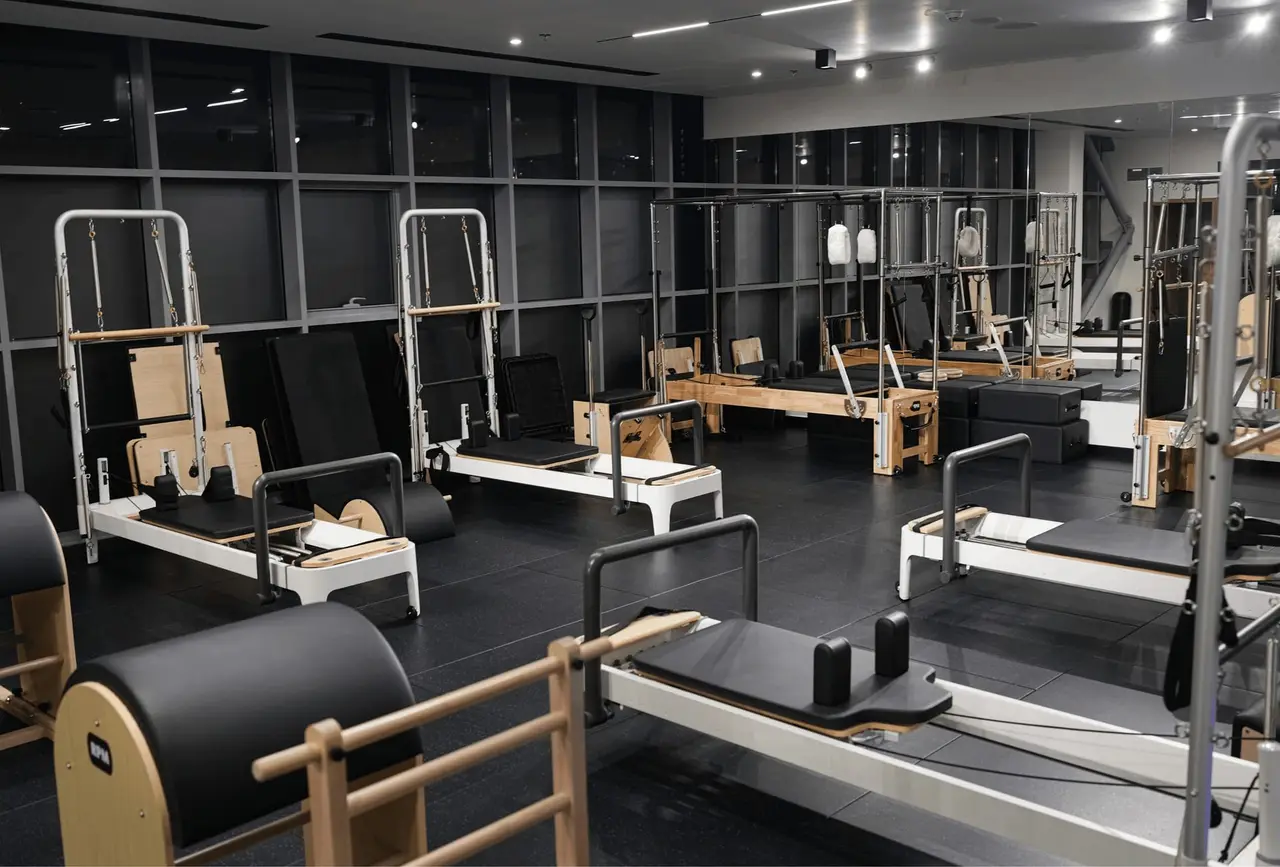
RPM's Pilates studio is inside the women-only Ladies section, on Level 4 of AD HUB Sports Complex in Al Manhal, and reformer classes run there. The studio photos show reformers (some with towers), trapeze-table frames and a ladder barrel.
Photos cannot tell you which apparatus a given session uses, how many people a class takes or how the springs are looked after. Ask about each of these on a women's tour, and push a carriage along its rails while you are there. Men train in the Mixed section, so the studio is not open to them.
Questions, answered.
What is a tower reformer?
A reformer with a frame at one end that holds extra springs and bars, so more exercises are possible. Ask whether your class uses the tower or only the carriage.
Should I tell the instructor about an injury?
Yes, before the class starts, along with any pregnancy or medical condition. Get clearance from your doctor or physiotherapist where you need it, and let the instructor adapt the springs and exercises.
Can I use a reformer on my own outside class?
Some studios allow it at set times for experienced clients, and many do not, because a machine set up wrongly is easy to misuse. Ask the rule rather than assuming.
How do I know the reformers are cleaned between classes?
Watch the end of a class. Upholstery, straps and footbars should be wiped before the next group lies down. If nobody wipes anything, ask why.