What your chest muscles do
The main chest muscle, the pectoralis major, fans out from the collarbone and breastbone to the upper arm. It pushes the arm forward, as in a press, and draws it across the body, as in a fly. Its upper fibres work harder when you press upwards at an angle, and the front of the shoulder and the triceps join in on every press.
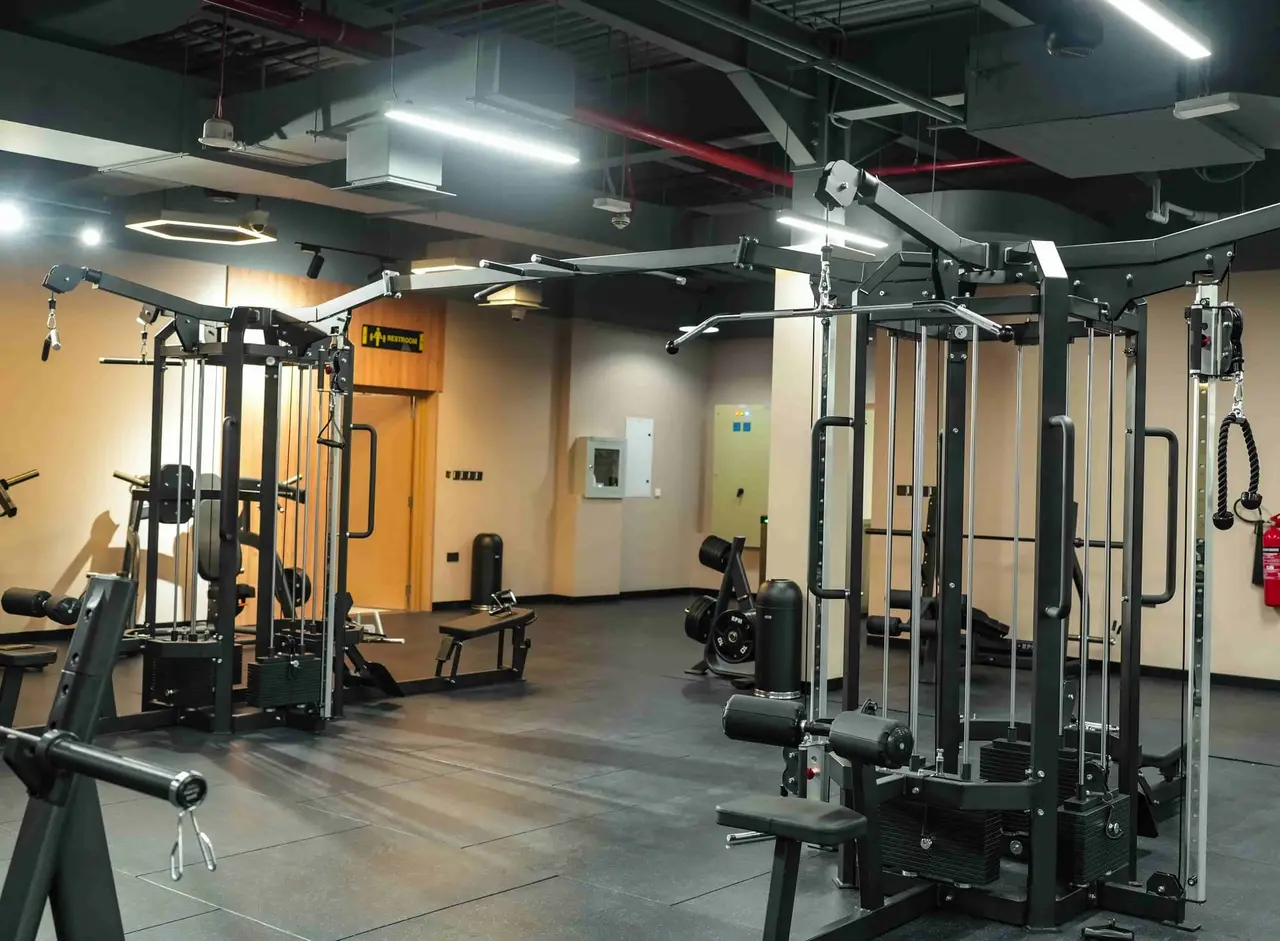
WHO's 2020 guidelines name the chest among the major muscle groups that adults should strengthen on two or more days a week. For the benches, rack and cable stations you would use, see RPM's strength floor.
Presses, flyes and push-ups: what each adds
| Exercise | What it adds | Kit on RPM's floor | Coaching point |
|---|---|---|---|
| Barbell bench press | The heaviest loads, and progress that is easy to measure | Benches, barbells and a squat rack (ask whether a bench fits inside it) | Lower the bar to the lower chest under control, wrists over the elbows |
| Dumbbell bench press | Each arm works on its own, and the hands can travel lower than a bar allows | Benches and dumbbells | Start with the dumbbells on your thighs and rock back |
| Incline dumbbell press | More work for the upper chest | Benches and dumbbells (ask whether a bench inclines) | Keep the incline low |
| Cable fly | A wide arc, with the angle set by the pulley height | Multi-station cable towers | A soft bend in the elbows, kept the same throughout |
| Dumbbell fly | A stretch across the chest with light loads | Benches and dumbbells | Lower only as far as your shoulders feel comfortable |
| Push-up | Pressing with no kit, easy to scale | The floor, benches and step boxes | Hips level with the shoulders on every rep |
In a 2005 study of 12 men and women lifting six-rep loads, chest and front-shoulder activity did not differ significantly between the barbell bench press, the dumbbell bench press and the dumbbell fly, but the fly kept the muscles working for a shorter share of each rep. The authors suggested using the fly as an extra and treating the two presses as interchangeable. For building up to a full push-up, see the push-up progression.
Flat, low incline or steep: what the bench angle changes
A 2020 study had 30 trained adults bench press at five angles, from flat to steep, using 60 per cent of their one-rep maximum. The table sums up where the activity went.
| Bench angle | Where the work goes | Use it for |
|---|---|---|
| Flat | Middle and lower chest were most active | Your main press, heavy or moderate |
| Low incline, about thirty degrees | Upper-chest activity peaked | A second press in the week |
| Steep, above about forty-five degrees | The front shoulder took over and the chest's share fell | Shoulder work rather than chest work |
Activity is not growth, so a training study matters too. In a 2020 trial, 47 untrained men did flat presses, incline presses or both, once a week for eight weeks with equal sets. Strength rose similarly in every group, while the upper chest thickened most with the incline. A flat press plus a low incline press covers both findings.
Dumbbells, barbell or cables
A 2011 study of 12 trained men compared the bench press on a Smith machine, with a barbell and with dumbbells. Their one-rep maximum with dumbbells was 17 per cent lower than with the barbell, yet chest and front-shoulder activity did not differ. Triceps activity was lower with dumbbells and biceps activity higher.
| Tool | Choose it when | Trade-off |
|---|---|---|
| Barbell | You want to load the press heavily and track small increases | Needs safety bars or a spotter once sets get hard |
| Dumbbells | You train alone, want both sides to work evenly, or find every rack in use | Lighter loads, and getting heavy dumbbells into position takes practice |
| Cables | You want flyes or presses at an angle you choose, with light loads | Hard to load heavily, and the station is often shared |
How many chest sets a week
A 2026 meta-regression of 67 studies by Pelland and colleagues found that muscle size and strength both rose with weekly sets, with diminishing returns, and that strength also rose with more sessions a week. The data fitted most closely when a set that trains a muscle only indirectly counted as half, so heavy pressing already gives your triceps some work. A 2022 review of trained young men suggested 12 to 20 weekly sets per muscle group for size, a figure that may not suit beginners.
ACSM's 2009 position stand puts newcomers on two or three training days a week, with loads they can lift 8 to 12 times. Start below the review's range, and add sets one at a time while recovery stays good and the weights keep going up.
One way to split the chest across two sessions.
| Session | Starting out | Trained lifter |
|---|---|---|
| A | Dumbbell bench press, 3 sets of 8 to 12 | Barbell bench press, 4 sets of 6 to 10, then cable fly, 3 sets of 10 to 15 |
| B | Incline dumbbell press, 2 sets, then incline push-ups, 2 sets | Incline dumbbell press, 4 sets of 8 to 12, then dumbbell fly or push-ups, 3 sets |
| Chest sets a week | 7 | 14 |
Pair each chest exercise with a pull so the back keeps pace, as the back-training guide sets out.
Spotters, safety bars and the rack
Heavy barbell pressing is the chest exercise where a missed rep can leave the bar stuck on you. Before a hard set, use one of these:
- Safety arms or pins set just below your chest height at the bottom of the rep, if you press inside a rack.
- A spotter who knows your planned reps and the signal for help, agreed before the set.
- Dumbbells instead of the barbell when you train alone and plan to finish a rep or two short of failure.
- A full grip, with the thumb wrapped round the bar.
Whether a flat bench fits inside RPM's squat rack, and whether the bench station has safety catches, are questions for the floor. The squat-rack guide covers safety arms and J-hooks.
Stop and see a doctor or physiotherapist if pressing causes shoulder or elbow pain.
Chest training at RPM
RPM is one club, on Level 4 of AD HUB Sports Complex in Al Manhal. Its floor photos show benches, a rack of fixed-weight barbells, dumbbells, multi-station cable towers and a squat rack with colour bumper plates. That covers everything above. A chest-press machine is not listed, so ask, and ask whether the benches incline.
- The women-only Ladies section has its own strength equipment. Ask which benches and cable stations it includes.
- For coaching, ask about Amer Khalil, the roster's bodybuilding and strength coach in the Mixed section, or Coach Maria, its strength and conditioning coach in the Ladies section. Engine adds coached programming, and Atelier is built around one-to-one coaching.
- Book a free guided tour at your training hour to see how busy the benches are.
Sources
- Rodríguez-Ridao D, et al. Effect of five bench inclinations on the electromyographic activity of the pectoralis major, anterior deltoid, and triceps brachii during the bench press exercise. International Journal of Environmental Research and Public Health, 2020
- Chaves SFN, et al. Effects of horizontal and incline bench press on neuromuscular adaptations in untrained young men. International Journal of Exercise Science, 2020
- Saeterbakken AH, van den Tillaar R, Fimland MS. A comparison of muscle activity and 1-RM strength of three chest-press exercises with different stability requirements. Journal of Sports Sciences, 2011
- Welsch EA, Bird M, Mayhew JL. Electromyographic activity of the pectoralis major and anterior deltoid muscles during three upper-body lifts. Journal of Strength and Conditioning Research, 2005
- Pelland JC, et al. The resistance training dose response: meta-regressions exploring the effects of weekly volume and frequency on muscle hypertrophy and strength gains. Sports Medicine, 2026
- Baz-Valle E, et al. A systematic review of the effects of different resistance training volumes on muscle hypertrophy. Journal of Human Kinetics, 2022
- American College of Sports Medicine position stand. Progression models in resistance training for healthy adults. Medicine and Science in Sports and Exercise, 2009
- World Health Organization. WHO guidelines on physical activity and sedentary behaviour, 2020
Questions, answered.
Do I have to bench press with a barbell to build my chest?
No. In the 2005 study the barbell and dumbbell presses worked the chest alike. Push-ups and cable presses count too, and the barbell simply makes heavy loads easier to add.
How many times a week should I train my chest?
Twice suits most people. ACSM suggests two or three training days a week for newcomers, and the 2026 meta-regression found strength rose with more frequent sessions.
Why do I feel presses more in my shoulders than my chest?
A steep bench is a common reason: in the 2020 study the front shoulder took over above about forty-five degrees. Lower the incline and ask a coach to check your set-up. If it hurts, see a doctor or physiotherapist.
Is chest training different for women?
The exercises and principles are the same. Ask which benches the women-only Ladies section has, and whether a female coach can check your pressing.