What the curl trains, and where it fits
The biceps has two jobs at the elbow: it bends the arm, and it turns the forearm so the palm faces up, which coaches call supination. That second job is why the classic curl is done palms-up, the position in which the biceps is strongest. Two other muscles share the bending. The brachialis, underneath the biceps, works in any grip, and the brachioradialis, on the thumb side of the forearm, helps most when the palm faces inward.
The curl is an isolation exercise: one joint, one main muscle. Rows and pulldowns already load the biceps, so curls usually come at the end of a pull or upper-body session, after the heavy lifts. Most people learn the movement in one session; the hard part is staying strict as the set gets tough. The biceps training guide shows how curls and pulls add up across a week.
Set-up: implement, grip and stance
- Choose dumbbells, a straight bar, an EZ bar or the low cable; how each one changes the curl is covered further down.
- Take an underhand grip with your hands about shoulder width apart, which on a bar puts them just outside the thighs. Wrap your thumb around the handle.
- Stand with your feet hip width, knees unlocked, and glutes and stomach lightly tensed so the torso stays still. For a stricter dumbbell version, sit upright on the end of a flat bench.
- Set your elbows beside your ribs, slightly in front of the body. They are the hinge of the movement and stay put for the whole set.
- Start with a weight you could curl about twelve times without swinging. Fixed barbells and EZ bars come in different weights, so check the number printed on the end.
How to curl, rep by rep
- Start with long arms and a soft elbow, shoulders back and down.
- Bend at the elbow only. The upper arm stays still, though it may drift forward slightly at the very top.
- With dumbbells you can start palms-in and turn them up as you lift, or keep them up throughout. Either way, finish with the little finger a touch higher than the thumb.
- Stop when your forearm is close to vertical. Curling higher pulls the elbows forward and hands the work to the front of the shoulder.
- Lower over two to three seconds to a straight arm, and start the next rep without bouncing out of the bottom.
Exhale on the way up and inhale on the way down. To test how strict you really are, do one set with your back and head against a wall: anything that leaves the wall was helping, and the weight that feels honest there is your real working load.
Mistakes to fix first
| Mistake | What it looks like | The fix |
|---|---|---|
| Swinging the torso | The hips push forward and the shoulders rock back to start each rep | Drop the weight, or brace your back against a wall or an upright bench back |
| Elbows travelling forward | The upper arm lifts towards horizontal at the top | Keep the elbows by the ribs and finish when the forearm is near vertical |
| Wrists folding back | The knuckles curl towards you and the weight hangs off the fingers | Keep the wrist in line with the forearm; if a straight bar forces it to bend, use the EZ bar |
| Dropping the weight | The arm snaps straight and the dumbbell bounces at the bottom | Count two to three seconds down on every rep |
| Cutting the range | The arms never straighten, so only the middle of the rep gets trained | Use a load you can move through the whole range; save partials for 21s |
Barbell, EZ bar, cable and 21s
Each of these is the same palms-up curl, held differently. Pick one as your main curl for a training block and switch when progress stalls.
Barbell curl
A straight bar, underhand grip at shoulder width. With both hands on one bar it is usually the heaviest version and the easiest to load in small steps. The fixed grip holds the forearms fully turned, which some wrists and elbows dislike; if yours do, move to the EZ bar. Watch for the backward lean late in the set.
EZ-bar curl
The zigzag bends let your hands turn slightly in, partway towards a hammer grip. Take the bends that put your hands about shoulder width apart. It loads nearly as heavily as a straight bar with less strain on the wrist, which is why many lifters make it their main curl.
Cable curl
Clip a short bar or a single handle to the low pulley and stand a step back. A dumbbell goes light at the bottom, where the forearm hangs straight down; the cable keeps pulling through the whole rep, and the stack moves in small increments. It is also the nearest thing to a curl machine, and working one arm at a time stops the stronger side taking over.
21s
One set of 21 reps in three parts with no rest: seven from the bottom to halfway, seven from halfway to the top, then seven full curls. Use well under your normal ten-rep weight, on an EZ bar or a cable. It is a finisher, so one or two sets at the end of a session is plenty.
If the cable station is busy, all of these work with dumbbells or a bar from the rack. For a neutral-grip curl that brings in more forearm, see the hammer curl; the cable machine page covers the station's other attachments.
Sets, reps and progression
| Goal | Sets × reps | How hard |
|---|---|---|
| Learning the curl | 2 × 12–15 | Stop with three reps left; every rep strict |
| Building arm size | 3–4 × 8–15 | End each set one or two reps short of failure |
| Strength on the barbell or EZ bar | 3–4 × 6–8 | Heavier, but the torso still does not move |
Rest about a minute to ninety seconds between sets. The hypertrophy volume calculator shows how your curls and pulling sets add up per muscle each week.
Add reps before weight: once every set reaches the top of the range with clean form, move up and accept fewer reps for a while. The jump between one pair of dumbbells and the next is large for a small muscle, so the cable stack or a barbell with small plates helps when you stall. Two curl sessions a week, after your pulling work, suit most people.
Bicep curls at RPM
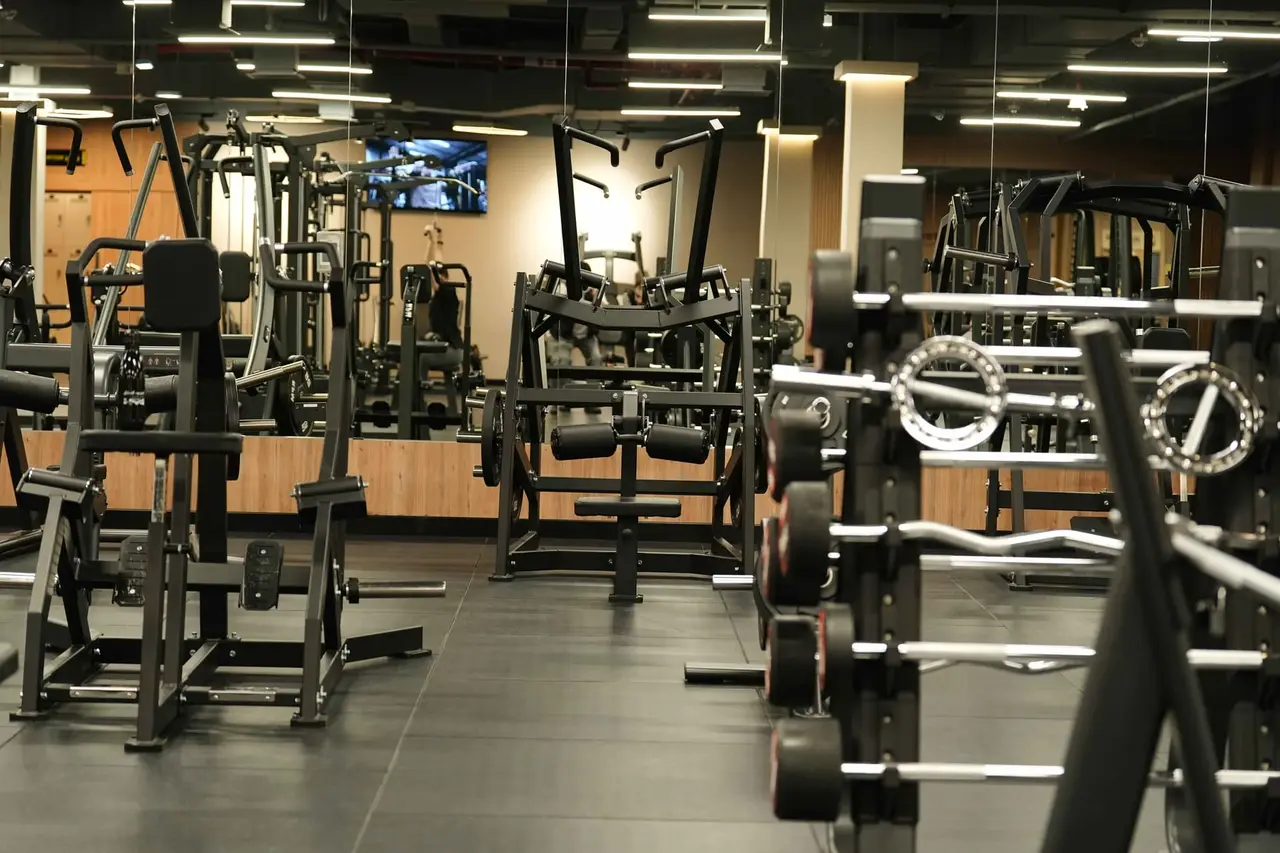
RPM's floor photos show a dumbbell rack, a rack of fixed barbells that includes EZ bars, and multi-station cable towers, so every version here can be done on the training floor in Al Manhal. A preacher bench or a curl machine is not in those photos; ask on your free tour what is on the floor. To have your grip and elbows checked, book a personal training session, and ask for a female personal trainer if you prefer.
Questions, answered.
What is the difference between a bicep curl and a hammer curl?
The grip. A bicep curl turns the palms up, where the biceps is strongest; a hammer curl keeps them facing each other, which shares more of the work with the brachialis and forearm. Most programmes use both, and the hammer curl page covers the neutral-grip version.
Are dumbbell curls or barbell curls better?
Neither wins outright. Dumbbells let each wrist rotate and reveal a weaker arm; a barbell or EZ bar lets you lift more in total and add weight in finer steps. Use one as your main curl and the other as a second exercise.
What can I do instead of curls if my elbow or wrist hurts?
Pain during a curl is a reason to stop, not to hunt for a version you can push through. Get it checked by a doctor or physiotherapist. Once you are cleared to train, many people find the EZ bar or a neutral grip more comfortable than a straight bar.
Can I work my biceps without weights?
Chin-ups with your palms facing you load the biceps with bodyweight, and a resistance band can stand in for the cable curl at home. At the gym, an underhand-grip lat pulldown builds towards your first chin-up.