What a cable machine is, and what it is for
Every cable station works the same way. A steel cable runs from a stack of weight plates, over one or more pulleys, to a clip where you attach a handle. You choose the load by moving a pin in the stack, and the direction of resistance by where the pulley sits. Because the cable pulls along its own line rather than straight down like a dumbbell, a single station can load almost any muscle from almost any angle.
That flexibility is why cables turn up in nearly every programme. Beginners like them because the load rises in small steps and nothing has to be balanced overhead; experienced lifters use them for accessory work after the big free-weight lifts. This page is one of the library's equipment guides. If you are comparing gyms rather than learning the station, choosing a gym with cable machines covers what to check on a visit.
Several names describe the same idea. A single adjustable column has one pulley that slides up and down. A functional trainer puts two adjustable columns in one compact frame. A cable crossover sets two tall towers facing each other across open floor, usually joined by a pull-up bar. A multi-station tower groups several stations around one frame, often with a pulldown seat and a low-row seat built in.
Attachments and what each one does
Most stations keep a rack or hooks of attachments nearby. These six cover nearly every exercise in a normal programme.
| Attachment | What it is | Common uses |
|---|---|---|
| Rope | A short, thick rope with a stopper at each end | Triceps pushdowns, face pulls, hammer curls, cable crunches |
| Short bar | A straight bar, or one with a slight bend for the wrists | Pushdowns, curls, upright rows |
| Long pulldown bar | A wide bar with angled ends | Lat pulldowns, straight-arm pulldowns |
| V-handle | A close handle that sets the palms facing each other | Seated rows, close-grip pulldowns |
| D-handle | A single stirrup handle for one hand, often used in pairs | One-arm rows, flyes, lateral raises, single-arm presses, Pallof presses |
| Ankle strap | A padded cuff that buckles around the ankle | Glute kickbacks, hip abduction, standing leg raises |
Clip the carabiner through the attachment's ring and check that its gate has closed before every set; a clip that has not shut fully can let go mid-rep.
Setting the pulley and the stack
- Find the pop-pin on the pulley carriage. Pull it, slide the pulley to the height you want and let go, then tug the carriage to make sure it has locked into a hole.
- High, above your head: pulldowns, triceps pushdowns, straight-arm pulldowns and high-to-low flyes.
- Middle, from chest to face height: face pulls at about forehead height, Pallof presses, standing one-arm rows and chest-height flyes.
- Low, at the floor: curls, lateral raises, seated rows on an adjustable column, low-to-high flyes and kickbacks with an ankle strap.
- Set the weight by pushing the pin fully through the plate you want. On a twin-column station, set both stacks to the same number for two-handed work.
- Step away until the plates lift clear at your start position, and line yourself up so the cable runs in the direction your arm will move.
Stack numbers do not compare between machines. Many columns use extra pulleys that change how heavy a pin number feels, so the same number on two stations can feel very different. Note the station as well as the weight in your log, and judge your first set by the reps, not the label.
Movements you can do on it
The library's movement pages cover each of these in depth, from set-up and technique to mistakes and sets and reps.
- Lat pulldown: high pulley and long bar, the main vertical pull for the back.
- Seated cable row: low pulley and V-handle, the horizontal pull to pair with it.
- Face pull: forehead height and rope, for the rear shoulders and upper back.
- Tricep pushdown: high pulley with a rope or short bar, a staple arm exercise.
- Bicep curl: low pulley with a short bar or a single handle.
- Lateral raise: low pulley and one handle, for the side of the shoulder.
- Rear delt fly: shoulder height, with the cables crossed or single handles.
Beyond those, cables handle chest flyes and crossovers, Pallof presses and woodchops for the trunk, cable crunches, pull-throughs for the glutes and hamstrings, and glute kickbacks. For the free-weight version of the fly, see the dumbbell fly.
Two sample cable workouts
Workout A: back and arms
Everything stays on one station, in an order that moves the pulley as little as possible.
| Exercise | Pulley and attachment | Sets × reps |
|---|---|---|
| Lat pulldown | High, long bar | 3 × 8–12 |
| Tricep pushdown | High, rope | 3 × 10–12 |
| Face pull | Forehead height, rope | 3 × 12–15 |
| Seated cable row | Low, V-handle | 3 × 10–12 |
| Cable curl | Low, short bar | 2–3 × 10–12 |
Workout B: chest, shoulders and trunk
This one needs two columns, or a crossover, for the flyes.
| Exercise | Pulley and attachment | Sets × reps |
|---|---|---|
| Cable fly | Chest height, a D-handle on each column | 3 × 10–12 |
| Rear delt fly | Shoulder height, a D-handle on each column | 3 × 12–15 |
| Pallof press | Chest height, one D-handle | 3 × 10 each side |
| Lateral raise | Low, one D-handle | 3 × 12–15 each side |
| Cable crunch | High, rope | 2–3 × 12–15 |
Rest about a minute between sets and stop each one with one or two good reps left. The training volume calculator helps you count what these sessions add to your week.
Mistakes at the cable station
| Mistake | What it looks like | The fix |
|---|---|---|
| Standing too close | The plates touch down between reps and the muscle gets a rest | Step back until the stack stays lifted at the start of every rep |
| Pulley at the wrong height | The cable pulls at an angle to the way your arm moves | Move the pulley so the cable lines up with the movement |
| Swinging the whole body | You lean and rock to get the handle moving | Lower the pin; a lighter weight moved cleanly trains the target muscle, not your momentum |
| Letting the stack crash | The plates bang together at the end of each rep | Return the handle under control so the plates barely touch |
| Skipping the clip check | The carabiner or the pin is not fully closed | Check both before every set, especially after someone else has used the station |
| Holding a whole crossover for one arm | Single-arm work on a twin station while others wait | Use one column, or let someone work in between your sets |
Cable machines at RPM
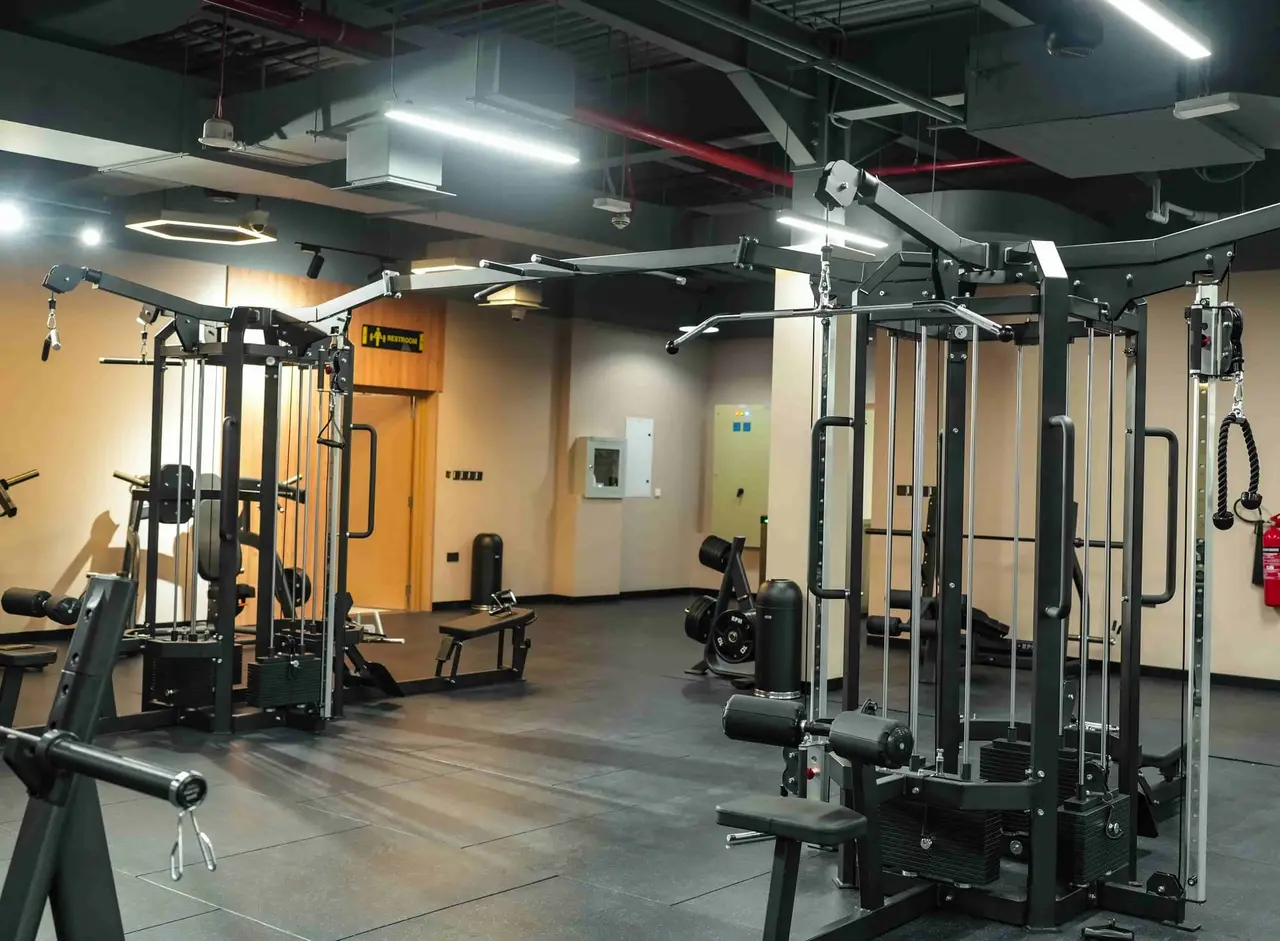
RPM's floor photos show multi-station cable towers set among benches on the training floor in Al Manhal, with pulleys at the top of each frame, pulldown seats with thigh pads, and a rope and single handles clipped to the stations. Photos cannot show which attachments are on hand on a given day, or every column type on the floor, so check both on a free guided tour. The women-only Ladies section has its own strength equipment, so ask which cable stations are there. To learn the station with a coach, book personal training.
Questions, answered.
What is a functional trainer?
A cable machine with two adjustable pulleys in one frame. Each pulley can sit anywhere from the floor to overhead, and you can work one arm or both, which makes it one of the most adaptable stations in a gym.
What is the difference between a cable crossover and a functional trainer?
A crossover has two separate towers set wide apart, so you can stand between them for flyes with a long arc. A functional trainer is more compact, with its columns closer together in one frame. The exercises are mostly the same.
Which attachments do I need for a home cable machine?
A rope, a short bar, two D-handles and an ankle strap cover most exercises. Add a long pulldown bar and a V-handle if the machine has a seat for pulldowns and rows.
Can I train my whole back on a cable machine?
Yes. Pulldowns, seated rows, one-arm rows, face pulls and straight-arm pulldowns cover both the vertical and horizontal pulls. The back training guide shows how to build them into a week.
How do I do a chest fly on the cable machine?
Set both pulleys at chest height with a D-handle on each, step forward between the columns and, with a slight bend in your elbows, bring your hands together in front of your chest in a wide arc. Setting the pulleys high shifts the work towards the lower chest; setting them low shifts it towards the upper chest.
Is the cable machine good for beginners?
Yes. The load moves in small steps, the handle follows a path you control without balancing a bar, and one station covers the whole body. The equipment guides show which other machines suit a first programme.