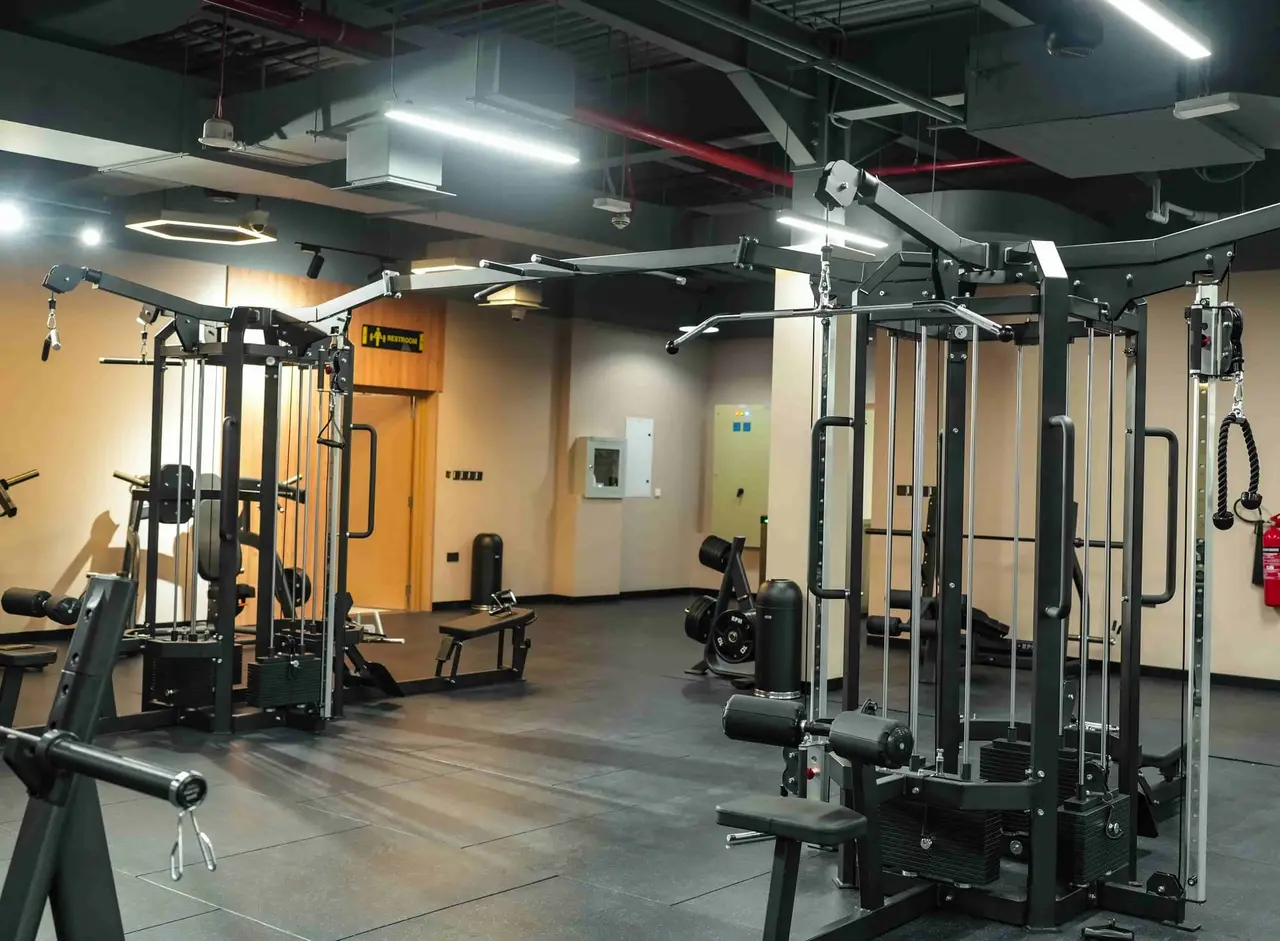
What the lat pulldown trains, and who it suits
The pulldown is a vertical pull: the same direction of movement as a pull-up, but with the load set on a weight stack instead of your bodyweight. The main worker is the latissimus dorsi, the broad muscle that runs from your upper arm down to your lower back and gives the back its width. The biceps bend the elbow, the muscles between the shoulder blades pull them down and together, and the rear shoulders help at the bottom of the rep.
That adjustable load is the point. Someone who cannot yet do a single pull-up can pull a fraction of their bodyweight with good form, and someone who can do ten can add load or slow the rep down. It is one of the first machines most coaches teach, and it stays in experienced lifters' programmes because it lets them train the lats hard without balancing anything. It sits at the centre of most back workouts, usually paired with a row.
Setting up the machine
- Set the thigh pads so your feet are flat and your thighs are pinned firmly when you sit. If you lift off the seat as you pull, the pads are too high.
- Choose the attachment. A long straight bar is the default; a neutral-grip (palms facing) or close-grip handle changes the feel, not the main muscle.
- Stand up, take the bar with a grip slightly wider than your shoulders, and sit down with it so the stack lifts a little. Your arms should be straight at the top.
- Set your torso: chest up, a slight lean back of roughly the angle you would sit in a comfortable chair, and your lower back neither rounded nor arched hard.
- Pick a weight you can pull to your upper chest ten times without leaning further back or yanking. Start lighter than you think; the stack numbers vary from one machine to the next.
How to do a rep
- Start every rep from a long arm with your shoulders slightly up, so the lats begin stretched.
- Pull your shoulder blades down first, then drive your elbows down and slightly back, as if you were putting them into your back pockets.
- Bring the bar to the top of your chest, around collarbone height. Your torso stays still; only the arms and shoulder blades move.
- Pause for a moment with the bar close to your chest and your chest up to meet it.
- Let the bar rise under control over about two seconds until your arms are straight again, and let your shoulders rise slightly at the top before the next rep.
Breathe out as you pull and in as the bar rises. If you find yourself holding your breath, the weight is too heavy for the reps you are doing. Our guide to breathing and bracing covers this in more detail.
Mistakes to fix first
| Mistake | What it looks like | The fix |
|---|---|---|
| Leaning back to move the weight | Your torso swings back as the bar comes down, turning the pull into a row | Take weight off and keep the torso angle fixed from the first rep to the last |
| Pulling with the hands | The forearms and biceps tire before the back does | Think of the hands as hooks and lead with the elbows |
| Short reps | The bar stops at chin height and never returns to a straight arm | Use a load you can take from full stretch to the chest |
| Bar behind the neck | The head goes forward and the bar touches the back of the neck | Pull to the front; most coaches no longer teach the behind-the-neck version because it forces the shoulder into an awkward position for no extra benefit |
| Letting the stack drop | The plates crash at the top of each rep | Control the bar up; the lowering half of the rep is half the work |
Grips and variations
Grip changes how the pull feels more than which muscle does the work: every version below is still a lat exercise. Rotating through two grips across a training block is a sensible way to keep the movement fresh.
Close-grip lat pulldown
A V-handle or a close grip shortens the distance between the hands and usually lets the elbows travel further, which many people feel as a stronger squeeze at the bottom. The biceps work a little harder.
Underhand (reverse-grip) pulldown
Palms facing you, hands about shoulder width. It resembles a chin-up and brings in more biceps; good for people building towards their first chin-up.
Single-arm pulldown
One handle, one arm at a time. It is useful when one side is clearly weaker, and lets you lean slightly into the working side for a longer range.
If the pulldown station is busy, the seated cable row or a one-arm dumbbell row trains the same muscles from a horizontal angle.
Sets, reps and where it fits in your week
| Goal | Sets × reps | How hard |
|---|---|---|
| Learning the movement | 2–3 × 10–12 | Stop with three or four good reps left in the tank |
| Building muscle | 3–4 × 8–12 | Finish each set with one or two reps left |
| Strength for pull-ups | 4–5 × 5–8 | Heavier, with a full pause at the chest |
Rest about one and a half to two minutes between heavier sets and around a minute for lighter ones; the rest-between-sets calculator gives a starting point for your goal.
Most back sessions pair one vertical pull, such as the pulldown, with one horizontal pull, such as a row. Twice a week is enough for most people. When you can complete every set at the top of your rep range with clean form, add the smallest weight increment the stack allows.
The lat pulldown at RPM
RPM's floor photos show multi-station cable towers with a pulldown seat and thigh pads on the training floor in Al Manhal. If you want someone to watch your first sets, a personal training session is the fastest way to get the grip, the torso angle and the load right.
Sources
Questions, answered.
What muscles does the lat pulldown work?
Mainly the lats, the wide muscles at the sides of your back. The biceps, the muscles between the shoulder blades and the rear shoulders assist.
Is the lat pulldown as good as pull-ups?
They train the same muscles. Pull-ups add the challenge of moving your own bodyweight; the pulldown lets you choose the load, which makes it better for learning and for adding volume. Many programmes use both.
Should I pull the bar in front of or behind my neck?
In front, to the upper chest. The behind-the-neck version puts the shoulder in an extreme position and offers nothing the front version does not.
How much weight should I start with?
A load you can pull to your chest ten times without leaning back or jerking. Stack numbers differ between machines, so judge by the reps, not the number on the pin.
Is the lat pulldown good for beginners?
Yes. It is one of the easiest back exercises to learn and to adjust, which is why it appears in most beginner programmes. See the back training guide for how to build a session around it.