What the pushdown trains, and where it goes in a session
The triceps has three heads. The lateral and medial heads run from the upper arm bone to the elbow and do most of the straightening; the long head also crosses the shoulder, so it is stretched most when your arm is overhead. A pushdown, with the upper arms by your sides, works all three, with the lateral and medial heads taking the larger share. That is why a complete triceps plan adds an overhead extension alongside it.
The pushdown is the easiest triceps exercise to learn and to load. There is nothing to balance, the cable sets the path, and the weight changes in seconds. It usually comes at the end of a push or upper-body session, after pressing has done the heavy work, or paired with a curl on an arm day. Some people call it a pressdown; it is the same exercise. The triceps guide shows how it fits with presses and overhead work.
Setting up the cable
- Move the pulley to its highest position and clip on a rope, a straight bar or a V-bar. The differences are covered below.
- Take hold. On a rope, grip just above the end stops with your palms facing each other; on a bar, palms down, hands about shoulder width or slightly narrower.
- Step in until the cable hangs straight down in front of you, just clear of your face. Feet hip width, or one foot a little behind the other for balance.
- Hinge forward slightly at the hips with your chest up, and pull the attachment down until your elbows sit at your sides and your forearms are roughly level with the floor. That is the start position.
- Choose a load you can push down 12 to 15 times without your elbows moving. Stacks differ between stations, so go by the reps rather than the number.
How to do a pushdown
- From the start position, straighten your elbows to push the attachment down. The upper arms stay exactly where they are.
- Finish with straight arms. With a rope, pull the ends apart so your hands end up beside your thighs.
- Hold for a moment and tighten the back of the arm.
- Let the attachment rise until your forearms are just above level, roughly chest height, and stop there; going higher lets the elbows float up.
- Keep the same slight lean and the same elbow position from the first rep to the last.
Picture your elbows pinned to the sides of your ribs. If they slide forward as the attachment rises, or your shoulders roll over the bar to force it down, the stack is too heavy. Exhale on the push and inhale as it comes back up.
Pushdown mistakes and how to fix them
| Mistake | What it looks like | The fix |
|---|---|---|
| Turning it into a press | The elbows flare out and the chest and shoulders lean over the bar | Lighten the stack and keep the elbows tucked by your sides |
| Elbows riding up | The elbows drift forward and up as the attachment rises | Stop the return as soon as the forearms pass level |
| Leaning your weight on it | The torso folds forward so bodyweight drives the bar down | Stand nearly upright with only a slight hinge, and reduce the load |
| Bent-back wrists | The wrists fold back over a straight bar | Keep the knuckles in line with the forearm, or switch to the rope |
| Bouncing short reps | The stack never settles and the arms never fully straighten | Finish each rep with straight arms and a controlled return |
Rope, bar, V-bar and the single-arm version
The movement is the same with every attachment. What changes is your wrist position, how much weight you can use and how the bottom of the rep feels.
Rope vs straight bar vs V-bar
The rope lets your hands travel apart and turn slightly at the bottom, which many people feel as a stronger finish, and it keeps the wrists neutral; expect to use a little less weight. The straight bar fixes your hands palms-down and generally moves the most load, but some wrists dislike it. The V-bar angles the hands partway and is a common middle choice. Use whichever your wrists and elbows are most comfortable with, and rotate between them across training blocks if you like.
Single-arm reverse-grip pushdown
Use a single D-handle with your palm facing up and push down beside your body, one arm at a time. You will need less weight than for the two-handed versions, and the weaker arm cannot hide behind the stronger one. Many people feel it more towards the inner part of the back of the arm. Keep the wrist straight and the elbow tight to your side.
If every cable station is taken, an overhead dumbbell extension or a kickback trains the same muscle, and pressing with your hands closer together, as in a close-grip bench press, loads it heavily.
How many sets and reps
| Goal | Sets × reps | How hard |
|---|---|---|
| Learning the movement | 2 × 12–15 | Stop with three reps left |
| Building the triceps | 3–4 × 10–15 | One or two reps short of failure |
| Finisher after pressing | 2 × 15–20 | Last set close to failure, without the elbows moving |
Rest about a minute between sets. Pushdowns recover quickly, which makes them easy to superset with a curl.
If you bench press or overhead press during the week, your triceps already get heavy work from those; pushdowns add focused volume on top. Twice a week suits most people. Add reps first, and when every set reaches the top of the range, move the pin down one plate. If that jump is too big, stay at the new weight and add a rep each session until it settles.
The tricep pushdown at RPM
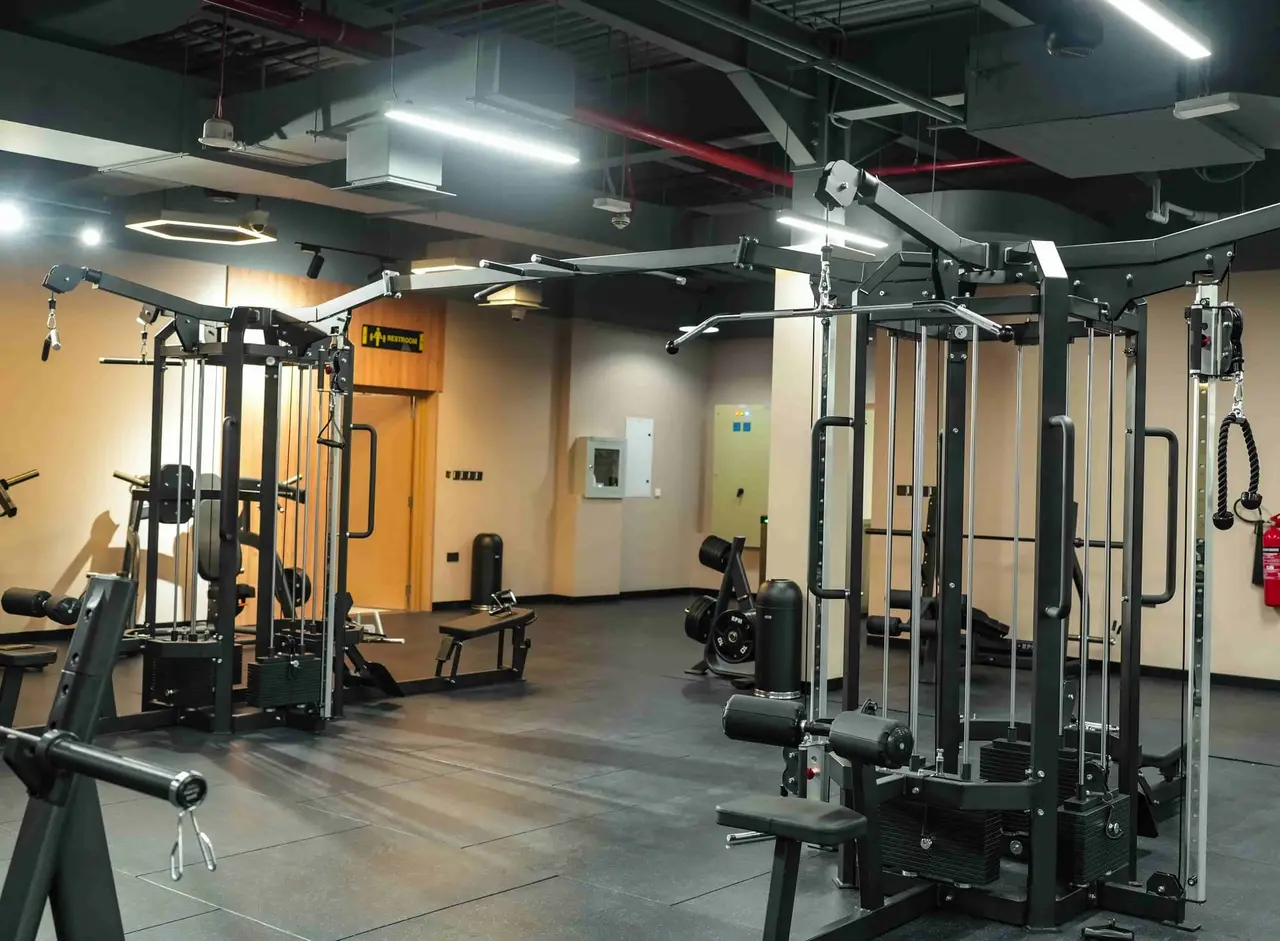
RPM's floor photos show multi-station cable towers on the training floor in Al Manhal, which is where you will do your pushdowns. Ask the team on your free tour which attachments are available on the station. If you want your elbow position checked before you start adding weight, book a personal training session.
Questions, answered.
Is it a tricep pushdown or a pulldown?
Pushdown, or pressdown: you push the attachment down by straightening your elbows. A pulldown is a back exercise in which you bend the elbows to pull a bar down to your chest; see the lat pulldown.
Tricep pushdown vs overhead extension: which is better?
They complement each other. The pushdown is easier to learn and load, with the lateral and medial heads doing more of the work. The overhead extension stretches the long head, which crosses the shoulder. A balanced plan includes one of each.
What muscles does the tricep pushdown work?
All three heads of the triceps, on the back of the upper arm. Your abs and the muscles around the shoulder blades work lightly to hold your posture.
What can I do instead of pushdowns with dumbbells?
An overhead dumbbell extension, holding one dumbbell in both hands behind your head, or a kickback, hinging forward and straightening one arm behind you. A close-grip dumbbell press works the triceps alongside the chest.
How heavy should pushdowns be?
Heavy enough that the last two reps of a set of 12 to 15 are hard, light enough that your elbows and torso stay still. If you have to lean over the bar to finish, the weight is too heavy.
Do pushdowns hurt your elbows?
Elbow pain during or after pushdowns is a reason to stop the exercise, not to switch grips and carry on. Get it checked by a doctor or physiotherapist before you train it again.