What the rotation adds, and who should use it
Named after Arnold Schwarzenegger, who made it popular, the Arnold press starts where a regular dumbbell press cannot: elbows in front of your body, dumbbells at chin height, palms towards your face, much like the top of a curl. As you press, the elbows open out to the sides and the palms turn to face forward, so by the time the dumbbells pass your forehead you are in an ordinary shoulder press. The lowering reverses the turn.
That start loads the front of the shoulder from a lower, longer position, and the side shoulders take a bigger share as the elbows sweep out. It is a variation of the dumbbell shoulder press, not an exercise for different muscles, and nothing suggests it builds the shoulders faster. Its value is variety, a longer range and a strong front-shoulder focus with lighter weights. Learn the regular press first. In a session it can be the day's main shoulder press, or a second, lighter press after a barbell overhead press. The shoulder exercise guide shows how to balance it with side and rear shoulder work.
Setting up
- Choose your seat. An upright bench with a back pad gives the most support; sitting on the end of a flat bench, or standing, also works, as the variations below explain.
- Pick a pair one or two steps lighter than your usual dumbbell shoulder press. The rotation and the low start make the same weight feel heavier.
- Get the dumbbells to your shoulders as you would for any seated press: rest them on your thighs, then lift them one at a time with a drive of the knee.
- Set the start: dumbbells in front of your chin or upper chest, palms facing you, elbows pointing forward and close together, upper arms roughly level with your chest.
- Feet flat and wide, ribs down, the back of your head in line with your spine.
How to do a rep
- Start pressing up, and at the same moment let the elbows travel out to the sides while the palms turn outwards.
- Finish the turn by about forehead height, palms facing forward, then press on to straight arms with the dumbbells above your shoulders.
- Keep the shoulders down and the neck long at the top rather than shrugging.
- Lower by reversing the movement: as the dumbbells come down past your forehead, bring the elbows forward again and turn the palms back towards you.
- Arrive back at chin height with the elbows in front, pause briefly, and start the next rep without bouncing.
Think of the press and the turn as one smooth spiral, not a press followed by a twist. Lower over two to three seconds, breathing in on the way down and out as you press. If the dumbbells wobble during the rotation, the pair is too heavy.
Mistakes to fix first
| Mistake | What it looks like | The fix |
|---|---|---|
| Pressing, then twisting | The dumbbells rise palms-in and turn only at the top | Start the turn as the press begins and finish it by forehead height |
| Elbows wide at the bottom | The start looks like a normal press, so the extra range is lost | Bring the elbows forward and close together at chin height |
| Leaning back | The lower back arches and the press becomes an incline press | A lighter pair; ribs down, hips and upper back against the pad |
| Too heavy | A fast, jerky rotation and short reps | Drop a pair: the turn should look the same on every rep |
| Shrugging | The shoulders rise to the ears at the top | Press the dumbbells up while keeping the shoulders low |
Pressing should feel like effort in the muscle, not a pinch in the joint. If the rotation causes pain at the front or top of the shoulder, stop the exercise and get it checked by a doctor or physiotherapist before you press again.
Seated or standing, the half Arnold and back support
Three set-up choices change how the Arnold press feels; the rotation itself stays the same.
Seated or standing Arnold press?
Seated, the bench takes your legs and balance out of it, so you can focus on the shoulders and usually handle slightly heavier dumbbells. Standing, your trunk and glutes hold you still, so you press lighter but train posture too, and you need nothing but a pair of dumbbells. For building the shoulders, seated is the simpler default; standing earns its place when every bench is taken or when you want the whole body involved.
Half Arnold press
Rotate on the way up as usual, then lower in a straight line with the palms forward, as in a regular press, and turn the palms back towards you only at the bottom, between reps. You keep the long start of each rep but the lowering gets simpler, which helps while you learn the full spiral, or late in a set when the turn starts to get sloppy.
With or without back support?
A back pad set upright, or one notch back, stops you leaning away and keeps the work on the shoulders. Without one, sitting on the end of a flat bench, your trunk has to stay upright on its own, so expect a little less weight and keep the ribs down. Avoid reclining the pad far back: that turns the movement into an incline press for the upper chest.
There is no common Arnold press machine. If you want a machine, use a shoulder press machine; if the dumbbells are busy, the barbell overhead press trains the same muscles, and the lateral raise covers the side shoulders on their own.
Sets, reps and progression
| Goal | Sets × reps | How hard |
|---|---|---|
| Learning the rotation | 2–3 × 10–12 | A light pair; stop with three or four smooth reps left |
| Building the shoulders | 3–4 × 8–12 | One or two reps left, rotation intact |
| Second press after a heavy lift | 2–3 × 10–15 | A moderate pair, close to failure with clean form |
Rest about one and a half to two minutes between sets. The hypertrophy volume calculator helps you count your weekly shoulder sets.
Use the Arnold press in place of your regular dumbbell press for a training block, or alongside a barbell press on a different day; doing both dumbbell presses heavy in one session mostly repeats the same work. Progress through the reps before the weight: when every set reaches twelve clean reps with the rotation intact, take the next pair and drop back to about eight. One or two pressing sessions a week is enough for most people.
The Arnold press at RPM
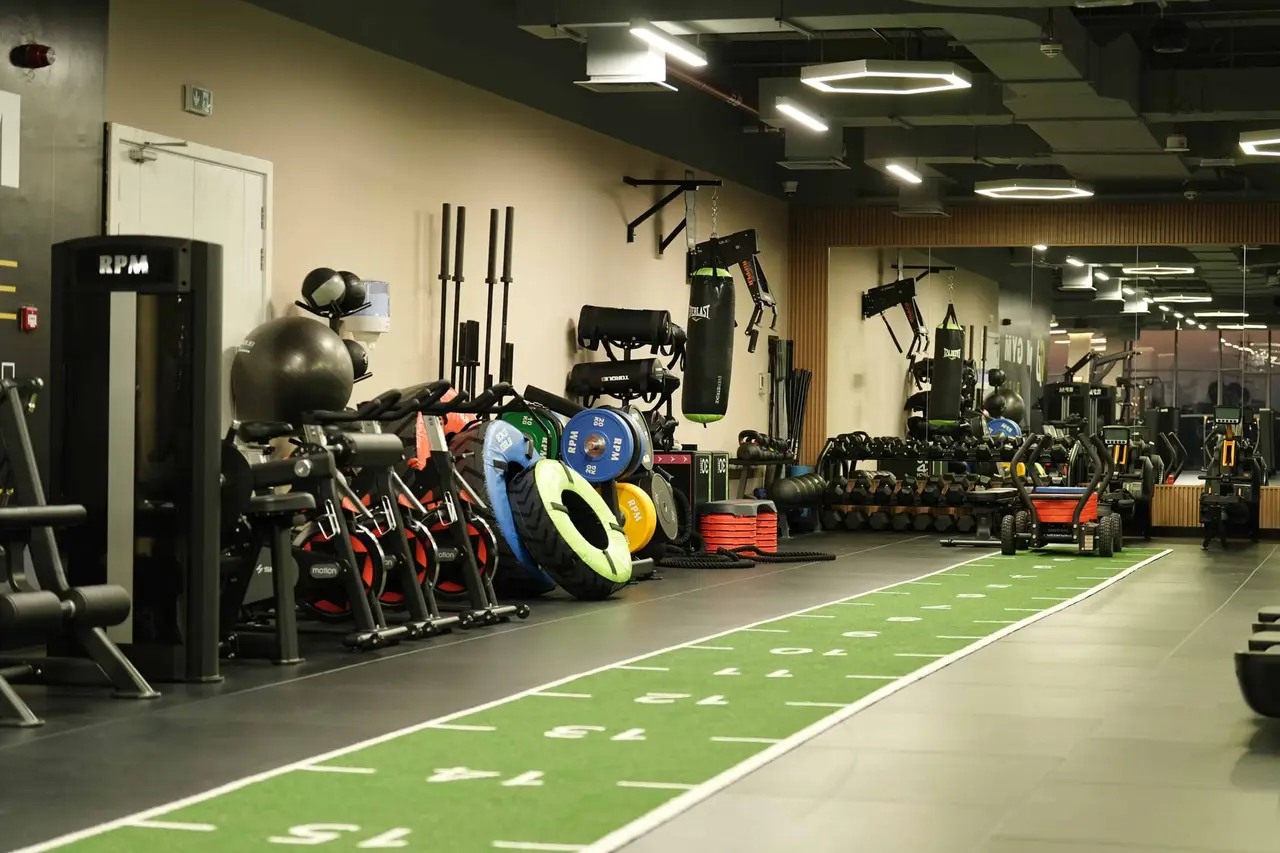
RPM's floor photos show a dumbbell rack in the functional area and flat benches on the training floor, so the standing version and the version seated on a flat bench are covered. A bench with an upright back pad does not appear in the photos, so ask on your free tour. For a coach to check your rotation and elbow position, book personal training.
Questions, answered.
Arnold press or dumbbell shoulder press: which is better?
Neither builds the shoulders better; they train the same muscles. The Arnold press adds a longer range at the bottom and a strong front-shoulder focus, but you use lighter dumbbells. The regular shoulder press lets you lift more and add load more easily. Many people keep the regular press as their main lift and use the Arnold press for a block of variety.
What muscles does the Arnold press work?
Mainly the front and side shoulders, with the triceps straightening the elbows and the upper back steadying the shoulder blades. The rear shoulders do little, so they still need their own exercise.
Do I still need lateral raises if I do Arnold presses?
Yes, if you want well-developed side shoulders. The side head helps in the Arnold press, but a lateral raise loads it on its own, through the range where it does most of its work. Pair one press with one raise and one rear-shoulder movement.
Arnold press or overhead press?
The barbell overhead press is a standing strength lift that moves the heaviest loads and involves the whole body; the Arnold press is a dumbbell variation for shoulder volume. They do different jobs, and a week can hold both. The overhead press vs dumbbell shoulder press comparison explains how to combine barbell and dumbbell pressing.
How heavy should the Arnold press be?
Heavy enough that the last two reps of a set of ten slow down while the rotation still looks the same as on the first rep. For most people that is one or two pairs lighter than their regular dumbbell press.