What shrugs train, and where they fit
The trapezius is a large, kite-shaped muscle with three parts. The upper fibres, running from the neck out to the shoulders, lift the shoulder blades, and they are what a shrug trains, with help from a smaller neck muscle beneath them, the levator scapulae. The middle fibres pull the shoulder blades together and the lower fibres draw them down; those parts get their work from rows, face pulls and rear delt flies, not from shrugging. Your grip works hard too, because the weights are heavy and you hold them for the whole set.
Shrugs are an accessory. People add them for bigger upper traps or a stronger grip, and they sit at the end of a back or shoulder session for a few sets. If you already deadlift heavy or do farmer's carries, the upper traps work hard in those lifts, and extra shrugs become optional rather than necessary. In the library the traps sit with the shoulders: the shoulder exercises guide covers the rest of the area and how many sets a week it needs.
Setting up
- Choose your tool. Dumbbells are the easiest start; a barbell suits heavier sets once the movement is grooved.
- Take a barbell from a rack set at mid-thigh height, or from the fixed-barbell rack, rather than deadlifting it from the floor. Lift dumbbells off their rack with a hip hinge, keeping them close.
- Stand tall with your feet about hip-width apart. Dumbbells hang at your sides, palms facing in; a barbell hangs against the front of your thighs, overhand, with your hands just outside your legs.
- Let your arms hang straight and relaxed. The elbows do not bend at any point.
- Pick a load you can lift to full height and hold for a second, twelve times. The traps are strong, so this is often heavier than you expect, but full height comes first. Straps are fine if your grip fails before your traps do.
How to do a rep
- Start with the shoulders sunk fully down, so the upper traps begin stretched.
- Lift the shoulders straight up towards your ears, as if trying to touch them with the tips of your shoulders.
- Hold the top for one or two seconds.
- Lower over about two seconds until the shoulders are fully down again.
- Keep your head still throughout, chin level and eyes forward.
The hold at the top is the test. If you cannot pause there for a second, the weight is too heavy and the reps have turned into bounces. Breathe steadily; there is no need to hold your breath on a movement this short. Neck or shoulder pain during shrugs, as opposed to a burn in the muscle, is a reason to stop and have it checked by a doctor or physiotherapist.
Mistakes to fix first
| Mistake | What it looks like | The fix |
|---|---|---|
| Rolling the shoulders | The shoulders circle forwards or backwards at the top | Go straight up and straight down; the roll adds nothing for the traps |
| Bending the elbows | The arms pull, turning the shrug into an upright row | Keep the arms long, like ropes hanging from the shoulders |
| Short, bouncy reps | The shoulders barely move under a heavy load | Take weight off, lift to full height and pause |
| Head poking forward | The chin juts out as the shoulders rise | Keep the chin tucked and the eyes forward |
| Dipping the knees | The legs kick to get the weight moving | Stand still; a leg drive turns it into a different lift, the power shrug |
Dumbbell, barbell, behind-the-back and other versions
The movement is the same in every version. The implement changes where the weight hangs and how much you can hold.
Dumbbell or barbell shrug?
Dumbbells hang at your sides, so the shoulders rise in a straight line and each side works on its own; they are the usual starting point. A barbell hangs in front of the thighs and takes heavier loads in smaller jumps, but it tends to pull the shoulders slightly forward. Neither is better for the traps. Many people start with dumbbells and add barbell sets later.
Behind-the-back shrug
The barbell is held behind the thighs instead of in front. With the bar behind you the shoulder blades tend to sit a little further back, and many people feel more of the middle of the traps. Picking up a loose barbell behind your back is awkward, so this version is usually done on a Smith machine, with lighter loads than a front shrug.
Smith machine or trap bar shrug
A Smith machine fixes the bar on rails, so you can set the start height exactly and rack it at any point, which makes heavy and behind-the-back sets easier to manage. A trap bar puts the handles at your sides like dumbbells but in one implement, so it takes the heaviest loads with a palms-in grip. Both do the same job as the free-weight versions.
Cable shrug
Stand between two low pulleys with a handle in each hand, or face one low pulley holding a straight bar. The cable keeps tension at the bottom of the rep and the stack allows small jumps, which makes it a useful option when the heavy dumbbells are taken.
If you would rather train the traps with a whole-body lift, farmer's carries load them along with the grip and the trunk; the loaded carry guide has sessions built around them.
Sets, reps and progression
| Goal | Sets × reps | How hard |
|---|---|---|
| Learning the movement | 2 × 12–15 | Light; full height and a one-second hold |
| Building muscle | 3–4 × 10–15 | One or two reps left, with the hold kept at the top |
| Heavy sets for grip and strength | 3 × 6–8 | Heavier, straps if needed, still lifting to full height |
Rest about a minute between sets. Twice a week, at the end of a back or shoulder session, is plenty.
Add reps first, then load. Progress stalls quickly when the weight outruns the range, so if the next pair or plate costs you height or the pause, stay where you are and add a second to the hold instead. If you deadlift or carry heavy in the same week, two or three sets are usually enough.
Shrugs at RPM
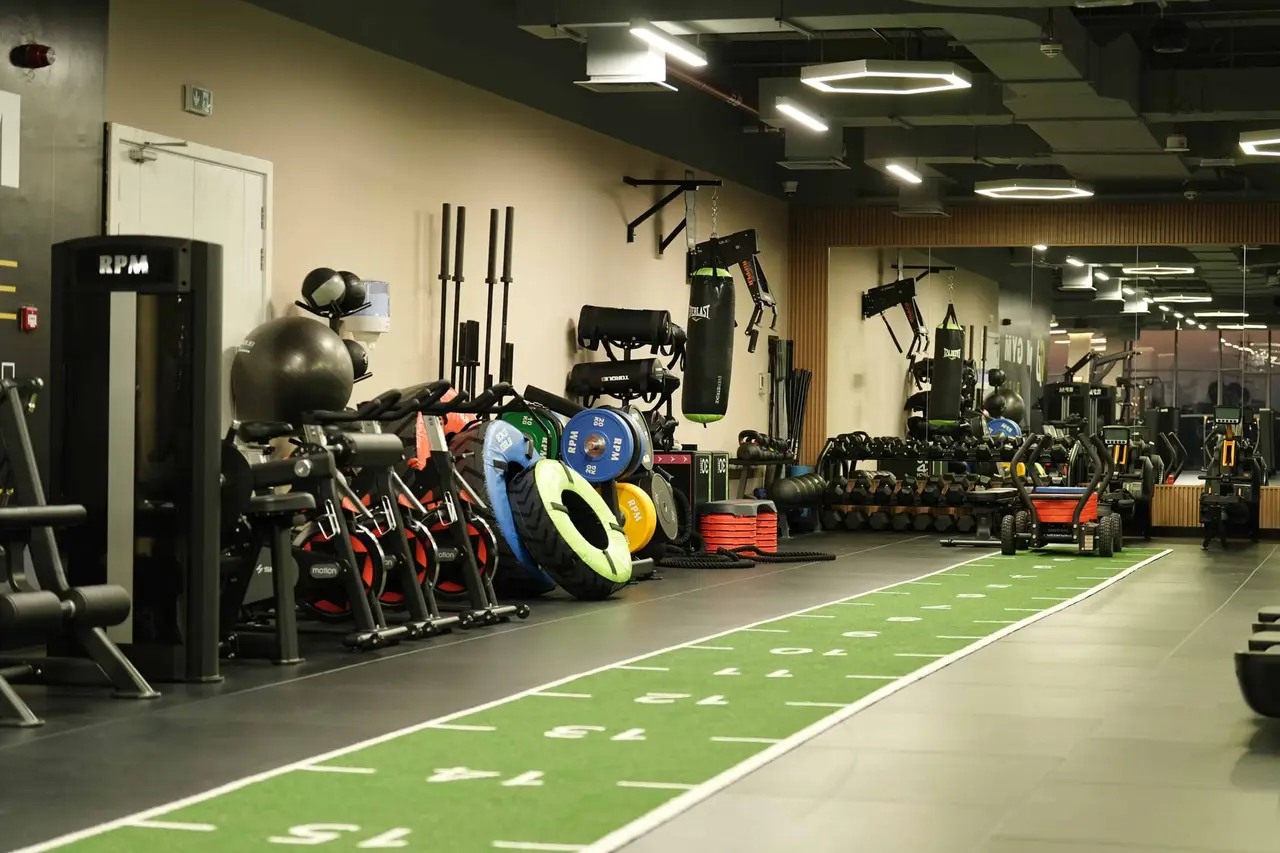
RPM's floor photos show the dumbbell rack, barbells with colour bumper plates and a rack of fixed barbells, so dumbbell and barbell shrugs need nothing else, and the cable towers have the low pulleys for the cable version. A Smith machine and a trap bar are not in the photos, so ask about them on your free tour. If you want your shoulder and neck position checked, a personal training session can do it in a few sets.
Questions, answered.
What muscles do shrugs work?
Mainly the upper trapezius, with a small neck muscle, the levator scapulae, helping. The forearms and grip work hard to hold the weight.
Shrugs or upright rows for the traps?
Both work the upper traps, but the upright row also trains the side shoulders and lifts the elbows high, a position some people find uncomfortable in the shoulder. The shrug works the traps with the arms simply hanging. If upright rows pinch, keep the shrug.
Shrugs or face pulls?
They train different parts. Shrugs work the upper traps by lifting the shoulders; face pulls work the rear shoulders and the middle and lower traps by drawing the shoulder blades back. Most upper-body plans have room for both.
Is there a machine for shrugs?
Some gyms have a plate-loaded shrug machine, and the Smith machine and trap bar do the same job; ask on a tour what is on the floor. On a cable station, low pulleys with handles work well.
Do I need shrugs if I deadlift?
Not necessarily. Heavy deadlifts and farmer's carries load the upper traps hard. Add shrugs if you want more trap size or grip work, or if you do not deadlift at all; the trap bar deadlift is another lift that trains them.
Are shrugs good for women?
Yes, as for anyone who wants stronger upper traps and grip. Women who would rather not build the traps much can keep shrugs light or leave them out; they are an accessory, not a requirement.