What a burpee is, and what it trains
The exercise is named after Royal H. Burpee, an American physiologist who used a four-count version as a quick fitness test in the 1930s: squat, kick the feet back, bring them in, stand. The push-up and the jump were added later, and that longer version is what most people mean by a burpee today.
Each rep strings several movements together. The squat down and the jump up use the quads, glutes and calves. Lowering to the floor and pushing back up is a push-up, so the chest, front shoulders and triceps work. Holding the plank in between asks the trunk to stop the hips from sagging. Because the whole body travels from standing to lying and back many times a minute, your heart rate and breathing climb faster than in almost any strength exercise.
That is why burpees turn up in conditioning circuits, session finishers and race training rather than as a strength builder. They never get heavier, only faster or longer, so they will not replace squats or presses for building muscle. Beginners can start on day one with the step-back version described below; the full jumping rep becomes a fair test of fitness once you can do ten in a row with the same shape. The exercise library lists the strength movements that pair well with them.
Before you start: space, surface and your level
- Clear a patch of floor about your own length plus a step, away from benches and dumbbells, on a surface that does not slip. A mat is fine under the hands, but do not land jumps on a soft one that shifts.
- Wear trainers with grip. Socks and bare feet slide in the plank and on the landing.
- Stand with your feet about hip-width apart, weight through the whole foot and arms relaxed at your sides.
- Pick your starting version. New to burpees? Begin with the step-back version without the push-up, and add the jump back and the push-up once ten steady reps feel easy.
- Decide the work before you start, a number of reps or a fixed time, so you pace the whole set instead of sprinting the first five.
How to do one burpee
- Squat down and place your hands flat on the floor just in front of your feet, shoulder-width apart.
- Shift your weight onto your hands and jump both feet back so you land in a high plank: a straight line from head to heels, hands under your shoulders.
- Lower your chest and thighs to the floor under control, or do a full push-up if you can keep your body straight.
- Push back up to the plank, then jump your feet forwards so they land flat, just behind or beside your hands.
- Stand and jump, reaching your arms overhead. Land softly with bent knees and flow straight into the next rep.
Breathe out as you push up from the floor and again as you jump; breathe in as you drop. The cue that fixes most burpees is to keep the plank honest: if your hips sag or pike when your feet land behind you, slow down until they stop. Speed comes from smooth changes between positions, not from throwing yourself at the floor.
Mistakes to fix first
| Mistake | What it looks like | The fix |
|---|---|---|
| Sagging hips in the plank | The lower back dips towards the floor as the feet land | Brace before the feet go back; step back instead if you cannot hold the line |
| Belly-flopping | The body drops to the floor in one heavy slap | Lower with the arms, or put the knees down first, and do not let the chest bounce |
| Feet landing far from the hands | You stand up out of a deep lunge, or round your back to get up | Jump the feet in until they land flat, close to your hands |
| Stiff landings | The jump finishes on locked knees with a thud | Land on the whole foot with soft knees, as quietly as you can |
| Going out too fast | The first ten reps fly, then every rep slows and the shape falls apart | Choose a pace you can hold to the end; a steady rep every few seconds beats a sprint and a stop |
Burpees load the wrists, shoulders, knees and lower back in quick succession. If any of them hurts during or after a set, stop, and get it checked by a doctor or physiotherapist before you carry on. If you are pregnant, or have been told you have abdominal separation, ask your doctor or midwife whether burpees suit you; this page gives no guidance for either.
Easier and harder burpees
The basic rep can be scaled down or built on. These three versions cover most of what people search for and most of what programmes use.
No-push-up, step-back burpee
Hands on the floor, then step one foot back and then the other into a plank, step them back in and stand, finishing with a calf raise or a small hop instead of a full jump. Nothing lands with force, so it suits beginners, heavier lifters, people coming back after a break and anyone training at home with neighbours below. Putting your hands on a sturdy bench or box instead of the floor makes it easier still.
Burpee broad jump
Instead of jumping straight up, you jump forwards as far as you can from both feet, land, and drop into the next burpee where you landed. It is one of the stations in a HYROX race, so it is a staple of HYROX-style training. The forward landing asks more of the knees and hips than a vertical jump, so learn it with short jumps first. RPM is an independent gym, not an official HYROX venue: check the current HYROX rulebook for what a race rep has to include.
Burpee box jump-over
Do a burpee facing a low box, jump onto it or over it and land on both feet, then do the next burpee on the far side. Two moves are chained together, which makes it a conditioning drill rather than practice for either one. Use a soft plyo box at a low height, and step over or step down once your legs tire; the box jump page covers the jump itself.
Short on space, or the floor is busy? A kettlebell swing or a set of wall balls raises the heart rate in a similar way on less floor, and a squat thrust, the burpee without the push-up and the jump, keeps the pattern.
Sets, reps and burpee workouts
| Goal | Sets × reps | How hard |
|---|---|---|
| Learning the rep | 3–4 × 5–8 step-back burpees | Every rep the same shape; rest until your breathing settles |
| Building conditioning | 6–10 rounds of 30 seconds on, 30 seconds off | Breathing hard, but the last round looks like the first |
| Finisher after strength work | 3 × 10 | Steady pace, no rushing through the plank |
| Race-style practice | Short blocks of burpee broad jumps between runs | A pace you could hold for the whole race |
Rest is part of the plan: in conditioning work the clock sets it, and while you are learning, rest as long as you need for clean reps. The rest-between-sets calculator helps when burpees sit inside a lifting session.
A short conditioning circuit
Three to five rounds, with a minute of rest between rounds, after a warm-up.
| Exercise | Reps or time | Notes |
|---|---|---|
| Burpee | 10 | The version in which you can hold the plank |
| Kettlebell swing | 15 | The bell rises from the hip snap, not the arms |
| Goblet squat | 10 | Moderate weight, full depth |
| Plank | 30 seconds | Hips in line with the shoulders |
Progress one thing at a time: first the version (step-back, then jump-back, then with the push-up), then the reps per round, then the number of rounds, and only then shorter rests. A useful benchmark is how many clean reps you complete in a fixed time; retest it every few weeks rather than every session. Two or three short burpee blocks a week are plenty alongside strength training, and they belong at the end of a session, when nothing heavy follows.
Burpees at RPM
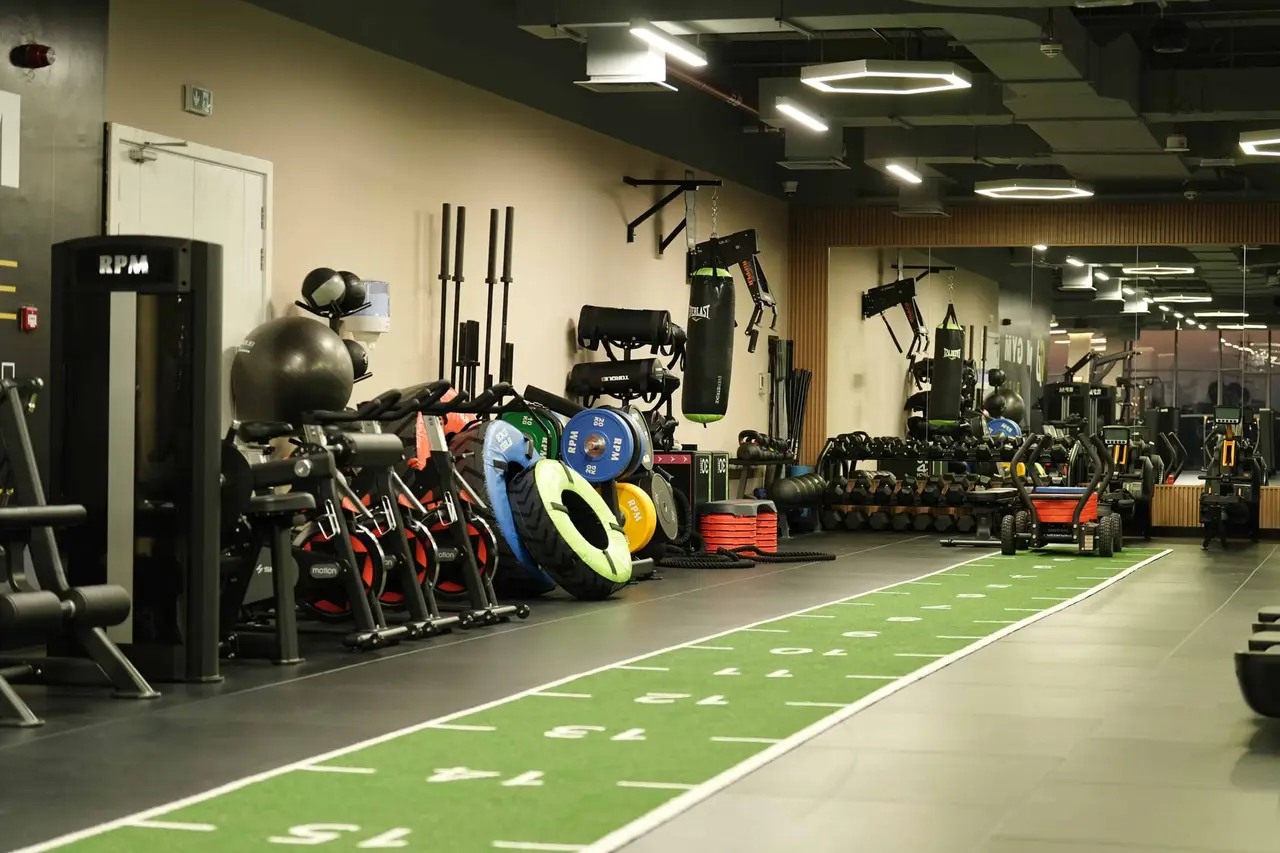
Burpees need nothing but floor. RPM's functional area in Al Manhal has a turf lane with room for broad jumps and lines of burpees away from the benches, and the women-only Ladies section has its own strength equipment; ask on a free guided tour where floor work fits at the hour you train. For a coach to choose your version and pace, see personal training or HYROX-style training at RPM.
Questions, answered.
What muscles do burpees work?
The quads, glutes and calves in the squat and the jump, the chest, front shoulders and triceps in the push-up, and the trunk in the plank. The heart and lungs work hardest of all, which is why burpees are used for conditioning more than for building muscle.
What is the difference between a burpee, a squat thrust and a sprawl?
A squat thrust is the original four-count move: squat, kick back to a plank, bring the feet in, stand, with no push-up and no jump. A sprawl, borrowed from wrestling, throws the legs back and drops the hips to the floor, then snaps back up. A burpee adds a push-up and a jump to the squat thrust.
How many calories does a burpee burn?
There is no honest single number. It depends on your body size, how fast you move and how long you keep going. Burpees are hard work for the time they take, but this page gives no calorie figure; the calories burned calculator gives a rough estimate for a whole session.
Are burpees better than running?
They do different jobs. Running builds the ability to keep going for a long time and is the skill a runner needs; burpees pack a lot of whole-body work into a few minutes and need almost no space. Many people do both, and HYROX-style training mixes them on purpose.
What can I do instead of burpees if a joint hurts?
If your wrists, shoulders, knees or back hurt, stop and get it checked by a doctor or physiotherapist rather than looking for a workaround. If nothing hurts and you just want a gentler option, the step-back burpee with your hands on a bench takes out the jumps and the drop to the floor. If you are pregnant, ask your doctor or midwife first.
Are burpees good for beginners?
Yes, in the step-back version. Build up to ten smooth reps before adding the jump back and the push-up, and keep sets short so the form holds. The exercise library has the strength basics worth learning alongside them.