How the quads work
The quadriceps are four muscles on the front of the thigh. The vastus lateralis runs down the outside and is the largest; the vastus medialis forms the teardrop shape just above and inside the knee; the vastus intermedius lies underneath, against the bone; and the rectus femoris runs down the middle. All four merge into one tendon that wraps around the kneecap and attaches to the shin, so when they contract, the knee straightens. They also work as brakes: walking downstairs, landing from a jump or lowering into a squat, the quads control how fast the knee bends.
The rectus femoris is the odd one out because it also crosses the hip, where it helps lift the thigh. When the hip and knee bend together, as at the bottom of a squat, its overall length hardly changes, so it tends to contribute less than the other three. It is worked harder when the hip stays open while the knee bends and straightens, which is what the leg extension, the sissy squat and the reverse nordic have in common. A complete quad programme therefore pairs a squat-type movement with at least one of those.
What trains the quads
Most quad exercises share one feature: the knees travel forward over the toes while the torso stays fairly upright. The more the knee bends under load, the more the quads have to do. Grouped by the job they do:
- Squats. The back squat handles the most weight; the front squat and the goblet squat keep you more upright, which pushes the work further towards the quads. A sumo squat widens the stance and hands part of the job to the inner thighs.
- Machine squats and presses. The hack squat and the leg press let you push hard with your back supported; the hack squat vs leg press comparison explains which suits whom.
- Single-leg work. The Bulgarian split squat, the lunge and the step-up train each thigh on its own; an upright torso and a shorter stance or lower step keep the quads in charge.
- Isolation. The leg extension is the one common machine that trains the quads alone. Without a machine, the sissy squat (rising onto the balls of the feet and leaning back as the knees travel far forward) and the reverse nordic (kneeling tall and leaning back from the knees with the hips kept straight) do a similar job with bodyweight. Both are advanced: start with a small range and lengthen it gradually.
- Holds. The wall sit builds quad endurance with no equipment, as a finisher or at home.
Which machine trains the quads? An honest comparison
The question people search for most is which machine builds the quads. The honest answer is that three machines do most of the job, each in a different way, and none makes the others redundant.
| Machine | What it does for the quads | Worth knowing |
|---|---|---|
| Leg extension | Trains all four quads, including the rectus femoris, with nothing else helping | Moderate loads and a slow lowering; it trains neither the hips nor balance |
| Hack squat | Deep knee bend with an upright, supported torso: the most quad-focused squat machine | Not every gym has one |
| Leg press | Quads and glutes together; feet lower and closer on the platform put more on the quads | Lower only as far as your hips stay on the pad |
| Smith machine | Squats and split squats on a fixed bar path, with the feet able to sit slightly forward | A different skill from a barbell squat in a rack |
| Pendulum or belt squat | Squat patterns that load the legs without a bar across the shoulders | Less common; check before planning around one |
The Smith machine guide explains how that bar differs from an unguided one, and the gym machine names page gives the Arabic name for each machine.
So which is the best quad exercise? For most people it is a combination rather than a single lift: one squat pattern you can load heavily, with a barbell or on a machine, one single-leg movement, and the leg extension or a bodyweight equivalent for the front of the thigh on its own. Choose the squat you can keep progressing for months without pain; that matters more than which one it is.
How often and how many sets
Twice a week suits most people, with at least two days between hard quad sessions; deep squats and split squats leave the thighs sore for longer than leg extensions do. A common coaching range is about 10 to 20 hard sets a week for the quads once you have trained for a while, and roughly 6 to 10 when you are starting out, the same range the leg training guide uses for each leg muscle. Squats, presses, split squats, step-ups and extensions all count in full; hinges such as the Romanian deadlift count for very little.
The quads respond to a wide range of reps. Sets of 6 to 10 on squats and presses and 10 to 20 on extensions and single-leg work both build muscle, provided each set ends with no more than two or three good reps left. Add reps at the same load until every set reaches the top of its range, then add a little weight. The hypertrophy volume calculator totals your weekly sets.
Two sample quad sessions
Session A: machines and barbell
Built around a squat pattern, then the leg press for volume. If there is no hack squat, use the back squat or the front squat.
| Exercise | Sets × reps | Coaching note |
|---|---|---|
| Hack squat or back squat | 3–4 × 6–10 | The full depth you can control, two reps left |
| Leg press, feet low and hip-width | 3 × 10–15 | Hips stay on the pad |
| Bulgarian split squat | 2–3 × 8–12 each leg | Upright torso, slightly shorter stance |
| Leg extension | 2–3 × 12–20 | Pause at the top, lower slowly |
Session B: dumbbells and bodyweight
Needs only dumbbells, a box and a wall, so it suits a busy floor, or home with lighter loads. The step-up and wall sit pages cover the details.
| Exercise | Sets × reps | Coaching note |
|---|---|---|
| Goblet squat, heels raised on small plates | 3 × 10–15 | Knees travel forward, chest up |
| Step-up, low to mid step | 3 × 8–12 each leg | The top leg does the work |
| Walking or reverse lunge | 2–3 × 10–12 each leg | Even, controlled steps |
| Wall sit | 2 × 30–60 seconds | Thighs parallel, steady breathing |
Each session is about 10 to 12 hard sets for the quads. Train the back of the thigh on the same day or another: the hamstring guide has the hinges and curls.
Quad training at home, and around sore knees
At home, bodyweight and a staircase go a long way: split squats, step-ups, slow squats with the heels raised on a thick book, wall sits and, for the strong, sissy squats holding a door frame. Make them harder by slowing the lowering to three or four seconds, pausing at the bottom, moving to one leg or wearing a loaded backpack. A gym becomes necessary when you need more load than that.
Many people search for quad exercises for bad knees or knee pain, or for physiotherapy programmes. Those are clinical questions this page cannot answer: knee pain has many causes, and the right exercises depend on which one you have. See a doctor or physiotherapist, follow the plan they give you, and ask them which gym movements fit around it. Muscle soreness a day or two after leg training is normal; sharp pain at the knee during a set is a reason to stop.
Quad training mistakes
- Cutting depth to lift more. Shallow squats and half leg presses train only the top of the range; take weight off and use the depth you can control.
- Letting the heels lift. If stiff ankles stop the knees travelling forward, raise the heels on small plates or a wedge rather than tipping onto your toes.
- Feet too high on the leg press. A high, wide foot position moves work to the glutes; for the quads, place the feet lower.
- Kicking the leg extension. Momentum takes the quads out of the rep; lift in about a second and lower in two or three.
- Training only the front of the thigh. Pair quad work with hamstring work in the same week.
- Ignoring a knee that complains. Soreness in the muscle is expected; pain in the joint is not, so stop and get it looked at.
Quad training at RPM
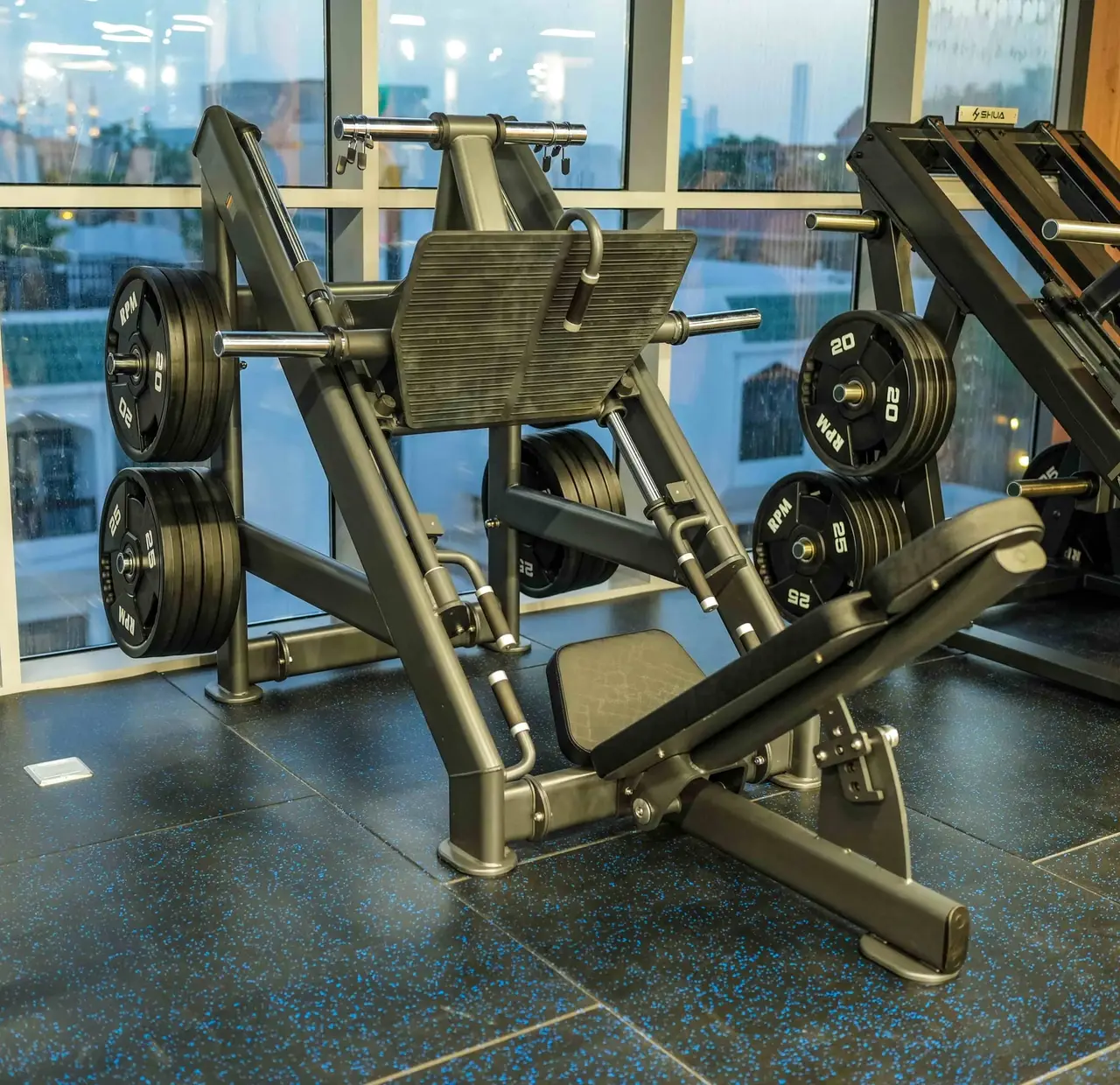
RPM's photos of the Al Manhal floor show squat racks with barbells and colour bumper plates, a plate-loaded 45-degree leg press and other plate-loaded machines, flat benches, a dumbbell rack, kettlebells and soft plyo boxes: enough for every squat, press and single-leg movement above. A hack squat, a leg extension and a Smith machine are not in those photos, so ask which are on the floor in the Mixed and Ladies sections during your free tour.
This page zooms in on the front of the thigh; the leg training guide plans the whole leg day across the quads, hamstrings, glutes and calves. For a programme written around your goals, see personal training or a female personal trainer.
Questions, answered.
What quad exercises can I do with dumbbells?
Goblet squats, with the heels raised for extra quad work, Bulgarian split squats, step-ups, lunges and the dumbbell sumo squat. Single-leg versions keep moderate dumbbells challenging; the dumbbell guide covers choosing a pair.
Are quad exercises different for women?
No. The muscles and movements are the same for everyone; only loads and preferences differ. Women who also want a glute emphasis add hip thrusts and Romanian deadlifts, as the glute guide explains.
Can older adults train their quads at the gym?
Usually, at the right level. Strong quads help with everyday tasks such as climbing stairs and getting up from a chair, and the leg press, squats to a bench and low step-ups are common starting points, with a coach scaling each exercise to you.
How do I stretch my quads?
Stand on one leg, holding something for balance, bend the other knee and hold that ankle behind you, keeping the knees together and pushing the hips slightly forward. Hold for about thirty seconds a side after training. Stretching helps comfort and range of motion but builds little strength; the cool-down guide shows where it fits.
Do squats work the quads or the glutes?
Both. A deep squat trains the quads and glutes hard, and how upright you stay decides the balance: a front squat or a heels-raised goblet squat favours the quads, while a back squat with more forward lean brings the hips in.