What wall balls train, and who they suit
Each rep is two jobs joined together. The squat and the stand use the quads and glutes. The throw starts in the legs and is finished by the shoulders and arms, which push the ball up and away from the chest. Catching a ball that falls from several metres and absorbing it into the next squat works the trunk and the upper back. String twenty or thirty of those together and your breathing becomes the limit long before any single muscle does.
That is why wall balls belong to conditioning rather than strength training. The ball is light next to what you could squat, so it will not build leg strength the way a goblet squat or a barbell squat will. What it builds is the ability to keep squatting and pushing while you are out of breath, which is also why it closes a HYROX race. Beginners can learn it with a light ball and a lower target; full race-standard sets are intermediate work. The exercise library has the strength movements that support it.
Setting up: the ball, the target and your stance
- Use a wall ball: a large, soft medicine ball made to hit a wall and be caught. A hard or sand-filled slam ball is built for the floor, not for a wall.
- Find a target. Event targets are usually a marked line or ring about three metres up; while you learn, a clearly marked spot on a solid wall that the gym lets you throw at will do. Check the house rule first.
- Choose a ball you could throw fifteen times without your arms giving out. Lighter is fine while you learn the rhythm.
- Stand an arm's length or a little more from the wall, feet shoulder-width apart, toes turned slightly out.
- Hold the ball at chest height with your hands under and to the sides of it, elbows below the ball rather than flared out.
How to do a rep
- Squat with the ball at your chest until your hip crease is below the top of your knee, chest up and weight through the whole foot.
- Drive up hard out of the squat. As your hips and knees straighten, push the ball up and slightly forwards from your chest.
- Let go as your arms straighten, aiming for the ball to hit the target at the top of its flight.
- Watch it come back and catch it at chest height with soft arms, letting your elbows bend.
- Use the weight of the catch to move straight into the next squat, so each rep flows into the next.
Breathe out as you throw and in as the ball falls. The cue to remember: the legs throw the ball and the arms only steer it. If your shoulders tire long before your legs, you are pushing with the arms and not standing up fast enough.
Mistakes to fix first
| Mistake | What it looks like | The fix |
|---|---|---|
| Shallow squats | The hips stop well above the knees, especially late in a set | Squat to a low box or a second ball as a depth marker while you learn |
| Throwing with the arms | The squat finishes, then the arms press the ball up as a separate move | Time the push with the stand so the ball leaves as your legs straighten |
| Standing too far from the wall | The ball hits low and bounces back out of reach | Step in until the ball drops back to your chest |
| Catching with straight arms | The ball slaps into your hands and jolts the shoulders | Reach to meet it with soft elbows and bring it into your chest |
| Heels rising | Your weight tips onto your toes at the bottom | Keep pressure through the middle of the foot; a slightly wider stance helps |
| Racing the first reps | The first twenty are fast, then you stop every few reps | Split big sets into planned chunks from the start |
Wall balls load the shoulders and lower back on every rep. If either hurts, stop, and get it checked by a doctor or physiotherapist before you carry on.
Target height, ball weight and HYROX-style sets
Most questions about wall balls come down to how high, how heavy, and how they compare with other squat-and-press moves.
Target height and ball weight
Event standards usually put the target around three metres high, a little lower in many women's divisions, with balls commonly between about four and nine kilograms. Those are race numbers, not starting points. To learn the movement, use a light ball and a target you reach on every rep, and raise the height before the weight: a heavier ball that falls short of the target only teaches you to miss.
Wall ball vs thruster
Both join a front squat to an overhead push. A thruster uses a barbell or dumbbells and finishes with the arms locked out overhead, so it can be loaded far heavier and builds more strength. A wall ball lets go of the ball, so there is no lockout and every rep includes a catch, which makes it lighter and better suited to long sets. A dumbbell thruster is a fair substitute when there is no wall or ball.
HYROX wall ball standards
In a HYROX race, wall balls are the final station after the last run, and a rep counts only when you reach the required squat depth and the ball hits the target zone. The ball weight, target height and number of reps depend on the division and can change between seasons, so check the current official rulebook rather than a figure you find online. RPM is an independent gym, not an official HYROX venue; HYROX-style training at RPM covers how the stations are practised.
No ball or wall to use? A dumbbell or kettlebell thruster, or a goblet squat followed by a push press, covers the same pattern, and burpees or the kettlebell swing fill the same conditioning slot.
Sets, reps and wall ball workouts
| Goal | Sets × reps | How hard |
|---|---|---|
| Learning the rhythm | 3–4 × 10 | Light ball, every rep on target, rest until your breathing settles |
| Conditioning | 5 × 15–20 | Breathing hard, but no missed targets |
| Race-style practice | Big sets split into planned chunks after a run or a row | A pace you can hold to the last rep |
Rest a minute or two between sets while you learn. For race practice, plan the breaks in advance, such as sets of ten with a few breaths between them, instead of going until you have to stop. The rest-between-sets calculator gives a starting point.
A short wall ball session
After a warm-up, three or four rounds with two minutes of rest between rounds.
| Exercise | Reps or time | Notes |
|---|---|---|
| Wall ball | 15 | Every rep to the target |
| Burpee | 8 | Smooth; step back if you need to |
| Goblet squat | 10 | Slow lowering, full depth |
| Sled push on the turf | One length | Steady drive, not a sprint |
Progress in this order: depth and target on every rep, then reps per set, then fewer breaks, then a heavier ball. Once or twice a week is plenty alongside strength work. If you are training for a race, practise wall balls on tired legs, after a run or a sled push, because that is how you will meet them on race day.
Wall balls at RPM
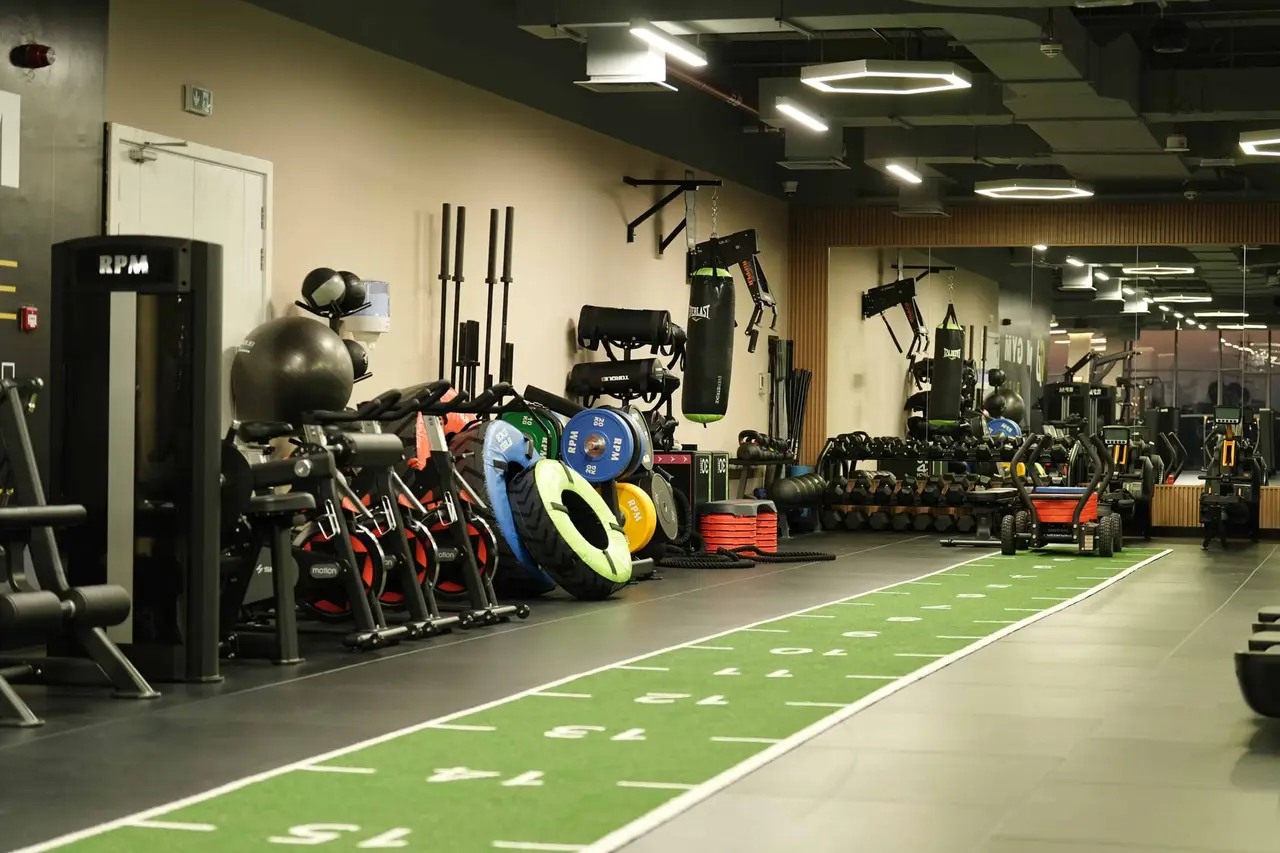
RPM's floor photos show medicine balls on a ball rack in the functional area in Al Manhal, alongside the turf lane, sled, kettlebells, battle ropes and soft plyo boxes. They do not show a wall-ball target on the wall, so ask on a free guided tour which balls are meant for wall throws and where you can throw them. Coaching for race stations is part of HYROX-style training at RPM, and a personal training session can set your depth, ball weight and pace.
Questions, answered.
What muscles do wall balls work?
The quads and glutes in the squat and the drive up, the shoulders and triceps in the throw, and the trunk and upper back in the catch. Over a long set, the heart and lungs work hardest of all.
What is the difference between a wall ball, a medicine ball and a slam ball?
A wall ball is a type of medicine ball: large, soft and built to hit a wall and be caught. Other medicine balls are smaller and firmer, for throws and passes. A slam ball is heavy and hard and made to be driven into the floor without bouncing, so do not throw one at a wall. The medicine ball and slam ball guide covers the other throws.
What weight wall ball should I use?
One you can throw to the target fifteen times with full depth. For a race, your division sets the weight, so check the current rulebook and build up to it over weeks rather than starting there.
What can I do instead of wall balls?
A dumbbell or kettlebell thruster is the closest match. If your shoulders hurt, though, stop and have them checked by a doctor or physiotherapist rather than switching exercises. For conditioning without overhead work, try burpees, swings or the sled.
What are wall ball sit-ups?
A sit-up in which you throw a medicine ball against a wall or to a partner at the top and catch it on the way back down. It is a trunk exercise with a throw, not a version of the squat-and-throw wall ball on this page.