What it trains, and why dumbbells on an incline
Tilting the bench changes the direction of the press: your arms drive up and back towards your head rather than straight away from your chest. That brings in the upper, collarbone portion of the chest and the front shoulders more than a flat press does, while the triceps still straighten the elbows at the top. The angle question itself, and why a low setting keeps the chest in charge, is covered on the incline bench press page; this one is about doing the lift with dumbbells.
Dumbbells suit the incline well. Each hand follows its own path, so you can lower a little deeper, turn the wrists to a comfortable position and see straight away if one side is lagging. There is no bar to unrack, and a rep you cannot finish ends with the dumbbells lowered to your shoulders rather than a bar pinned across you, which is why this is the incline press most people learn first and the one they use when training alone. In a week it usually sits first on an upper-chest day or second after a flat press; the chest training guide shows both layouts.
Setting the bench and getting the dumbbells up
- Raise the back pad one or two notches above flat. If the seat tilts too, lift it a notch so you do not slide towards the floor as you press.
- Pick a pair lighter than you use on a flat bench; most people drop at least a pair or two. Start with dumbbells you could press twelve times with reps to spare.
- Sit with your hips right at the back of the seat and stand the dumbbells on end on your thighs, close to your knees.
- Kick them up one at a time: lift one knee to pop the first dumbbell to your shoulder, then the other. You are already sitting up, so this is easier than on a flat bench, where you have to roll back at the same moment.
- Lean back into the pad with the dumbbells at your shoulders, plant your feet wide and flat, pull your shoulder blades back and down, and press to straight arms to begin.
Pressing on the incline
- Start with the dumbbells above your upper chest, arms straight, handles in a line and close together. They belong over your collarbones, not over your face or your stomach.
- Lower them down and slightly out until they sit beside the top of your chest, elbows angled a little in front of your body rather than straight out to the sides.
- Keep each forearm vertical beneath its dumbbell. The weight goes where your hand goes, so a drifting forearm is the earliest sign the set is getting away from you.
- Stop when you feel a clear stretch across the upper chest, usually with the elbows just below the line of the bench. Your shoulder blades stay pinned throughout.
- Press up and slightly in, so the dumbbells finish close together over your collarbones again, without clinking them.
Aim the press at the ceiling, not at your face. As you tire, the dumbbells tend to drift back towards your head, which turns the last reps into a shoulder press. Breathe in as they come down and out as you drive them up, and take two or three seconds on the way down.
Mistakes to fix first
| Mistake | What it looks like | The fix |
|---|---|---|
| Bench set too steep | The lift feels like a shoulder press and the dumbbells travel overhead | Drop the back pad to the first or second notch |
| Sliding down the bench | Your hips creep forward and the angle changes set by set | Raise the seat a notch and sit right at the back of it |
| Elbows flared to the sides | Upper arms at right angles to your body, with the strain landing at the front of the shoulder | Bring the elbows in so they sit a little in front of the torso |
| Lowering to the wrong spot | The dumbbells come down by your neck or by your ribs | Lower to the sides of the top of the chest, forearms vertical |
| Dropping the dumbbells to finish | The set ends with the weights thrown out to the sides from straight arms | Bring them back to your shoulders, sit up with them on your thighs, then stand them on the floor |
Angle, grip and one-arm versions
Three small changes to the set-up change how the press feels. Each one still trains the chest; they shift the balance between the upper chest, the shoulders and the triceps, or between your two sides.
Low incline vs steep incline
With the back pad on the first or second notch, the upper chest takes a clear share and you can still handle a decent pair. Every notch higher hands more of the work to the front shoulders, and near the upright end of the bench it is a seated shoulder press. A steeper bench is not a harder chest exercise, just a different one; if you want both, do a low incline press and a separate shoulder press.
Neutral (hammer) grip incline press
Turn the palms to face each other so the handles run in line with your body. The elbows tuck naturally closer to your sides, the triceps do a little more, and many people find the front of the shoulder more comfortable. Lower the dumbbells to the outside of the upper chest, and expect to use the same pair as with palms forward, or one slightly heavier.
Single-arm incline press
Press one dumbbell while the other hand holds the side of the bench, or rests the second dumbbell on your shoulder. The uneven load tries to twist you off the pad, so your trunk works hard to stay square, and any difference between your sides shows within a few reps. Use a lighter dumbbell than usual, start with the weaker arm and match its reps on the other.
If every adjustable bench is taken, a low-to-high cable crossover works the upper chest standing up, and the chest press machine covers the pressing.
Sets, reps and moving up a pair
| Goal | Sets × reps | How hard |
|---|---|---|
| First weeks on the incline | 2–3 × 10–12 | Stop with three or four reps left while you settle the angle and the path |
| Building the upper chest | 3–4 × 8–12 | One or two reps left on each set |
| Heavier upper-chest work | 3–4 × 6–8 | Two reps left, and only once the kick-up is reliable with a heavy pair |
Rest one and a half to two minutes between sets. The training volume calculator helps you count how many chest sets this adds to your week.
Familiar formats such as three sets of ten, four sets of ten, or a pyramid of twelve, ten and eight reps with the dumbbells getting heavier each set all work; pick one and repeat it until it gets easier. Because the next pair up can be a large jump, there are two ways across it. Add reps at the current weight until you reach the top of your range on every set, or do your first set with the heavier pair and the rest with the old one, adding one more set with the new pair each week until all of them use it.
The incline dumbbell press at RPM
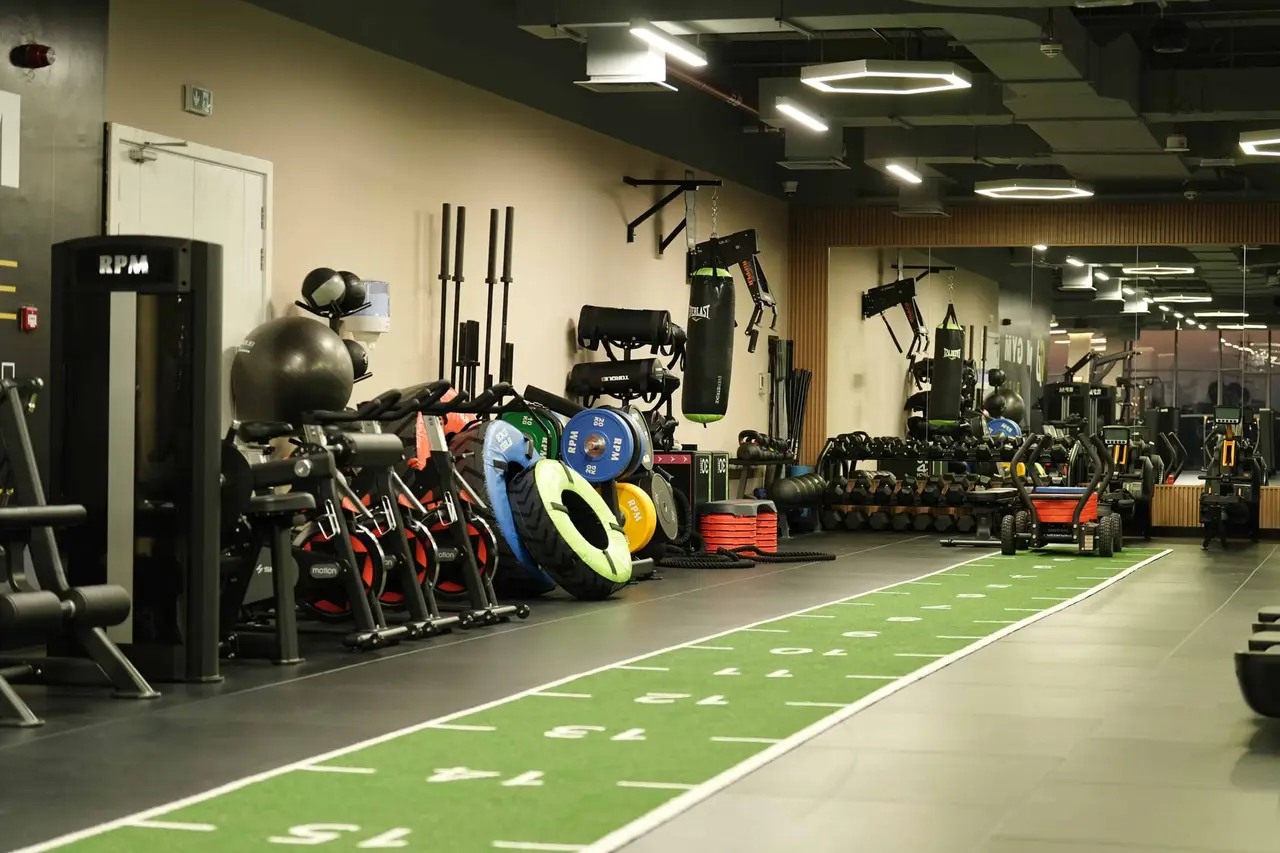
RPM's floor photos show a dumbbell rack and flat benches on the training floor in Al Manhal, but they do not confirm an adjustable bench that inclines, so ask on your free tour which benches tilt and where they sit. The women-only Ladies section has its own strength equipment, so ask about its benches too. To find the angle and elbow position that keep the work in your chest, book a personal training session.
Questions, answered.
Is the incline dumbbell press harder than the flat?
For most people, yes. The shoulders take a bigger share and the upper chest is the smaller part of the muscle, so you will press lighter dumbbells for the same reps. That is normal, and comparing the two numbers tells you nothing about your progress.
What muscles does the incline dumbbell press work?
Mainly the upper chest and the front shoulders, with the triceps straightening the elbows. The middle and lower chest still work, just less than on a flat bench, and the muscles around the shoulder blades hold the shoulders steady.
What is the difference between the incline dumbbell press and the shoulder press?
Direction. On a low incline you press up and slightly back with the chest leading; in a shoulder press you push straight overhead and the shoulders lead. The higher you raise the bench, the closer the two become.
Incline dumbbell press or machine chest press?
The machine fixes the path, so you can push close to failure without balancing anything; dumbbells make each arm steady its own load and allow a deeper stretch. A common order is dumbbells first while you are fresh and the machine later, when your shoulders are too tired to control a pair. The chest press machine page covers its settings.
Incline dumbbell press or incline Smith machine press?
The Smith machine runs the bar on rails, so you can load it heavier and stop it anywhere, which helps when you train alone. Dumbbells let each arm find its own path and turn the wrists, which many shoulders prefer. Use the Smith version for heavier, steadier sets and dumbbells for freer pressing; the Smith machine guide covers the bench position.