What the crossover trains, and how it differs from a dumbbell fly
Like every fly, the crossover trains the chest's hugging action: bringing the upper arms in across the body while the elbows hold one angle, so the triceps stay out of it and the front shoulders help a little. What the cables change is where the load sits. A dumbbell pulls straight down, so it is heavy with your arms wide and almost weightless once it is over your chest. A cable pulls along its own line, so the tension carries on right up to the point where your hands meet and cross.
That makes the crossover strong at the squeeze end of the movement, and the pulleys let you aim the arc high, low or straight across, which a bench cannot do. The dumbbell fly loads the stretch harder; the pec deck fixes the path for you. All three are accessories to pressing, usually done after one or two presses, as in the chest training guide.
Setting up the station and taking the handles
- Use two pulleys that face each other across open floor, on a crossover frame or a two-column functional trainer, and clip a single D-handle to each.
- Set both pulleys to the same height and both pins to the same weight. Start light, with a load you could move fifteen times: the long arm makes the far end of the arc much harder than the number suggests.
- Take one handle, walk to the other column and take the second, then step to the middle so the cables draw your arms gently out to the sides.
- Stand with one foot a step in front of the other, knees soft, and lean your chest slightly forward from the hips. Step far enough forward that both stacks stay lifted with your arms wide.
- Set your shoulders back and down and your chest up, with the elbows softly bent and pointing out and slightly back. That bend stays the same for the whole set.
How to do a rep
- Start with your arms open, hands level with your body or slightly behind it, and a light stretch across the chest.
- Sweep both hands forward and in along a wide arc, as if wrapping your arms around a broad tree trunk, moving only at the shoulders.
- Bring the hands together in front of you and let them cross by a hand's width, one wrist over the other. Swap which hand goes on top each rep or each set.
- Hold the squeeze for a moment, chest still up and shoulders still back.
- Let the handles travel back along the same arc over two or three seconds, stopping when you feel the stretch again and before the stacks touch down.
Breathe out as the hands come together and in as they open. Where your hands meet should match the pulley height: low and in front of your hips when the cables come from above, at chest height for a straight-across fly, and around chin height when they come from below.
Pulley heights: high-to-low, low-to-high and straight across
The pulley height sets the line the cable pulls along, and that line decides which part of the chest works hardest. Most people name the versions by the direction the hands travel.
High-to-low cable crossover
Pulleys above your head, hands sweeping down and in to finish in front of your hips. The line runs with the lower, larger part of the chest, which makes this the usual cable answer for lower-chest work and a stand-in for a decline bench press or dips. Lean forward a little more than usual so the cables clear your shoulders.
Low-to-high cable crossover
Pulleys at or near the floor, hands rising up and in to meet at about chin height, palms turned slightly up. It follows the line of the upper chest, like a standing incline fly, and sits well after an incline dumbbell press. Stand more upright and keep the weight light: the front shoulders take over quickly if you heave.
Middle (straight-across) crossover
Pulleys at about chest or shoulder height, hands moving straight forward to meet in front of the breastbone. It works the chest as a whole and is the easiest version to learn, so start here if you are new to the station. Many people simply call it the standing cable fly.
Single-arm cable crossover
One handle, one column, your other hand on the frame or your hip. You can reach across further, so the working hand passes the midline of your body, which many people feel as a stronger squeeze, and your trunk has to resist being pulled round. It also leaves the second column open for someone else.
If both columns are taken, the dumbbell fly trains the same action on a bench, and a single adjustable pulley still allows the one-arm version.
Mistakes to fix first
| Mistake | What it looks like | The fix |
|---|---|---|
| Turning it into a press | The elbows bend and straighten, and the triceps start to burn | Fix the elbow angle and move at the shoulder only; lighten the stack |
| Too heavy to control the stretch | The cables yank your arms back behind your body and the shoulders roll forward | Drop the pin until you can stop the handles at the stretch you choose |
| Rocking the torso | You bob forward on every rep to get the handles moving | Brace the staggered stance and keep the same lean throughout |
| Pulleys at different heights | One arm travels a different path and the hands meet off-centre | Count the holes on each column, or match the carriage markings, before you start |
| Hands meeting in the wrong place | High pulleys with the hands meeting at chest height, or low pulleys meeting at the waist | Match the finish to the pulley: below for high cables, above for low ones |
Sets, reps and the crossover ladder
| Goal | Sets × reps | How hard |
|---|---|---|
| First sessions at the station | 2–3 × 12–15 | Stop with three reps left and the stacks never landing |
| Building muscle | 3 × 10–15 | One or two reps left, with a pause at the squeeze |
| High-rep end of a session | 1–2 × 15–20 | Close to failure, as long as the elbow angle holds |
Rest about a minute between sets. Cables suit sets taken close to failure, because a failed rep simply ends with the handles drifting back to the columns.
Progress by adding reps first, then a plate. Cable stacks move in small steps, and some columns run extra pulleys that make each plate feel lighter, so log the station along with the weight. The ladder that people search for is a drop set across pulley heights: a set high-to-low, then move both pulleys to the middle and go again with no rest beyond the time that takes, then finish low-to-high. Each new angle lets you keep going after the last one has tired, so it makes a hard finisher; one ladder at the end of a session is enough.
Cable crossovers at RPM
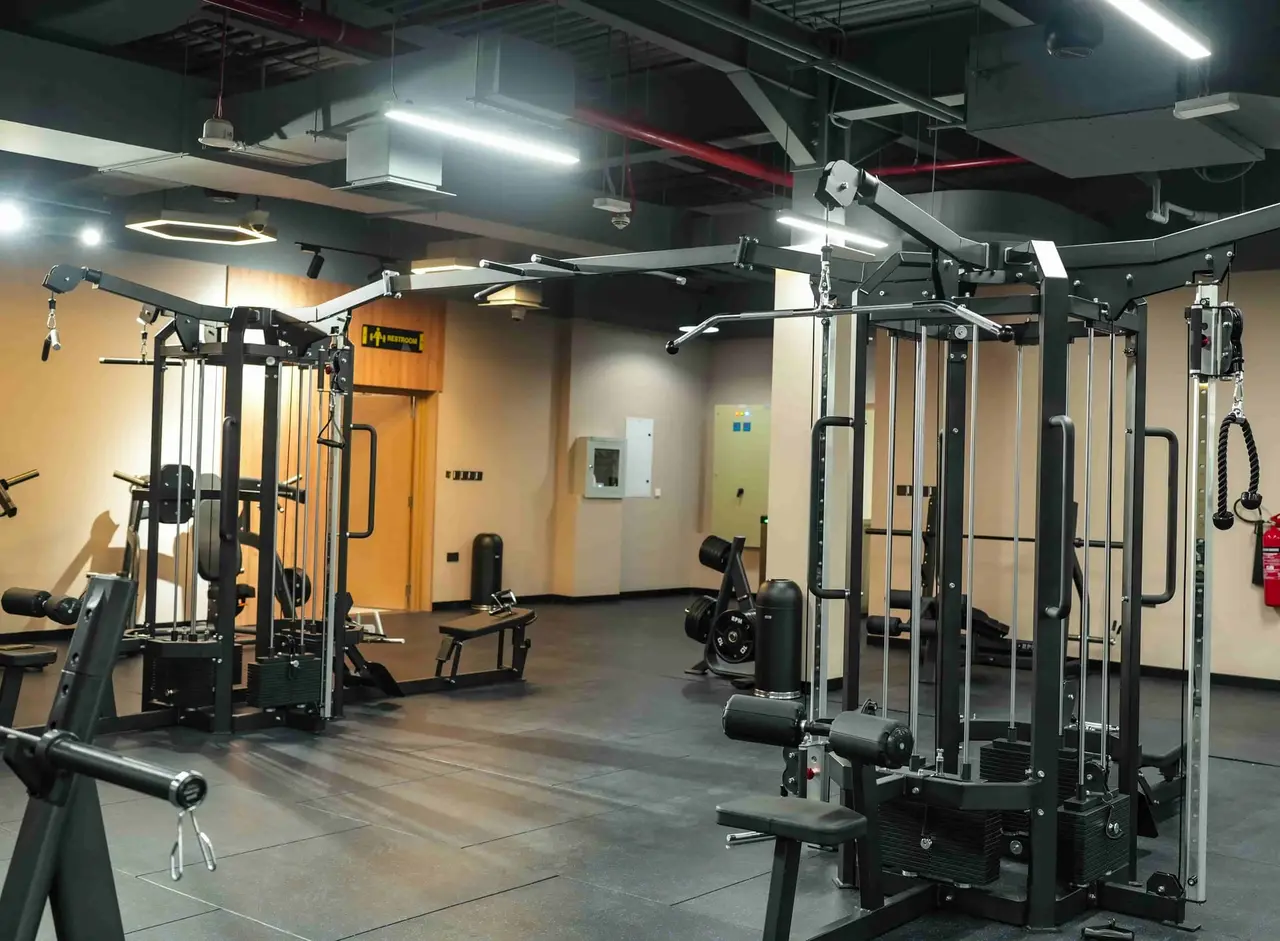
RPM's floor photos show multi-station cable towers on the training floor in Al Manhal. They do not show which columns adjust from the floor to overhead, or whether two of them face each other for a full crossover, so check both on your free tour; one adjustable column is still enough for the single-arm version. The women-only Ladies section has its own strength equipment, so ask which cable stations it includes. To get the pulley height and stance right first time, book personal training.
Questions, answered.
Is a cable crossover the same as a cable fly?
Yes. Cable fly, cable chest fly and cable crossover all describe drawing two cable handles together in front of you. Crossover usually implies that the hands cross at the end, and sometimes refers to the two-tower machine itself.
Cable crossover or pec deck?
The pec deck fixes the path and supports your back, so it is simpler to learn and easy to push hard; the crossover lets you choose the angle and work one arm at a time, but you hold your own position. The three-way fly comparison sets out when to pick each.
Can cable crossovers replace the bench press?
No. A press moves heavier loads through the chest, shoulders and triceps together and builds strength the fly cannot; the crossover adds targeted chest work afterwards. Keep a press as the main lift, as the chest training guide does, and add the crossover after it.
Why do I feel cable crossovers in my shoulders or arms?
Usually the stack is too heavy, the arms are reaching too far back at the stretch, or the elbows are bending into a press. Lighten the load, shorten the stretch and fix the elbow angle. If the shoulder hurts rather than simply works, stop and have it checked by a doctor or physiotherapist.
What can I use instead of cables at home?
Resistance bands anchored behind you at chest height copy the cable's line of pull, and a dumbbell fly on a bench or the floor trains the same action with the load moved into the stretch.