What the pec deck is, and what it trains
Look for an upright seat with a tall back pad and two long arms hinged above your shoulders, one on each side, linked by cable to a weight stack behind or beside the frame. On some models each arm ends in a vertical pad you press with your forearms and elbows; on others it ends in a handle you grip. The arms open and close like wings, which is where the butterfly name comes from. Many machines do two jobs on the same frame: sitting facing outwards, it is a chest fly; sitting the other way round, it is a reverse fly for the back of the shoulders.
On the chest side it trains the same hugging action as any fly, bringing the upper arms in across the body while the elbows hold one angle, with the front shoulders assisting. The machine fixes the arc and supports your back, so there is nothing to balance and nothing to steer. That makes it one of the easiest chest exercises to learn, and a useful way to keep working the chest after your presses, when your shoulders are too tired to control dumbbells. The chest training guide shows where flyes fit in a week.
The parts and what each one changes
| Part | What it is | What it changes |
|---|---|---|
| Seat | A padded seat on a lever or pin that moves up and down | Where your arms travel relative to your shoulders |
| Start-position adjuster | A pin, lever or dial near the top pivots | How far back the arms begin, and so how deep the stretch is |
| Arms with elbow pads | Vertical pads you push with the forearms | The load goes through the elbows and the grip stays relaxed |
| Arms with handles | Long levers ending in vertical or horizontal grips | You hold the load in your hands, on a slightly longer lever |
| Back pad | A tall pad behind your back and head | Keeps the torso still, so only the arms move |
| Weight stack | Plates selected with a pin | The load, in fixed steps |
Makers place the adjusters differently, so check the diagram on the frame. Some models also have a foot bar that brings the arms forward to you, so a heavy set never has to start from a deep stretch.
Setting up the machine
- Set the start position before you sit: move the arms with the adjuster until they lock where your hands will sit about level with your chest, not behind it.
- Sit tall and adjust the seat until your upper arms are level with your shoulders, or just below, when you take the pads or handles.
- Press your back and head into the pad, plant your feet and draw your shoulders gently back and down.
- Take the handles lightly, or rest your forearms against the pads with the elbows a little below shoulder height.
- Put the pin in a light plate for the first set and adjust after it; stack numbers vary between machines.
A smooth rep on the pec deck
- Start with the arms open at the position you set, chest up and a light stretch across it.
- Sweep the arms forward and in, leading with the elbows or the inside of the forearms rather than pushing with the hands.
- Bring the pads or handles together in front of your chest, stopping just before they touch so the stack stays loaded.
- Squeeze for a moment with your back still on the pad.
- Open the arms over two or three seconds until you reach the start position, without letting the plates land.
Breathe out as the arms close and in as they open. The return is where this machine is most often wasted: let the arms swing back fast and they pull your shoulders forward at the end of the range, exactly where you want control. If the front of the shoulder hurts at the start position, stop and get it checked by a doctor or physiotherapist.
Mistakes to fix first
| Mistake | What it looks like | The fix |
|---|---|---|
| Start position set too far back | Your hands begin well behind your body and the front of the shoulder feels stretched hard | Move the adjuster so the hands start level with your chest |
| Seat too low | Your elbows sit above your shoulders and the shoulders shrug up | Raise the seat until the arms move just below shoulder height |
| Pushing with the hands | The wrists bend and the forearms burn before the chest | Lead with the elbows; on a pad machine, keep the hands loose |
| Leaving the back pad | Your chest pokes forward and your head comes off the pad to finish the rep | Lighten the stack until your back stays put |
| Slamming the arms together | The pads clash and the stack crashes on the way back | Stop a little short of touching and control the return |
Pads or handles, seat height and the reverse pec deck
Pec decks differ in a few details, and the same frame often does a second job. These are the versions and settings people ask about.
Elbow pads vs straight handles
On the pad version you press with your forearms, elbows bent to about a right angle, so the lever is short and your hands do nothing; it is the most forgiving set-up for the grip and wrists. On the handle version, often labelled a pec fly, your arms are much straighter, the lever is longer and the opening stretch can be bigger, so the same pin feels heavier. Both train the chest. Use whichever the gym has and keep the elbow angle steady on either.
Seat height: what changes if you go higher or lower
The arms pivot at a fixed height, so the seat decides where they meet your shoulders. Too low and your elbows end up above shoulder level, which crowds the front of the shoulder and tends to make you shrug. Raising the seat so the arms travel just below the shoulders usually feels more comfortable and keeps the chest doing the work; going much higher than that shortens the movement without adding anything. Note the setting so each session starts from the same place.
Reverse pec deck for the rear delts
Sit facing the back pad with your chest against it, set the arms to their rearmost start position and sweep the handles back and out. The machine then trains the back of the shoulders and the upper back, not the chest; the rear delt fly page covers that set-up along with the dumbbell and cable versions.
If the machine is taken, a chest-height cable crossover trains the same action and lets you choose the angle.
Sets, reps and moving the pin
| Goal | Sets × reps | How hard |
|---|---|---|
| First sessions on the machine | 2–3 × 12–15 | Keep three reps in reserve while you settle the settings |
| Building muscle | 3–4 × 10–15 | One or two reps left, with a one-second squeeze |
| Taking it close to failure | 2–3 × 12–20 | To the last smooth rep; the fixed path holds your form for longer |
Rest a minute or a little more between sets.
Once every set reaches the top of the range, move the pin one plate and work back up. Pec deck stacks often jump in bigger steps than cable columns, so if the next plate is too much, slow the lowering to three or four seconds or add a pause at the squeeze before you move up.
The pec deck at RPM
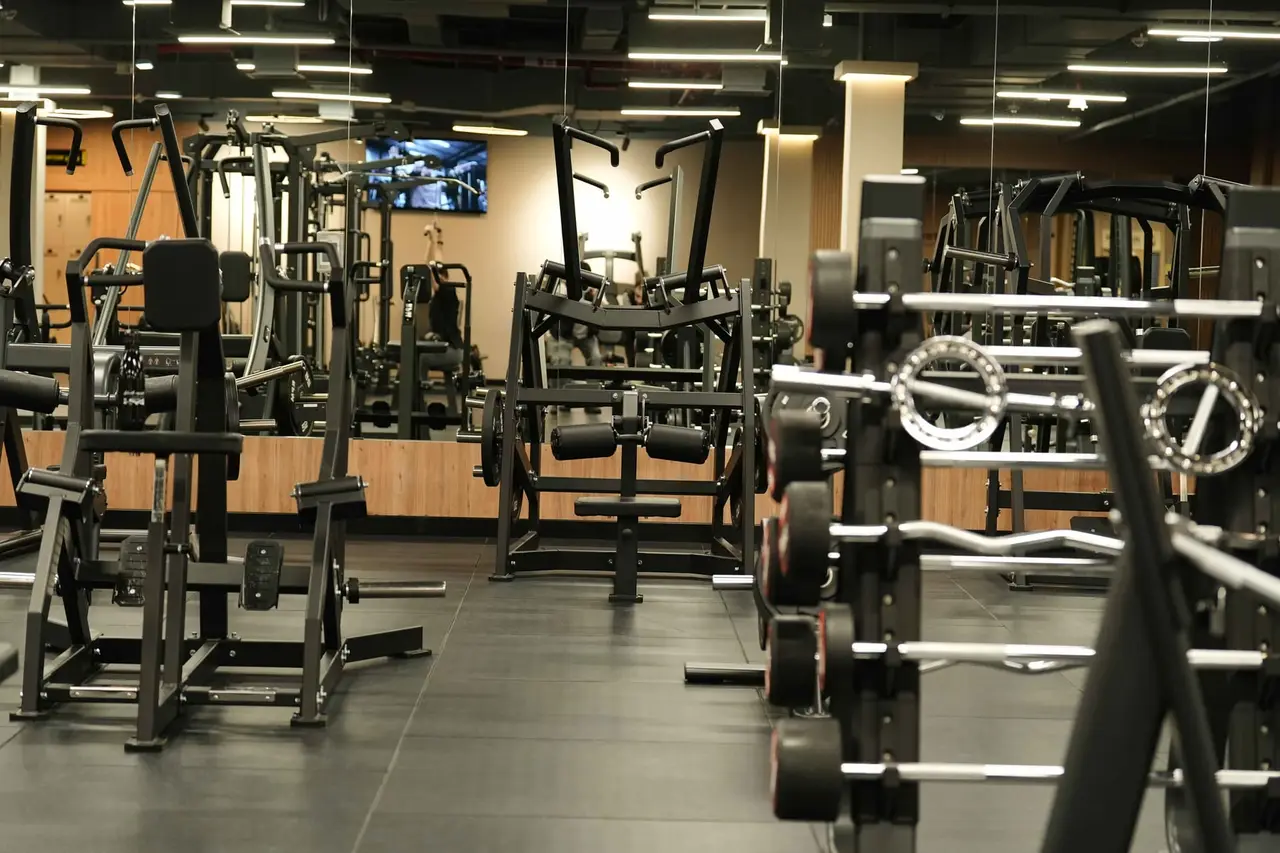
RPM's floor photos show plate-loaded machines and multi-station cable towers on the training floor in Al Manhal, but they do not confirm a pec deck. Ask on your free tour whether there is one and whether it converts for the reverse fly; if not, a cable crossover on the towers does the same job. A personal training session can set the seat and start position for your build.
Questions, answered.
Are the pec deck, butterfly machine and pec fly machine the same?
Broadly, yes. Pec deck often means the version with elbow pads, pec fly the version with handles, and butterfly machine either one. All of them train the chest through the same fixed arc.
Pec deck or chest press?
They do different jobs. The chest press is a push: the elbows bend and straighten and the triceps help, so it takes heavier loads. The pec deck isolates the chest's hugging action and leaves the triceps out. Many sessions use the chest press machine first and the pec deck after it.
Pec deck or cable fly?
The pec deck is quicker to set up and fixes the path; the cable fly lets you change the angle and work one arm at a time. Both keep tension at the squeeze. The comparison of the dumbbell fly, cable crossover and pec deck covers when to choose each.
Does the pec deck work the upper or the lower chest?
The whole chest, mostly its middle fibres, because the arms move roughly level. The seat shifts the line only slightly, so for clear upper- or lower-chest emphasis, low-to-high or high-to-low cable crossovers are easier to adjust, as the chest training guide notes for cable flyes.
What can I do instead of the pec deck at home?
A dumbbell fly on a bench or the floor trains the same action, and a resistance band anchored behind you at chest height gives a cable-like pull. Neither fixes the path, so start lighter than you would on the machine.