What the leg extension trains, and where it belongs
The machine does one job: it straightens the knee against resistance. That is the work of the quadriceps, four muscles that join into a tendon over the kneecap. Three cross only the knee; the fourth, the rectus femoris, crosses the hip too, so in a squat it lengthens at one end while it shortens at the other. Here the hip stays still and all four pull together, which is one reason coaches add the machine next to the bigger lifts.
With a single joint moving, it is easy to learn, and it lets you take the quads close to failure without balance or your lower back ending the set first. It is useful for beginners who want to feel the front of the thigh working, as a second or third exercise after squats or the leg press, and as a finisher on a lower-body day. It adds to a squat pattern rather than replacing one; the leg exercises library shows where it sits among the compound movements.
The lever loads the knee joint directly. Plenty of people use it without trouble at a moderate weight, but if you feel pain in or around the kneecap during or after a set, stop and get it checked by a doctor or physiotherapist rather than working around it.
Adjusting the seat and pads
- Find the pivot, usually marked with a coloured dot on the side of the lever. Move the back pad until the middle of your knee lines up with it when you sit all the way back.
- The crease behind your knee should sit just past the front of the seat cushion, so the edge does not dig in when your legs bend.
- Set the shin pad low, just above the ankle. Too close to the knee and it slides as you lift; down on the foot and it presses into the laces.
- If there is a range adjuster near the pivot, start with your knees bent to roughly a right angle. Go deeper only if it feels comfortable.
- Sit tall with your hips pushed into the back of the seat, take the side handles, and fasten the lap pad if there is one.
- Choose a load you could lift about fifteen times with a slow lowering. If the last reps of the first set turn into kicks, drop one step on the stack.
How to do a rep
- Pull down on the handles so your hips stay planted from the first rep to the last.
- With your toes pointing up, straighten your knees in about one second, smoothly, with no kick from the bottom.
- Stop just short of a hard lockout and squeeze for a beat. You should see the kneecap draw upwards as the quads tighten.
- Lower over two to three seconds until the plates are about to touch, then start the next rep without resting the weight.
- Keep your back against the pad. If your upper body rocks forward to help, the load is too heavy.
Tempo matters more here than on most exercises: the weight is light enough to throw around, and a thrown rep spends most of its time with the quads switched off. Breathe out as you lift, in as you lower, and count the way down. When you can no longer keep a two-second lowering, the set is over.
The mistakes that waste a set
| Mistake | What it looks like | The fix |
|---|---|---|
| Knee out of line with the pivot | The pad slides up and down your shin and the knee feels strained at the top | Move the back pad until the middle of the knee sits level with the pivot marker |
| Kicking the weight up | The stack flies up and clatters back down | Lift in one second, lower in two or three, and lighten the load until you can |
| Hips leaving the seat | Your hips rise as the legs straighten | Pull on the handles, use the lap pad, and take some weight off |
| Snapping into lockout | The knees slam straight and the weight jolts at the top | Finish just short of locked and hold the squeeze there |
| Half reps without meaning to | Each rep starts with the knees already half straight | Let the knees return to the start angle every time, unless you are doing partials on purpose |
Single-leg, paused and partial versions
The machine stays the same; what changes is how you load it. Each version below earns its place once the standard rep is solid.
Single-leg leg extension
Lift with one leg while the other rests beside the pad. It shows whether one quad is weaker, a gap squats can hide because the stronger side quietly does more. Start with the weaker leg, match its reps on the other, and begin at around half your two-legged load.
Leg extension with a pause at the top
Hold the top for one to two seconds on every rep and squeeze hard. The pause removes momentum, so you will need a lighter weight, and most people find the last part of the range harder than they expected. It teaches what a full contraction feels like.
Partial reps on the leg extension
Once full reps are no longer possible, add a few short reps in the bottom half of the range, where the knees are most bent and the quads are longest. They extend a hard set rather than replacing full reps, and they only make sense at a load you can still lower slowly.
Leg extension without a machine
Nothing copies it exactly, because few free-weight exercises load the knee while the hip stays still. The closest options are a cable leg extension with an ankle strap, sitting on a bench facing away from a low pulley; a band looped round a heavy bench leg and your ankle; and the sissy squat, a bodyweight drill far harder than it looks. At home, slow goblet squats with your heels raised on a plate are a practical stand-in.
If the machine is taken, a Bulgarian split squat, or the leg press with your feet low and close together on the platform, keeps the focus on the front of the thigh.
Sets, reps and where it goes in a leg session
| Goal | Sets × reps | How hard |
|---|---|---|
| Learning the movement | 2 × 12–15 | Stop with three or four smooth reps left |
| Building muscle | 3 × 10–15 | Finish one or two reps short of failure |
| Finisher after squats | 1–2 × 15–20 | Close to failure, still lowering for two seconds |
Rest about a minute between sets: only one joint is working, so you recover quickly. The rest-between-sets calculator suggests a range for other goals.
Put it after your main squat or press unless a coach wants the quads tired first. Keep the weight until every set reaches the top of the rep range with a clean lowering, then add the smallest step the machine allows. Pairing it with the leg curl, one straight after the other, trains both sides of the thigh in little extra time, which is why gyms often put the two machines side by side.
Leg extensions at RPM
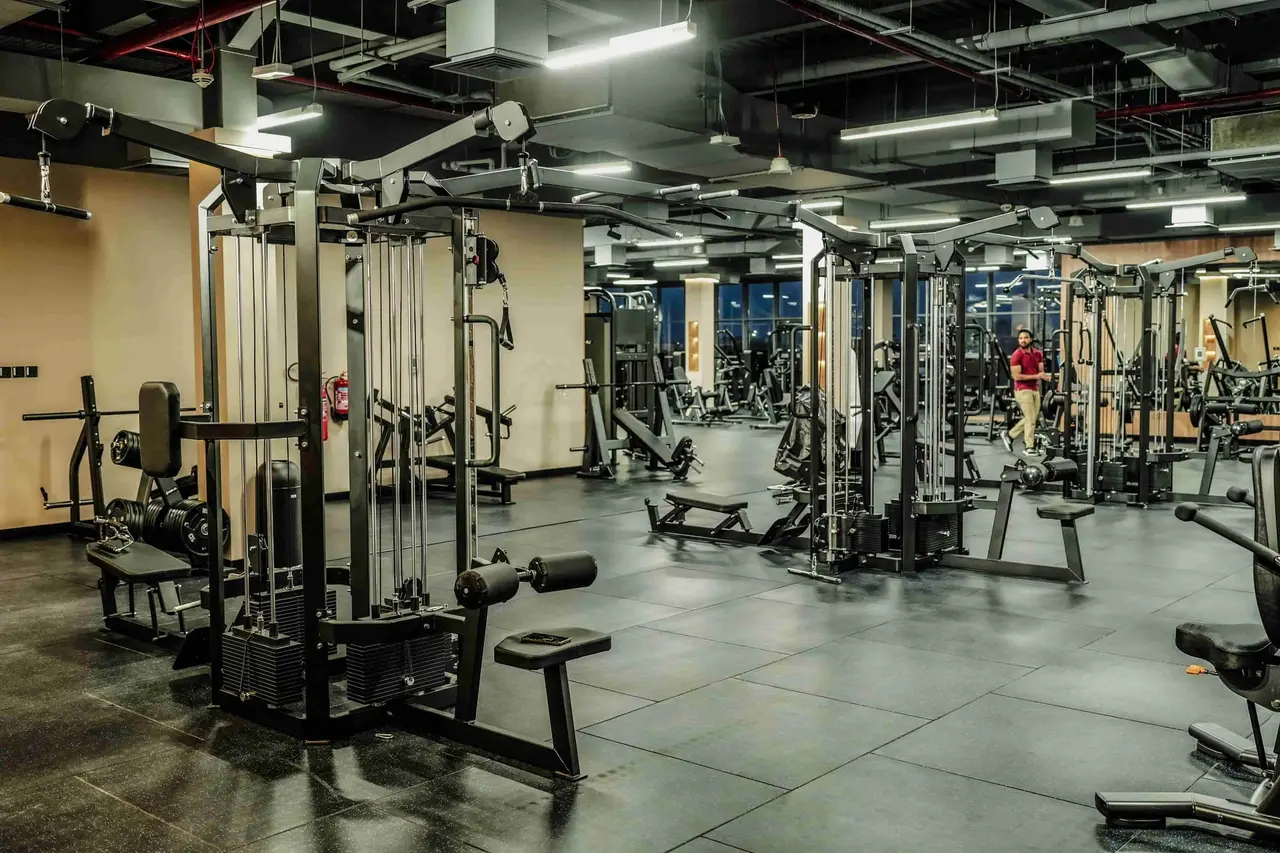
RPM's floor photos in Al Manhal show plate-loaded machines and a leg press, but a leg extension machine is not among the equipment they show, so ask the team to point one out on your free guided tour. If you would like a coach to set the seat and pick your starting weight, book a personal training session.
Questions, answered.
What muscles does the leg extension work?
The quadriceps, the four muscles on the front of the thigh, and very little else. That focus is the reason to use it: the quads work without the glutes, hips or lower back sharing the effort.
Leg extension or leg press: which should I do?
The leg press trains the quads together with the glutes and inner thighs, and lets you move much more weight; the leg extension isolates the quads. If you only have time for one, the press covers more muscle. Many programmes do the press first and the extension after it.
Are leg extensions bad for your knees?
No single answer fits everyone. The machine puts load across the knee, and many people use it comfortably at a moderate weight with a controlled rep. If it causes pain in or around the knee, stop and have it looked at by a doctor or physiotherapist, and ask them which leg exercises suit you.
What is the difference between the leg extension and the leg curl?
They work opposite sides of the thigh. The extension straightens the knee and trains the quads at the front; the leg curl bends it and trains the hamstrings at the back. The leg exercises library shows how to fit both into one session.