What it trains, and why it is worth the discomfort
Raising the back foot puts most of your weight on the front leg, so each side does the job a squat shares between two. The quads straighten the front knee, the glutes extend the front hip, and the inner thigh and the muscles at the side of the pelvis stop the knee and hips wobbling. The back leg mostly balances you, and the front of that hip gets a strong stretch. Because each leg works alone, a pair of moderate dumbbells challenges your legs far more than the weight in your hands suggests, with much less load on your spine.
That makes it useful for intermediate lifters who want hard leg work without a squat rack, for anyone with a clear difference between left and right, and for runners and field-sport players, who move on one leg at a time. The balance takes a few sessions to learn, which is why the version with the back foot on the floor comes first. It fits after your main squat or press, or as the main lift on a dumbbell day. The leg exercises library shows where it sits with the rest, and the guide to training one leg at a time explains what single-leg work adds.
Finding your stance on the bench
- Use a flat bench at about knee height or a little lower. If it is higher, the back hip and knee get pulled into an awkward stretch.
- Stand with your back to the bench, roughly a long stride in front of it, and rest the top of your back foot on the pad, laces down. Tucking the toes under is fine if it feels steadier.
- Test the distance with one slow rep. At the bottom your front heel should stay flat and your front shin should lean only slightly forward. If the heel lifts, hop the front foot further out; if you feel stretched and stuck, bring it in.
- Keep the feet roughly hip width apart side to side, as if standing on two rails rather than a tightrope.
- Hold a dumbbell in each hand at your sides, or one at your chest. Use bodyweight for the first sessions, until you can find the same stance every time.
How to do a rep
- Brace your trunk and stand tall, with most of your weight over the middle of the front foot.
- Lower by bending both knees, letting the back knee travel straight down towards the floor.
- Let the front knee move forward over the toes as you descend. That is normal, as long as the heel stays down and the knee points the same way as your middle toes.
- Stop when the back knee is a hand's width or less from the floor, or just before your lower back begins to arch.
- Push the front foot into the floor and stand back up, finishing tall without snapping the knee straight. Do all your reps on one leg, then switch.
Start each set with your weaker leg and match its reps on the stronger side. Think of the back foot as a kickstand, there for balance, not a second engine: if the back leg is pushing, the front leg is getting an easier set. Breathe in at the top, hold it on the way down, and breathe out once you are past the hardest part of the way up.
Mistakes to sort out first
| Mistake | What it looks like | The fix |
|---|---|---|
| Stance too short | The front heel lifts and the knee shoots far past the toes | Move the front foot further from the bench |
| Stance too long | The front leg stays nearly straight and you cannot get down | Bring the front foot a little closer |
| Pushing off the back foot | The back leg tires first and the front leg barely works | Keep most of your weight on the front foot; the back foot only balances |
| Front knee caving in | The knee drifts towards the big toe as you stand up | Keep the knee in line with your middle toes and lighten the load |
| Feet on a tightrope | You wobble sideways on every rep | Widen the gap between your feet to about hip width |
| Bench too high | The back of the hip and the lower back feel pulled | Use a lower bench or step |
Variations and what they change
Small changes in foot position and torso angle move the work between the quads and glutes. Choose the version that matches your goal, or use the easier one as a stepping stone.
Split squat with the rear foot on the floor
The same movement without the bench: both feet on the floor in a long split stance, back heel raised. It needs less balance and less hip flexibility, so it is the place to start, and it is still hard work for the front leg. Once you can do eight controlled reps a side holding dumbbells, raise the back foot.
Torso lean for glutes vs upright for quads
A slight forward lean from the hips, with a slightly longer stance, stretches the front glute more and shifts more of the work there. Staying upright with a shorter stance lets the front knee travel further forward, which loads the quads more. Both are correct; choose by goal, and keep your back flat in either.
Front-foot elevated split squat
Stand with the front foot on a low, stable plate or step and the back foot on the floor. The raised front foot lets you sink deeper, so the front leg works through a longer range. It suits people who want more depth without the balance demands of the bench version.
If every bench is taken, walking or reverse lunges or a goblet squat train the same muscles, and a step-up onto a sturdy box is another option.
Sets, reps and progression
| Goal | Sets × reps | How hard |
|---|---|---|
| Learning the stance | 2 × 6–8 each leg | Bodyweight; stop well before you get shaky |
| Building muscle | 3 × 8–12 each leg | Stop with one or two reps left |
| Strength | 3–4 × 5–8 each leg | Heavier dumbbells, two reps left, balance never lost |
Rest about thirty seconds between legs and one and a half to two minutes between rounds. The hypertrophy volume calculator helps you count the sets towards your weekly leg total.
Add reps first, then load. On heavier sets the grip often gives out before the legs; when that happens, use lifting straps, hold one heavier dumbbell at your chest, or, once your balance is solid, move to a barbell on your back set up in a squat rack.
Bulgarian split squats at RPM
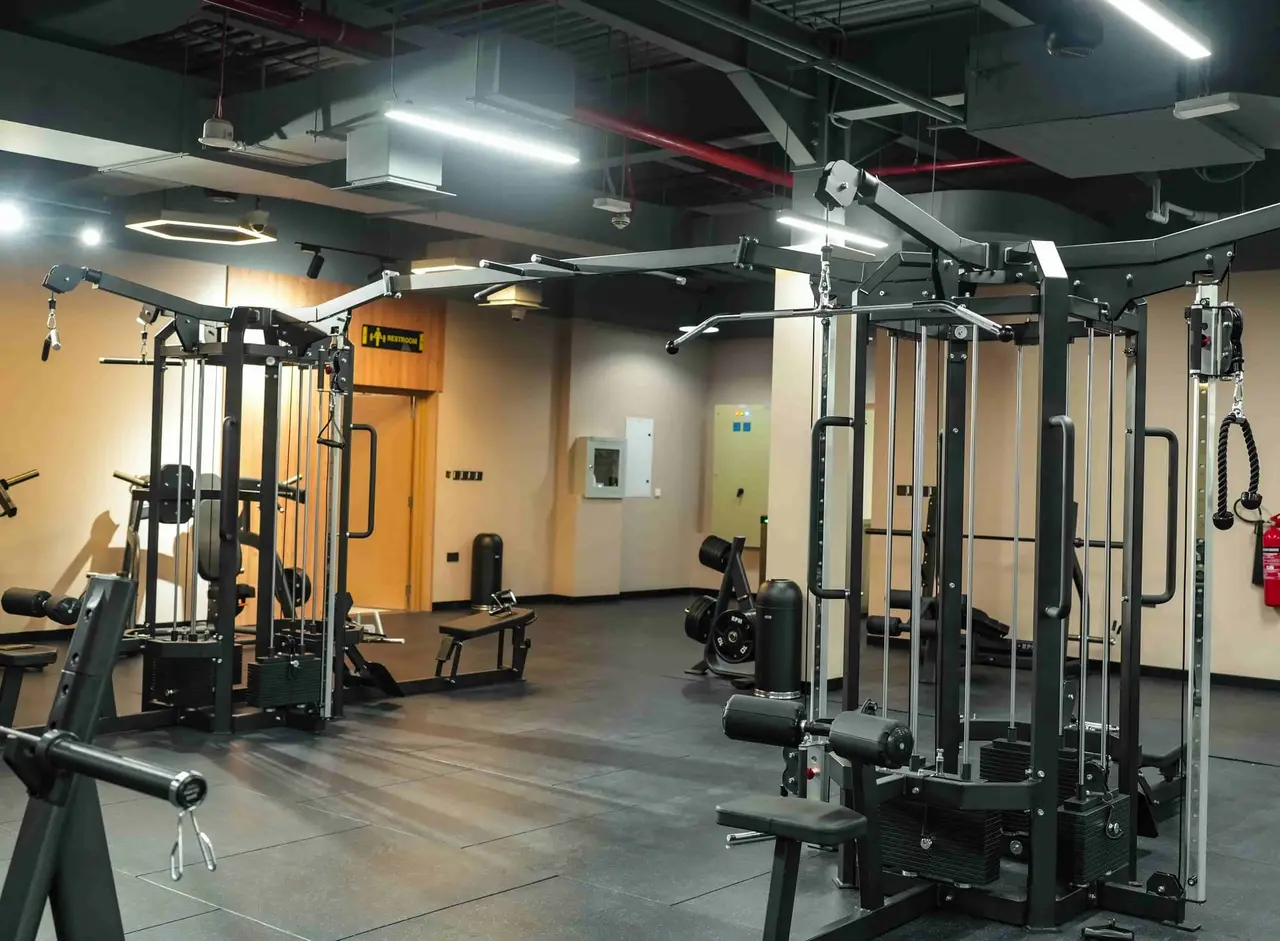
RPM's floor photos show flat benches and a dumbbell rack, which is everything this exercise needs. If the bench feels too high for your back foot, ask the team for a lower step. To learn the stance with a coach watching, book personal training, or see female personal training if you would rather work with a woman coach.
Questions, answered.
What muscles does the Bulgarian split squat work?
Mainly the quads and glutes of the front leg, with the inner thigh, the hip muscles at the side of the pelvis and the core working to keep you steady.
Bulgarian split squat vs lunge: what is the difference?
In a lunge you step in and out of the split stance on every rep, so you have to absorb and redirect your bodyweight. In the Bulgarian split squat your feet stay put and the back foot is raised, so more of the load stays on the front leg. The lunge page covers the stepping versions.
Is the Bulgarian split squat good for the glutes?
Yes, especially with a slightly longer stance and a small forward lean, which increases the stretch on the front glute. That is why it appears so often in glute training plans.
What can I do instead if my knees hurt?
Knee pain has many possible causes, so stop and get it checked by a doctor or physiotherapist before you choose a replacement. They can tell you which leg movements suit you; a shorter range, the split squat with the back foot on the floor, or the leg press are options you could ask them about.
Bulgarian split squat or regular squat?
They do different jobs. The squat lets you lift the most weight on both legs; the Bulgarian split squat trains each leg alone with far less load on the spine. Many programmes use a squat as the main lift and the split squat as the second.
Can I do it without a bench?
Yes. A sturdy step, a low box or a stable chair works for the back foot, or keep the back foot on the floor and do a regular split squat, which is the better starting point anyway.