How your legs work
Your legs are four muscle groups sharing a handful of joints. The quads, on the front of the thigh, straighten the knee, and one of the four, the rectus femoris, also crosses the hip. The glutes extend the hip, driving it forwards when you stand up, climb or sprint. The hamstrings, on the back of the thigh, cross both the hip and the knee, so they extend one and bend the other. The calves lift the heel and push you off the ball of the foot. Add the adductors on the inner thigh, which work hard in deep squats and lunges, and you have the whole picture.
That map explains why one exercise is never enough. Most leg movements train several groups at once, but none trains them evenly. A squat works the quads and glutes hard and the hamstrings very little; a Romanian deadlift does the reverse; a leg extension or a leg curl works a single group on its own. Planning leg training is mostly about covering the gaps between them.
The five kinds of leg exercise
Sort leg exercises by movement pattern rather than by machine and planning gets simpler. A full week touches each of these at least once.
- Squats, for the quads and glutes: the back squat, the more upright front squat, and the goblet squat, where most beginners start.
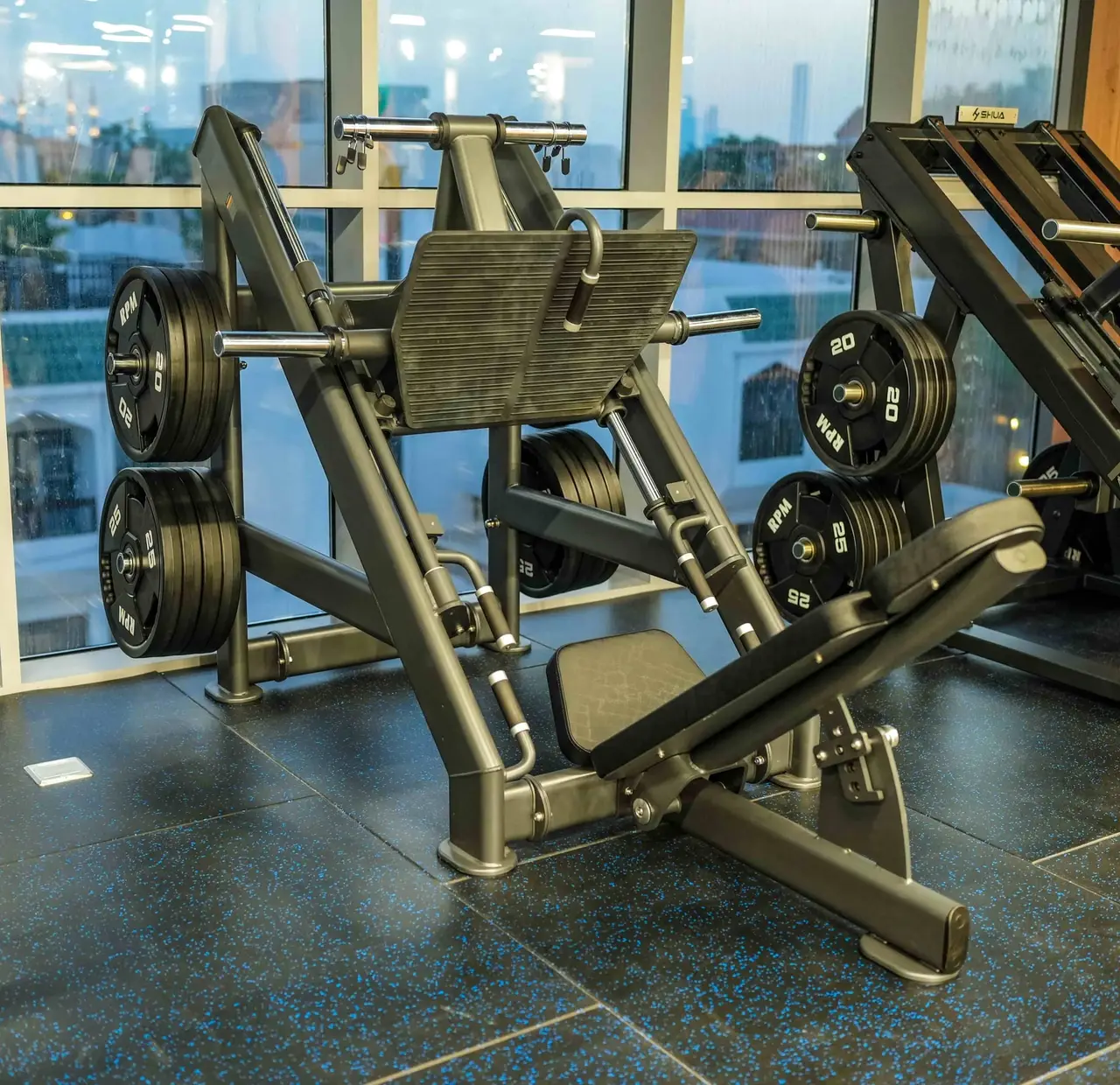
- Machine presses, the same muscles with the back supported: the leg press and the hack squat. The hack squat vs leg press comparison explains how they differ.
- Single-leg work, which trains each side on its own and tests balance: the Bulgarian split squat and the lunge.
- Hinges, for the hamstrings and glutes: the Romanian deadlift and the deadlift, covered in depth in the hamstring guide and the glute guide.
- Isolation at the knee and ankle: the leg extension for the quads, the leg curl for the hamstrings, and calf raises.
Machines or free weights: the best leg machines, honestly
No single leg machine wins outright, because each one answers a different question. What machines do well is remove balance and back position from the equation, so you can take the target muscle close to its limit with less technique to learn. What free weights do well is teach the whole body to work together under load, which is why barbell squats and deadlifts stay in strength programmes.
What each common leg machine is for. The gym machine names page gives the Arabic names as well.
| Machine | Main muscles | Why choose it |
|---|---|---|
| Leg press | Quads and glutes | Heavy leg work with the back supported, and quick to learn |
| Hack squat | Quads above all | A fixed, upright squat path that keeps the focus on the front of the thigh |
| Leg extension | Quads only | The most direct way to work the quads with nothing else helping |
| Leg curl | Hamstrings | Bends the knee under load, which hinges do not |
| Smith machine | Depends on the lift | A guided bar for squats, split squats and hip thrusts that you can rack at any point |
| Calf raise machine | Calves | More load than you could hold in your hands |
For most people the honest answer is a mix: one free-weight squat or hinge for strength, and a machine or two to add volume without the technique cost. The squat rack vs leg press guide looks at that first choice in detail, and the front squat vs back squat comparison helps once you already squat.
How often, and how many sets
Two leg sessions a week suit most people, with at least a day between them. Volume is easiest to plan per muscle: a common coaching range is about 10 to 20 hard sets per muscle group per week once you have trained for a while, and roughly 6 to 10 when you are starting out or coming back. A hard set is one that ends with no more than two or three good reps left.
Count carefully. A squat counts for the quads and the glutes, a Romanian deadlift for the hamstrings and glutes, a leg extension for the quads alone. Put the most demanding lift first, while you are fresh, and leave isolation work to the end. Rest two to three minutes after heavy squats and presses and about a minute after isolation sets. The hypertrophy volume calculator helps you total the week, and the workout split calculator shows where leg days fit.
Progress by adding a rep or two at the same weight, then a little load once every set reaches the top of its rep range. Leg muscles are large and take longer to recover from heavy, deep sets, so some soreness in the first weeks is expected and fades as you adapt.
Two sample leg days
Leg day A: barbell-based
Built around the back squat, with a hinge and a single-leg movement after it. New to the barbell? Use the goblet squat instead.
| Exercise | Sets × reps | Coaching note |
|---|---|---|
| Back squat | 3–4 × 5–8 | Only as deep as you can control; stop with two reps left |
| Romanian deadlift | 3 × 8–10 | Hips back, bar close to the legs |
| Bulgarian split squat | 3 × 8–10 each leg | Front heel down; start with bodyweight |
| Leg curl | 2–3 × 10–15 | Slow on the way down |
| Standing calf raise | 3 × 10–15 | Full stretch at the bottom, pause at the top |
The hamstring guide covers the Romanian deadlift and its alternatives.
Leg day B: machine-based
The same jobs with the back supported, starting from the leg press. It works as the second leg day of the week or as a beginner's first.
| Exercise | Sets × reps | Coaching note |
|---|---|---|
| Leg press | 3–4 × 8–12 | Lower until just before the hips curl off the pad |
| Hack squat or goblet squat | 3 × 8–12 | Upright torso, knees travel forwards |
| Walking lunge | 2–3 × 10 each leg | Steps long enough for the back knee to drop straight down |
| Leg extension | 2–3 × 12–15 | Pause at the top, two seconds down |
| Calf raise on the leg press | 3 × 12–15 | Balls of the feet on the bottom edge of the platform |
The lunge and leg extension pages explain set-up and the faults to avoid.
Machines all busy, or training with dumbbells only? Swap in goblet squats, dumbbell Romanian deadlifts, split squats and single-leg calf raises on a step. The single-leg strength guide has more one-leg options.
Leg day mistakes
- Skipping the back of the leg. A week of squats and leg presses with no hinge or curl leaves the hamstrings behind.
- Half reps with a full stack. Loading the leg press beyond what you can lower properly cuts the range, and the lower back takes strain when the hips roll off the pad.
- Saving the hardest lift for last. Squats after four other exercises are slower and sloppier; do them first.
- The same weight for months. Without more load or reps there is no reason for the muscle to change, so keep a log.
- Knees caving in. In squats, presses and lunges the knees should track roughly over the toes.
- Training through joint pain. A burning muscle is expected; sharp pain in the knee or hip is a reason to stop and have it checked by a doctor or physiotherapist.
Leg training at RPM
On the training floor in Al Manhal, RPM's photos show squat racks with barbells and colour bumper plates, an angled plate-loaded leg press, other plate-loaded machines, a dumbbell rack, kettlebells, soft plyo boxes and the turf lane with a sled, which between them cover every pattern on this page. A hack squat, a leg extension, a leg curl and a calf machine are not in those photos, so ask which are on the floor in the Mixed and Ladies sections during your free tour.
This page is the library's reference for leg training as a whole; the guides it links are narrower. The single-leg strength guide is about training one side at a time, and the squat rack vs leg press guide settles one choice in depth. If you would rather have a plan written for you, see personal training, and browse every movement in the exercise library.
Questions, answered.
What are the leg machines at the gym called?
The common ones are the leg press, the hack squat, the leg extension, the leg curl (seated or lying), the calf raise machine, the Smith machine, and the hip abduction and adduction machines. The machine names page lists each one with its Arabic name and what it trains.
What leg exercises should a beginner do at the gym?
One per pattern: a goblet squat or leg press, a dumbbell Romanian deadlift, a split squat or lunge, and a leg curl. Two sessions a week with two or three sets of each is enough for the first month.
Are leg exercises different for women and men?
No. The muscles and movements are the same; only the loads and sometimes the emphasis change. Someone who wants more glute work adds hip thrusts, as the glute guide explains.
Can I train legs at the gym without machines?
Yes. A barbell, a rack and dumbbells cover every pattern: squats, Romanian deadlifts, split squats, lunges and calf raises. Machines make isolation and high volume easier, but they are optional.
Do I have to squat to train legs?
No. The squat is an excellent tool, but the leg press, hack squat and split squat train the same muscles. Choose the version you can load and progress consistently without pain.