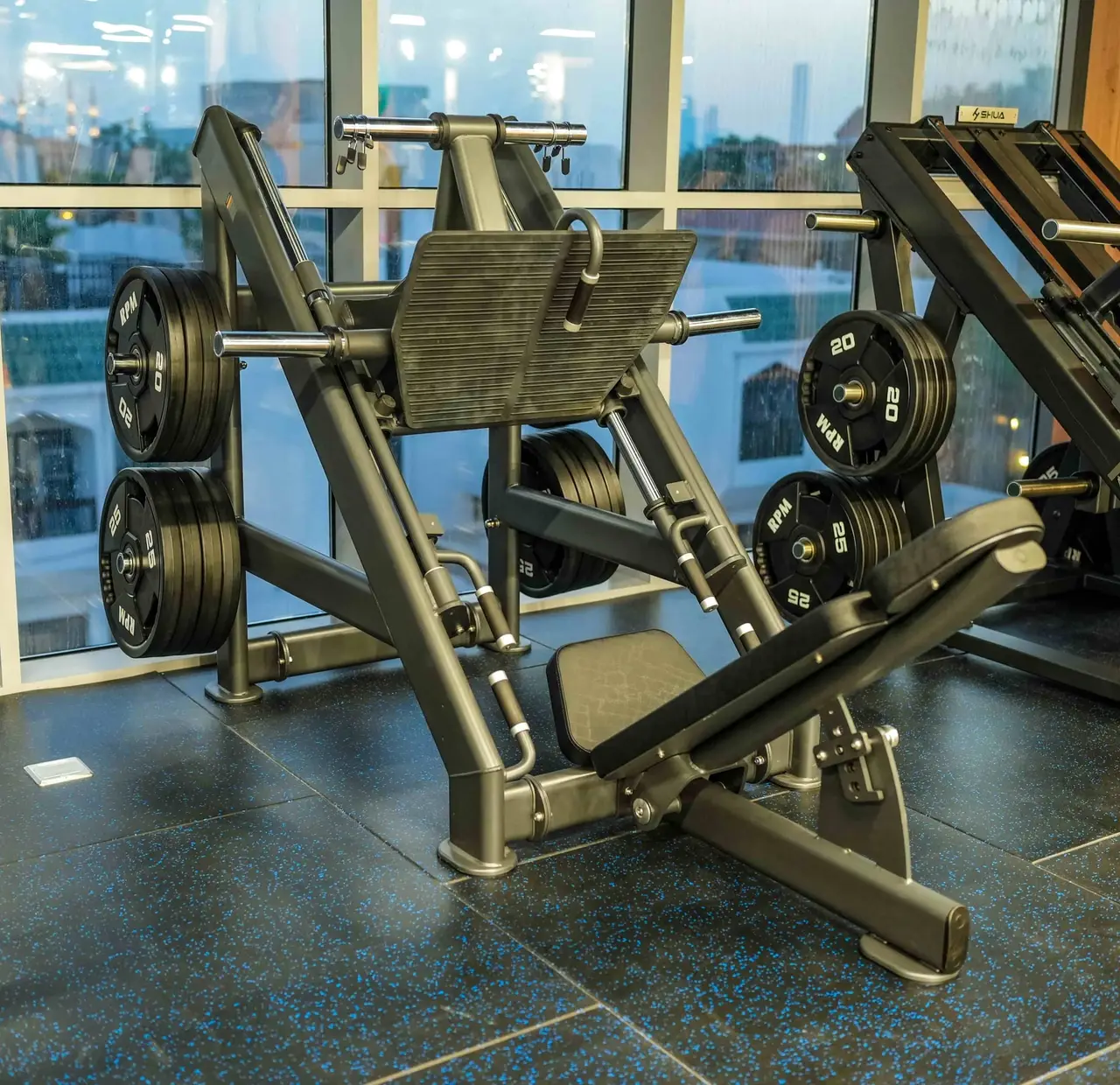
What the leg press trains, and where it fits
On a 45-degree leg press you sit in a reclined seat and push a platform that slides along rails. The quads straighten the knees, the glutes and adductors extend the hips, and the hamstrings help a little at the hip. Unlike a squat, the pad supports your back and the rails fix the path, so there is nothing to balance and the trunk does far less.
That support is the point. Beginners can load their legs before they can squat well, and experienced lifters can take sets close to failure without a spotter, often as the second leg exercise after squats. It is also a sensible pick on days your lower back is tired from deadlifts. The leg training guide shows how it combines with other movements, and the squat rack vs leg press guide covers when each tool makes more sense.
Before the first rep: seat, feet and safety stops
- Adjust the back pad if your machine allows it. A more upright pad shortens the range; a lower one lets you go deeper but makes it easier for the hips to roll off at the bottom.
- Sit with your hips and lower back pressed into the pad, then place your feet flat on the platform, about hip-width apart and halfway between its top and bottom edges.
- Load plates evenly on both sides, starting with the empty sled or one small plate a side. Sleds differ in weight between machines, so a number on one leg press tells you nothing about another.
- Press the platform up slightly, then turn the safety handles out to release it. Know where they are before you start: you turn them back in when the set ends.
- If the machine has adjustable stops, set them to catch the sled just below your lowest point.
Pressing a rep
- Hold the side handles lightly and brace your trunk, with your head resting back on the pad.
- Lower the platform under control by bending your knees towards your chest, knees in line with your toes.
- Stop at the depth where your lower back is still flat on the pad, usually around the point where your thighs come close to your ribs.
- Press the platform away through your whole foot, heels down, until your legs are nearly straight.
- Stop just short of locking the knees, then start the next rep. After the last one, straighten your legs and turn the safety handles back in before you take your feet off.
Breathe out as you press and in as you lower, holding the breath only through the hardest part of each press rather than across the whole set. A two-second descent keeps the sled from bouncing off the bottom. If your knees or lower back hurt during or after leg pressing, stop and have them looked at by a doctor or physiotherapist.
Leg press mistakes to fix first
| Mistake | What it looks like | The fix |
|---|---|---|
| Hips rolling off the pad | At the bottom the tailbone lifts and the lower back rounds | Shorten the range, raise the back pad or place your feet higher |
| Locking the knees out hard | The knees snap fully straight at the top, sometimes bending past straight | Stop each rep just before straight so the legs stay under tension |
| Heels lifting | Only the balls of your feet are pushing at the bottom | Move your feet higher on the platform and press through the heels |
| Knees caving in | The knees fall towards each other as you press | Lighten the load and keep the knees in line with the toes |
| Huge load, tiny range | A stack of plates moving a hand's width | Use a weight you can move through your full comfortable range |
| Pushing on your thighs | Your hands press on your legs to finish reps | Hold the handles and end the set when your legs cannot finish alone |
Foot positions and other versions
On a leg press, where you put your feet changes the exercise more than anything else. Small shifts are enough; there is no need for extreme positions.
Foot position: high, low, wide or narrow
Feet high on the platform make the hips bend more and the knees less, so the glutes and hamstrings do more. Feet low mean more knee bend and more quad work, but the heels tend to lift and the knees travel well past the toes, so only go low if it feels comfortable. A wide stance with the toes turned out brings in the inner thighs and glutes; a narrow one, hip-width or closer, keeps the focus on the quads. Middle and hip-width is the default.
Single-leg leg press
One foot in the middle of the platform, the other on the floor or the frame. Start with well under half your two-leg weight and build up. It shows up a weaker side and stops the stronger leg from covering for it. Keep the hips square on the pad and work the weaker leg first.
Vertical leg press
You lie on your back and press a platform straight up above you. The range is usually shorter and the hips bend more sharply at the bottom, so go lighter and check that your lower back stays down. It is much less common than the 45-degree sled.
Calf raises on the leg press
With your legs straight but knees soft, put the balls of your feet on the bottom edge of the platform and push it with your ankles only. Keep the safety handles within reach and use a modest load, because a foot can slip.
If the leg press is busy, the hack squat is the closest machine alternative, the goblet squat needs only a dumbbell, and the Bulgarian split squat trains one leg at a time.
Sets, reps and loading
| Goal | Sets × reps | How hard |
|---|---|---|
| Learning the machine | 2–3 × 12–15 | Stop with three or four reps left |
| Building muscle | 3–4 × 10–15 | Finish each set with one or two reps left |
| Heavier leg strength | 3–4 × 6–8 | One or two reps left, with longer rests |
Rest one and a half to two and a half minutes, since long leg press sets are tiring; the rest-between-sets calculator gives a range for your goal.
The leg press handles higher reps well because there is no balance to lose as you tire. Use it once or twice a week, after squats or as the main lift on a machine day. Add a pair of small plates when every set reaches the top of the range, and write down the seat setting and foot position so you can repeat them exactly.
The leg press at RPM
RPM's floor photos show a plate-loaded 45-degree leg press on the training floor in Al Manhal. If you would like someone to set the seat and feet with you and judge your depth, a personal training session is the quickest way; ask on your free tour about the other leg machines on the floor.
Questions, answered.
Is the leg press as good as the squat?
It is a different tool. The leg press builds the thighs and hips with your back supported; the squat also trains balance and trunk control and builds the squat itself. Most programmes use both, and the legs guide shows how.
Is the leg press good for glutes?
It works them, more so with your feet higher and slightly wider and when you lower deep while your back stays on the pad. If glutes are the main goal, pair it with a hip-focused movement such as the hip thrust.
Leg press or leg extension?
The leg press works the quads together with the glutes and inner thighs; the leg extension isolates the quads. Use the press as the main movement and the extension as a finisher if you want extra quad work.
Leg press or hack squat?
Both are machine squats on a fixed path. The hack squat usually loads the quads harder and feels more like a squat; the leg press is easier to learn and offers more foot positions. The hack squat vs leg press comparison goes through the details.
How much weight should I use on the leg press?
Whatever you can lower to full depth with your back on the pad and press for your target reps with one or two left. Ignore other people's numbers: sled weight and leverage vary between machines.
What can I do if there is no leg press?
Goblet squats, split squats and step-ups train the same muscles with dumbbells or bodyweight. At home, a slow bodyweight squat with a pause at the bottom stands in for light leg press work.