What calf raises train, and who they suit
The calf is two muscles sharing one tendon. The gastrocnemius is the visible, two-headed muscle at the top of the lower leg; it starts above the knee, so it works hardest when the knee is straight. The soleus lies underneath and starts below the knee, so it keeps working whatever the knee does, and it takes over most of the load when the knee is bent. Both pull on the Achilles tendon to lift the heel, which is all a calf raise does: the ankle moves, and nothing else should.
That makes it one of the simplest movements in the gym and one of the most often rushed. Runners, court and field players and anyone who jumps rely on the calves for every push-off; lifters train them for size and to keep the lower leg in proportion with the thighs. Calf raises usually go at the end of a leg session, but they are short and quick to recover from, so a few sets on an upper-body day work too. The calf training guide shows how to spread them across a week.
Setting up: the edge, the stance and the load
- Pick your station. A step or a weight plate laid flat gives you an edge for a dumbbell raise; a leg press, a standing calf machine or a Smith machine lets you load more; a seated calf machine puts a pad across your knees for the bent-knee version.
- Put only the balls of your feet on the edge so your heels hang beyond it. If your arches are on the step, the heels cannot drop and half the rep disappears.
- Set your feet about hip width apart, toes pointing straight ahead or turned out slightly, whichever lets you rise straight up over the big toe.
- Standing, keep the knees straight but not locked hard. Seated, slide the pad down onto your lower thighs, just above the knees, until it is snug with your heels at the bottom of their range.
- Hold something steady. On a dumbbell raise one hand grips a rack or upright and the other holds the weight; balance should never be what ends the set.
- Start with bodyweight. Once you can do fifteen slow reps with a pause at the bottom, add load. Most people overestimate what they can move through the full range.
How to do a rep
- From the top, let the heels sink slowly until you feel a strong stretch through the calf and the back of the ankle.
- Hold that bottom position for one to two seconds. The pause takes the bounce out of the Achilles tendon, so the muscle has to start the rep on its own.
- Push through the balls of the feet, mainly the big toe and the one next to it, and rise as high as you can.
- Squeeze at the top for a second without rolling onto the little-toe side of the foot.
- Lower over two to three seconds into the next stretch. Knees, hips and trunk stay still from the first rep to the last.
Count the pause at the bottom out loud for your first few sessions. The calf raise is the exercise most often reduced to quick, short bounces, and a two-second pause is the simplest fix. Breathe normally on light sets; on a heavy machine set, breathe out on the way up.
Mistakes to fix first
| Mistake | What it looks like | The fix |
|---|---|---|
| Bouncing out of the bottom | Fast reps that spring off the stretch with no pause | Hold the stretch for a second or two before every rise |
| Half reps | The heels never drop below the edge, or never rise fully | Use a lighter load you can move from full stretch to full height |
| Bending the knees to help | On a standing raise the knees dip and the thighs push the weight | Fix the knee angle; if it keeps happening, the load is too heavy |
| Rolling to the outside of the foot | The ankles tip outwards at the top of each rep | Think of pressing through the big toe as you rise |
| Feet creeping off the edge | On the leg press or a step, the feet slide until only the toes are on | Reset between sets and keep the ball of the foot, not the toes, on the edge |
A burning calf at the end of a set is expected. Pain at the back of the heel, in the Achilles tendon or low in the calf is not: stop the exercise and get it checked by a doctor or physiotherapist before you carry on.
Standing, seated and other versions
The movement is the same in every version. What changes is the knee angle, which decides how the work is shared between the two calf muscles, and the equipment, which decides how much load you can use.
Standing vs seated calf raise
Standing, with straight knees, trains both calf muscles and puts the gastrocnemius under a long stretch. Seated, with the knees bent, slackens the gastrocnemius, so the soleus does most of the work. In a 12-week study, fourteen untrained adults trained one leg standing and the other seated: the standing leg's gastrocnemius grew far more, while the soleus grew about the same in both. Build your calf work on standing raises and add seated sets as a supplement.
Calf raise on the leg press
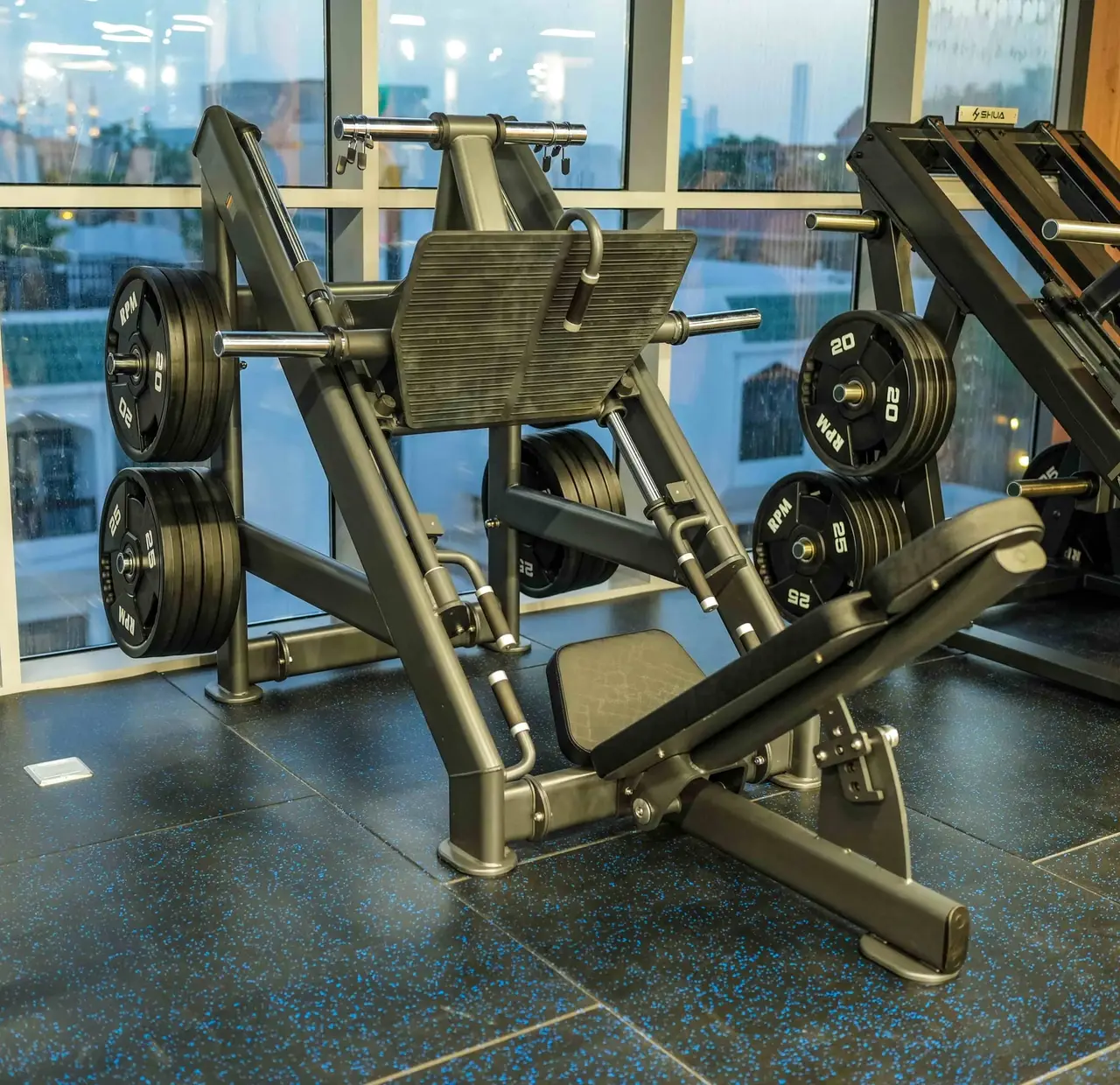
Sit in the leg press with your legs straight but not locked, and slide your feet down until only the balls of your feet are on the bottom edge of the platform. Release the handles as usual, then push the platform away with your ankles alone and let it come back into a stretch. Use a modest load, keep the knees still, and turn the handles back in before you move your feet, because a foot slipping off the edge lets the platform drop. The leg press page covers the seat and handles.
Single-leg calf raise off a step
Stand on one foot on a step or a plate, hold a dumbbell on the same side and steady yourself with the other hand. One leg carries your whole bodyweight, so it is hard work even before you add the dumbbell, and it shows quickly if one calf is weaker. It is the most useful version when dumbbells are all you have.
Smith machine calf raise
Set the bar at shoulder height, put a step or plate under the bar path and stand under the bar as you would for a squat. The bar runs in fixed rails, so you can load it heavily without balancing anything and rack it at any point with a turn of the wrists. Check that the step cannot slide before the first set. The Smith machine page explains the hooks and stops.
If the leg press is busy and there is no calf machine, the single-leg dumbbell raise needs nothing more than a dumbbell and an edge to stand on.
Sets, reps and progression
| Goal | Sets × reps | How hard |
|---|---|---|
| Learning the movement | 2–3 × 15–20 | Stop with three or four reps left, every rep paused at the bottom |
| Building muscle | 3–4 × 8–15 | Finish each set with one or two reps left |
| Strength for running and jumping | 3–4 × 6–10, single-leg or heavy | Slow on the way down, quick but controlled on the way up |
Rest about a minute between sets. Calves recover quickly within a session, so long rests add time without adding much.
Two or three calf sessions a week suit most people, with straight-knee raises in each and a few bent-knee sets once or twice. Progress in this order: more reps at the same load, then a longer pause in the stretch, then single-leg work, then more weight. Calves have a reputation for growing slowly, and part of that is genetic: the length of the muscle and where it joins the tendon are fixed, and training changes the size, not the shape. Months of consistent full-range work are what move them.
Calf raises at RPM
RPM's floor photos show a plate-loaded 45-degree leg press, a dumbbell rack and colour bumper plates on the training floor in Al Manhal, so the leg press and single-leg dumbbell versions are covered. A standing or seated calf machine and a Smith machine are not in those photos; ask what is on the floor during your free tour. To have a coach check your range and starting load, book a personal training session.
Sources
Questions, answered.
What muscles do calf raises work?
The gastrocnemius and the soleus, the two muscles of the calf, which both lift the heel through the Achilles tendon. Straight-knee raises work both; bent-knee raises shift the work towards the soleus. Small muscles in the foot and ankle help with balance.
What are calf raises good for?
Stronger calves push you off the ground when you walk, run and jump, and help steady the ankle. They also add size to the lower leg, which many lifters want in proportion with their thighs. They are not a fix for an injury; if you have ankle or Achilles problems, ask a physiotherapist what suits you.
What is the difference between a calf raise and a toe raise?
A calf raise lifts the heels and trains the back of the lower leg. A toe raise does the opposite: you stand with your back against a wall, heels on the floor, and lift the front of your feet, which trains the muscle on the front of the shin. Many runners do both.
Is a calf press the same as a calf raise?
Calf press usually means the version on a leg press, where you push the platform with your feet instead of lifting your body. The ankle movement and the muscles are the same; the machine supports your back and makes heavy loads easier to handle.
What can I do instead of a calf raise machine?
A single-leg calf raise off a step or a plate with a dumbbell in one hand. It loads one calf with your whole bodyweight plus the dumbbell, which is plenty for most people. Sled pushes and jumps also work the calves, less directly; the calf training guide lists the options.