The short answer
The two exercises share a split stance and the same main muscles, so the difference lies in what your feet do. In a lunge you step into the split position and back out of it on every rep, so each rep begins with a landing that the front leg has to brake. In a Bulgarian split squat your feet stay put and the back foot rests on a bench, which puts more of your weight on the front leg and lets it bend deeper.
So they are not the same exercise: a lunge is a stepping movement, while the Bulgarian is a single-leg squat with the back foot raised. Remove both the bench and the step and you have a third version, the static split squat, which is where most people should start before choosing either. The leg training guide shows where single-leg work sits in the week.
Side by side
| What differs | Bulgarian split squat | Lunge |
|---|---|---|
| What the feet do | Stay fixed; the back foot rests on a bench | Step in and out every rep: forwards, backwards or walking |
| Load on the front leg | Most of your weight; the back leg mainly balances | Mostly the front leg, but the back leg helps more and each step adds a landing to absorb |
| Range of motion | Deeper at the front hip and knee, with a strong stretch at the front of the back hip | Set by stride length; usually a little shallower |
| Balance | Awkward to set up, steady once you are in position | Tested again on every step; walking lunges ask the most |
| Loading | Dumbbells, a barbell in a rack or a Smith machine; grip often gives out first | Dumbbells, a barbell or a sandbag; control of the step limits the load |
| Learning curve | Finding the stance takes a few sessions | Reverse lunges are quick to learn; forward and walking lunges need more control |
| Space and kit | A bench and a small patch of floor | A clear lane for walking lunges, very little floor for reverse lunges |
| Soreness afterwards | Often severe at first, from the deep stretch | Noticeable, especially after long sets of walking lunges |
| Who it suits | Building muscle and strength in each leg; training without a rack | Beginners (reverse lunge), field and court sports, HYROX and conditioning |
Which one is harder, and what each trains that the other does not
For the same dumbbells, the Bulgarian is usually the harder set. The front leg carries more of the load through a longer range, and there is no pause between reps while you step, so the muscle never gets a break. That makes it the more efficient choice when the goal is muscle or single-leg strength, and the reason so many people dread it.
Lunges earn their place with something the Bulgarian cannot train: absorbing your bodyweight as you land and sending it back the other way. That is the skill behind stairs, sprint starts, uneven ground and changes of direction, and walking lunges add a conditioning effect that a static exercise does not. Neither replaces the other; they simply put the emphasis in different places.
When to choose the Bulgarian split squat
- You want the most work for each leg from a moderate pair of dumbbells.
- You are training without a squat rack, or want a hard leg exercise that keeps load off your spine.
- One leg is clearly weaker and you want to train it without the other one helping.
- Your hips are mobile enough to rest the back foot on a bench without your lower back arching.
When lunges make more sense
- You are new to single-leg training: the reverse lunge is easier to learn than the raised-foot stance.
- Your sport involves stepping, landing or changing direction.
- You are preparing for HYROX or circuits that include walking or sandbag lunges.
- Every bench is taken, or you would rather train along a straight lane on the turf.
Using both in one programme
They fit neatly into the single-leg slot of two different leg days, so you get the strength of one and the stepping skill of the other without doubling the soreness.
| Session | Main lift | Single-leg slot |
|---|---|---|
| Leg day A | Back squat or leg press | Bulgarian split squat, 3 × 8–10 each leg, two reps left |
| Leg day B | Romanian deadlift | Reverse or walking lunge, 2–3 × 10–12 each leg |
Rest about thirty seconds between legs and two minutes between rounds. In the first weeks, avoid putting both on the same day: the soreness adds up quickly.
If you want a third option for the same slot, the step-up is usually the gentlest of the three on the next day's legs. Progress each one on its own terms: dumbbell weight on the Bulgarian; more steps or a longer stride before more load on lunges.
Both at RPM
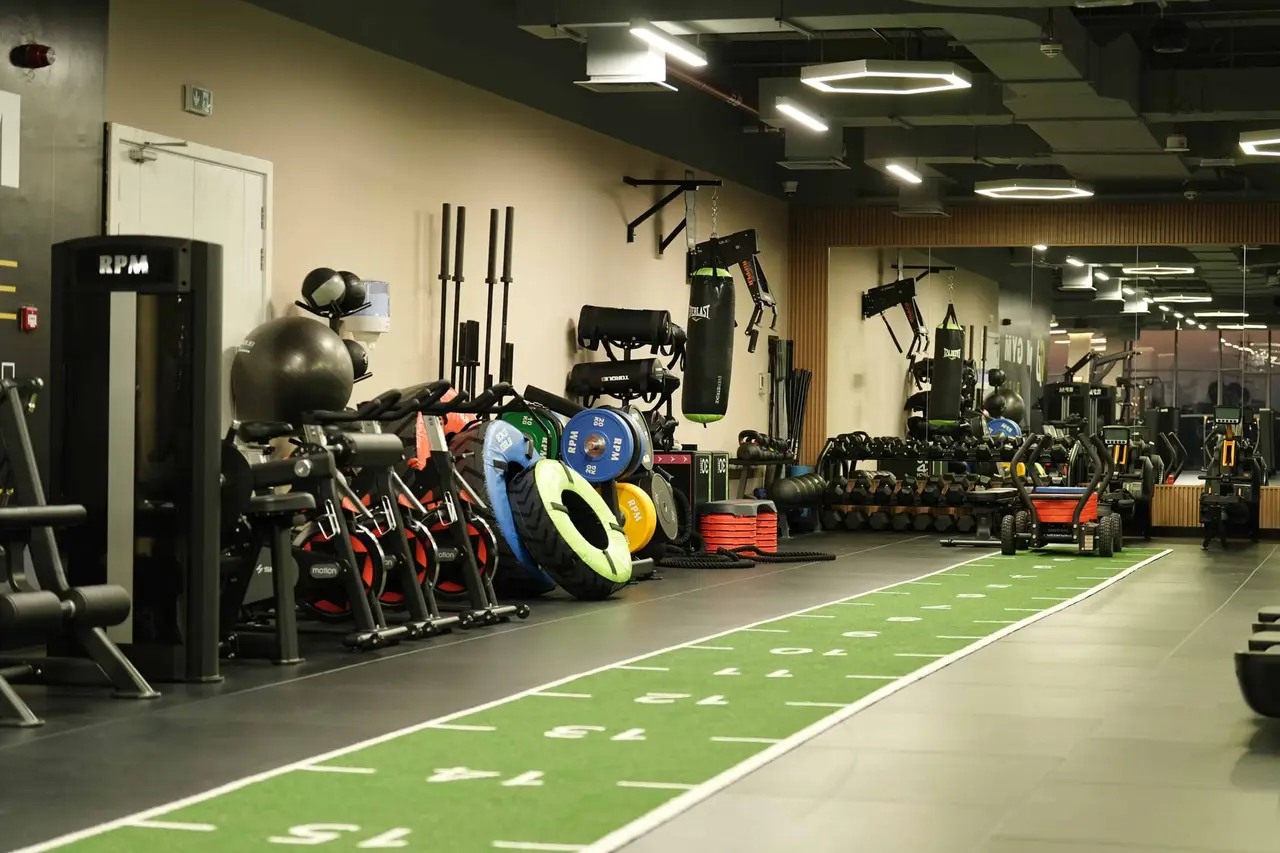
RPM's floor photos show flat benches and a dumbbell rack for the Bulgarian split squat, and a turf lane in the functional zone that gives walking lunges a straight run; ask the team when the lane is clear. A personal training session can set your split-squat stance and your lunge stride in one visit.
Questions, answered.
Which is better for glutes?
Either can be, if you set it up for the glutes: lean the torso slightly forward and take a longer stance in both. The Bulgarian reaches a deeper hip bend at the bottom, so it usually gives the glutes a stronger stretch, though a long reverse lunge comes close. For a glute-first plan, add a hip movement such as the hip thrust.
Which is better for quads?
The Bulgarian split squat, done upright with a slightly shorter stance so the front knee travels well forward. Forward and walking lunges also load the quads hard as they brake each landing. The quad training guide lists the other options.
Bulgarian split squat or reverse lunge?
The reverse lunge is the closer relative: stepping backwards keeps your weight on the front leg, so it feels like a split squat with a step added. Choose it to learn the pattern or to train stepping, and the Bulgarian when you want more range and more load per set.
Where does the regular split squat fit?
It is the Bulgarian without the bench: both feet on the floor, no step. It needs less balance and hip mobility, so it is the natural first stage before either exercise; the Bulgarian split squat page explains how to move from one to the other.
Which is better for conditioning?
Walking lunges. Continuous stepping raises your heart rate and suits timed sets and race preparation, while the Bulgarian works better as heavier strength work with full rest between sets.
What if both hurt my knees?
Stop and have the knee checked by a doctor or physiotherapist before choosing between them, because the cause decides which movements suit you. Ask them whether a shorter range or a machine such as the leg press is a sensible stopgap.