The short answer
Both are horizontal presses, and both train the chest, triceps and front shoulders. The difference is who controls the path. On the bench press you balance the bar and steer it from your chest to lockout, with your upper back, legs and grip holding you steady. On the chest press machine the handles move along a fixed track, so all you do is push.
That one difference decides the rest: how much skill each takes, whether you need a spotter, how close to failure you can go and how far the strength carries over to other lifts. The chest training guide uses both kinds of press across a week, and most people end up doing the same.
Side by side
| What differs | Bench press | Chest press machine |
|---|---|---|
| Body position | Lying on a flat bench | Seated upright, back on a pad |
| Path | Unguided: you balance and steer the bar | Fixed by the machine |
| Main muscles | Chest, triceps and front shoulders, plus the muscles that hold you steady | Chest, triceps and front shoulders, with less steadying work |
| Learning curve | Moderate: the unrack, touch point and bar path take practice | Low: seat height and handle position are most of it |
| Spotting and failure | Safety arms or a spotter for hard sets | Neither needed; you stop and let the handles return |
| Loading | Plates in small, measurable steps | A pin or plates; the steps vary by machine |
| Carry-over | Strength transfers to other free-weight presses | Strength shows most on the machine itself |
| Where it goes wrong | Loose upper back, bouncing, uneven lockout | Seat at the wrong height, shoulders rolling forward |
What a review of free weights and machines found
A 2023 systematic review and meta-analysis pooled thirteen studies, with just over a thousand adults, that trained people for at least six weeks with either free weights or machines; the bench press and the chest press were among the most common exercises. Muscle growth did not differ between the two, although only five of the studies measured it. Nor did strength when the groups were compared directly, but each group improved more on the kind of test it had trained for: free-weight trainees on free-weight lifts and, less clearly, machine trainees on machines.
The practical reading is simple. For a bigger chest, train hard and consistently with whichever press you will keep doing. For a bigger barbell bench, you need to bench, because strength is partly a skill specific to the lift. The authors put the choice down to individual preference and goals.
Why the numbers do not match
Lifters often press more on a machine than with a bar, or sometimes less, and wonder which figure is real. Both are, for that tool. A machine's levers, cams and pulleys change how heavy each plate feels, the handles may start partway into the press, and there is no balancing work to share the effort. Plate-loaded and pin-loaded machines also differ from each other, and the same pin number on two models can feel very different. So never convert one figure into the other: log the bench on one line and each machine on its own, with the seat setting written beside it.
When to choose each
When the bench press should be your main press
You want to get stronger at pressing a bar, you like small, measurable jumps in load, you enjoy learning a technical lift, or you have a rack with safety arms or a spotter for the hard sets. It is also the version to train if you might test or compete on it.
When the chest press machine makes more sense
You are new and want to press with the simplest set-up, you train alone without a spotter, you want to take sets close to failure, or your shoulders and upper back are tired from earlier work. It is also a good way to keep chest work going on days when the racks are busy.
Other presses against the machine
The same logic applies to the other presses people weigh against the chest press machine.
Dumbbell bench press vs chest press machine
Dumbbells add even more steadying work than a bar, because each arm controls its own weight, and they need only a bench; the machine removes all of that. The dumbbell bench press suits training alone with free weights, while the machine suits late-session sets and beginners.
Smith machine bench press vs chest press machine
Both fix the path, but on a Smith machine you still lie on a bench under a bar that runs on rails, so the set-up and touch point resemble a bench press, while a seated chest press moves handles at chest height. The Smith version sits halfway between the two presses compared here; the Smith machine guide covers its stops.
Incline bench press vs chest press machine
These answer different questions. The incline bench press changes the angle to bring in more upper chest, which a flat chest press machine does not. Some gyms have an incline machine press that combines the two ideas.
Using both in a week
| Session | Main press | Then |
|---|---|---|
| Chest day A | Bench press, 4 × 5–8, one or two reps left | Chest press machine, 2–3 × 10–15, close to failure |
| Chest day B | Incline dumbbell press, 3 × 8–12 | Single-arm chest press machine, 2 × 10–12 each side |
| Busy-floor swap | Chest press machine as the main press, 4 × 8–12 | Dumbbell fly or cable crossover, 2–3 × 12–15 |
Rest two to three minutes after heavy bench sets and a minute or so on the machine. Put the free-weight press first while you are fresh, and save the machine for when steadiness, not effort, would be the limit.
Both presses at RPM
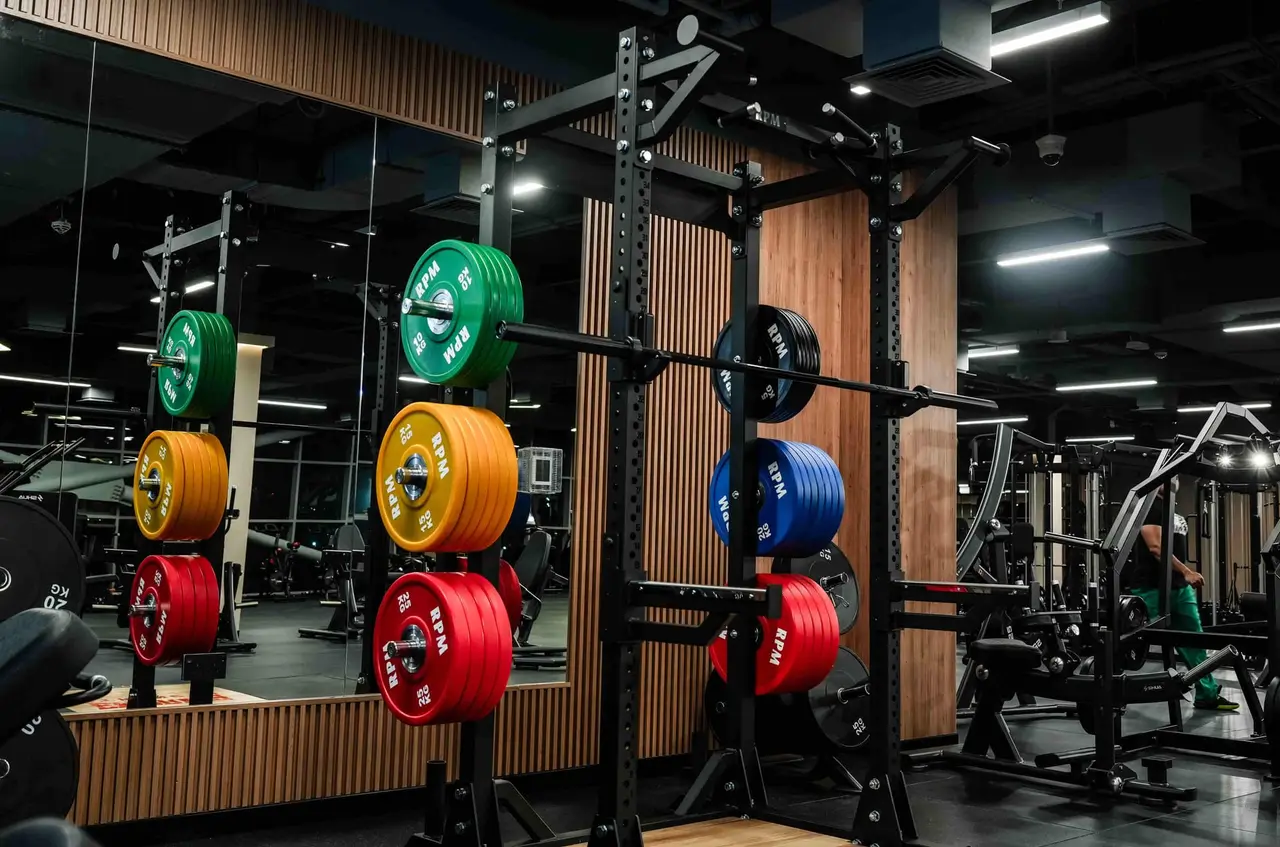
RPM's floor photos show squat racks with barbells and colour bumper plates, flat benches and plate-loaded machines in Al Manhal. They do not confirm which machines those are, so ask on your free tour whether there is a chest press machine and how it adjusts, and whether a flat bench fits inside a rack for pressing. A coach in a personal training session can set up both and spot your bench.
Sources
Questions, answered.
Is the chest press machine as good as the bench press for building muscle?
For muscle growth, the evidence suggests so: in the 2023 review, growth did not differ between free-weight and machine training. The bench press still builds more strength on the bench press itself, so choose by goal.
Bench press vs chest press: are they different exercises?
Chest press usually means the machine, though some people use the term for any chest press, dumbbells included. Bench press, unless stated otherwise, means the barbell on a flat bench. The pattern is the same; the tool and the balance demand differ.
Should beginners start on the machine?
It is a sensible start: you learn how the chest feels working without worrying about a bar tipping, then add the barbell within a few weeks, ideally with a coach watching your first sets. The free weights vs machines guide covers the same choice for the whole body.
Can I use only the machine and skip the bench press?
Yes, if your goal is chest size and general fitness. If you want to press a barbell well or test your bench, you need to practise it, as the chest training guide explains for heavy pressing.
Which should I do first in a session?
The free-weight press, usually. It needs the most coordination, so it benefits most from fresh muscles, and the machine works well later when you are tired.