The short answer
Use the trap bar deadlift if you are new to lifting from the floor, if you want a heavy leg lift that is quick to teach, or if you train for a sport and want to move heavy loads fast. Use the straight-bar deadlift if you want the most work for the hamstrings and back, if you compete or want to test the classic lift, or if your gym has no trap bar, which is common. Both train the whole lower body and the grip, and one programme can use both.
The difference comes from where the load sits. A straight bar has to travel up in front of your legs, so your shoulders start ahead of it and your hips are further from the weight. Standing inside a hexagonal frame lines the load up with your body, which lets the hips sit closer to it and the knees bend more. The hamstring guide shows where the straight-bar version sits among the other hinges.
Side by side
| What differs | Straight-bar deadlift | Trap bar deadlift |
|---|---|---|
| Where the load sits | In front of the shins | At your sides, in line with your body |
| Grip | Palms facing you, or a mixed or hook grip | Palms facing each other on two handles |
| Torso angle | Leans further forward | More upright |
| Knee bend | Less | More |
| Main muscles | Glutes, hamstrings and back, with the quads helping off the floor | Quads, glutes and hamstrings, with the back holding a more upright position |
| Bar path | Up and past the knees, close to the legs | Straight up through the middle of your body |
| Learning curve | The bar path and back position take practice | Simpler; most people pick it up quickly |
| Range | Set by the plate size | Changed by the high or low handles |
| Where you find it | Almost every gym | Many gyms, but not all |
What the research found
A study often quoted on this question tested nineteen male powerlifters on both bars across a range of lighter loads and at a one-rep maximum. They lifted a heavier maximum with the hexagonal bar. With it, the peak turning forces at the lower back, hip and ankle were lower and the force at the knee was higher, and at the lighter loads the lifters produced more peak force, speed and power than with the straight bar.
That matches what lifters feel: the trap bar moves some of the work from the hips and back towards the knees and lets you move a load quickly. It does not show that one bar builds more muscle, or that either one prevents injury. The participants were experienced male lifters, so the gap may differ for beginners, women or anyone with a different build.
Weight, muscles and how to track each lift
Most people lift somewhat more on a trap bar, especially with the high handles, which shorten the range. That does not make the trap bar number your real deadlift, or the other way round: trap bars differ in weight from model to model, the handles change the range, and different muscles limit each lift. Log them as two separate lifts, and include the trap bar's own weight in the total.
For muscles worked, the straight bar is the stronger choice for the hamstrings and the muscles along the spine, and the trap bar for the quads; the glutes work hard in both. If your plan already has plenty of quad work from squats, the straight bar fills a different gap. If it is heavy on hinges, the trap bar adds leg work that feels closer to a squat.
When the straight bar is the better fit
- You want the most work for the hamstrings and back from a single lift.
- You compete in powerlifting or want to test the standard deadlift.
- Your gym has no trap bar, or you train in several gyms and want a lift you can do anywhere.
- You already squat a lot and want a hinge that covers what the squat does not.
When the trap bar is the better fit
- You are learning to lift from the floor and want a simpler set-up.
- You want heavy leg work with a more upright torso, or you train for a sport and want to lift fast.
- The straight-bar start feels awkward, or you cannot yet reach it with a flat back; the high handles help.
- You want one bar for deadlifts, shrugs and farmer's carries.
Using both in one programme
They pair naturally because they load the lower body from two different positions.
| Day | Main lift | Sets × reps | Then |
|---|---|---|---|
| Lower body A | Straight-bar deadlift | 3–5 × 3–5, one or two reps left | Split squats and a core exercise |
| Lower body B | Trap bar deadlift | 3 × 5–8, two reps left | Leg press or goblet squats, then farmer's carries |
If you train the lower body once a week, alternate the two lifts from one block to the next. With no trap bar available, dumbbell deadlifts with the weights at your sides are the closest stand-in for day B.
Beginners can also use the two in sequence: start with the trap bar to build confidence pulling from the floor, learn the hip hinge with the Romanian deadlift, then add the straight bar.
Both lifts at RPM
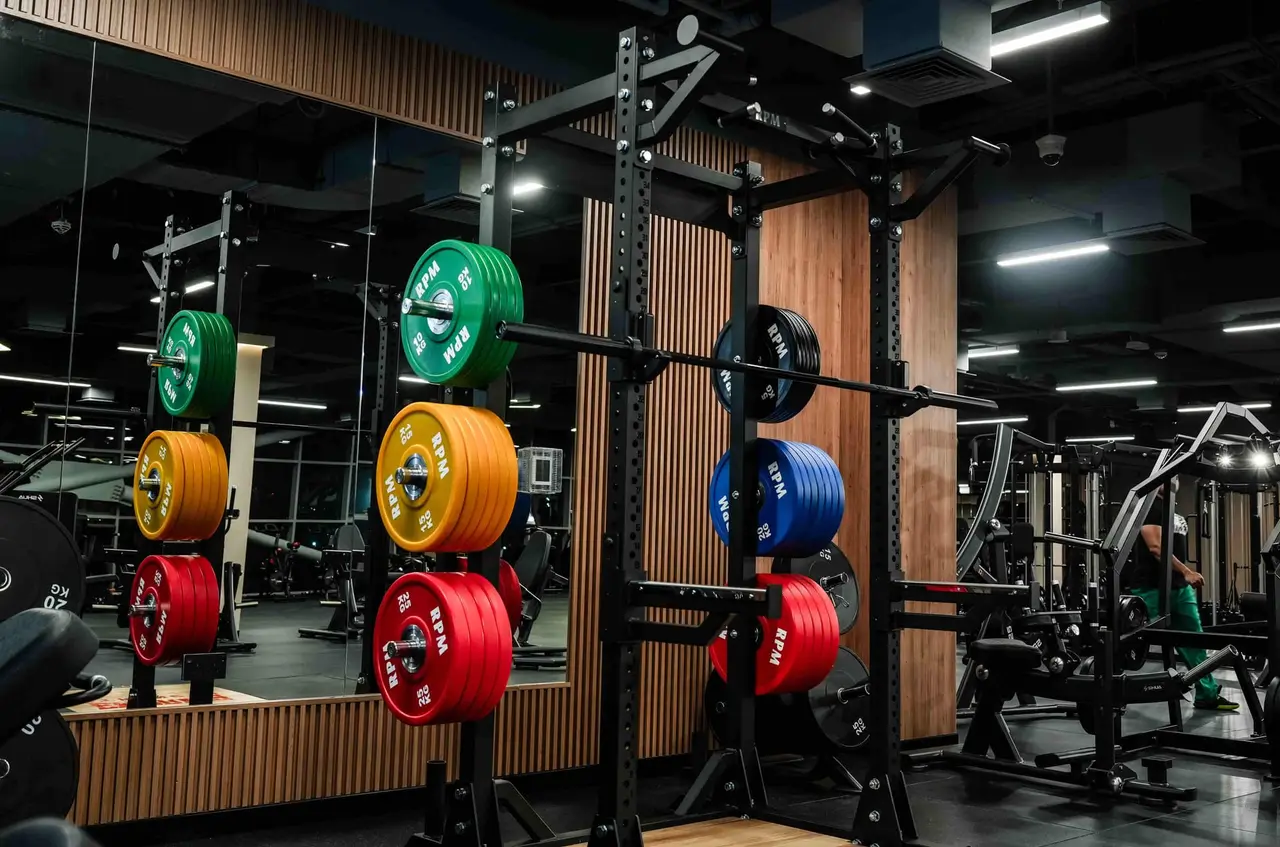
RPM's floor photos in Al Manhal show barbells with colour bumper plates for the straight-bar deadlift and a dumbbell rack for the dumbbell version. A trap bar and a lifting platform are not in those photos, so ask about both on your free tour, and book personal training if you want a coach to set you up on whichever bar you use.
Sources
Questions, answered.
Is the trap bar deadlift a real deadlift?
Yes: you lift a loaded bar from the floor to standing. It is a different variation, with more knee bend and a more upright torso, and it is not the lift used in powerlifting competition.
Is the trap bar better for your back?
In one study of experienced lifters it lowered the turning force on the lower back compared with a straight bar, and many people find it more comfortable. That is not the same as being better for a sore back: if pulling hurts, stop and get it checked by a doctor or physiotherapist.
Does the trap bar work the hamstrings less?
Somewhat, because the hips start closer to the load and the knees do more. If the trap bar is your main pull, add a hamstring exercise such as the Romanian deadlift or a leg curl; the hamstring guide lists the options.
Romanian deadlift or trap bar deadlift?
They do different jobs. The Romanian deadlift starts standing and targets the hamstrings and glutes in the stretch; the trap bar deadlift is a heavy lift from the floor for the whole lower body. They sit well in the same week.
How much more can I lift with a trap bar?
It varies too much between people and bars to give a figure. Most lifters handle somewhat more, and more again on the high handles. Track it as its own lift rather than converting it.